
Share
Men's Health
Mental Health
Women's Health
Ultra-processed food and depression: The mental health signal is getting harder to ignore
5 min read

Key takeaways
- Higher ultra-processed food intake has been associated with more depressive symptoms in longitudinal research.
- A 2025 older-adult analysis used four or more daily servings as its high-intake group.
- The useful intervention is substitution, not dietary purity.
- Diet can support mental health, but it does not replace treatment for clinical depression.
Food is not therapy, but it is not irrelevant either
Nutrition advice gets strange when it reaches mental health. One side promises that the right diet can cure depression. The other treats food as if it has nothing to do with the brain. The useful position is in the middle.
A 2025 target trial emulation followed more than 11,000 community-dwelling adults age 70 and older. Higher ultra-processed food intake was associated with a higher risk of depressive symptoms and slightly worse mental-health quality-of-life scores. The high-intake group was defined as four or more servings per day.
This was not a randomized feeding trial. It cannot prove that packaged food caused depression. It does strengthen a pattern that has appeared across prospective cohorts, and it gives us a practical exposure level to talk about without turning the kitchen into a purity test.
The useful target is substitution, not purity
Ultra-processed food is a broad category. It can include sugary drinks, packaged sweets, processed meats, ready-to-eat meals, snack foods, and many products designed around refined ingredients, additives, and convenience.
Trying to eliminate every ultra-processed item is not a mental health intervention. It can also turn food into another source of anxiety. The more useful question is whether ultra-processed foods are dominating your routine and crowding out minimally processed meals.
This is especially important because depression itself can make cooking harder. Low energy, poor concentration, disrupted appetite, and loss of interest are not ideal conditions for elaborate meal prep. The plan has to work on the days when motivation is low.
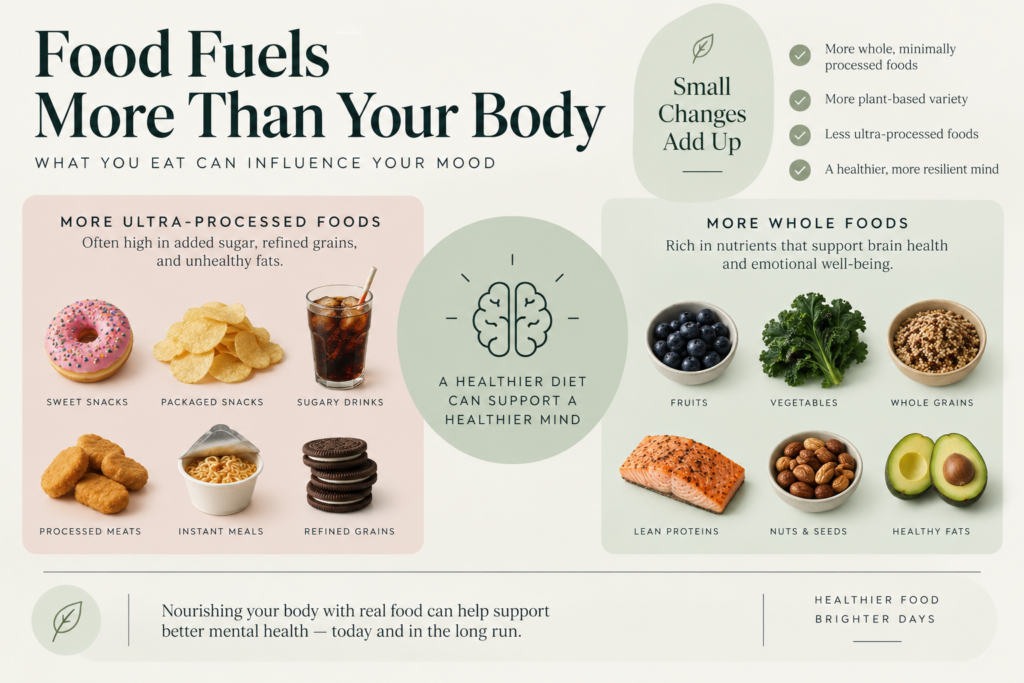
The simplest way to make this useful is to think in defaults. Breakfast, the afternoon snack, the drink you grab at a gas station, and the emergency dinner you buy when you are tired are repeated hundreds of times per year. Those defaults matter more than the occasional birthday cake.
Protein, fiber, produce, and regular meals can also make a substitution more satisfying. A replacement that leaves you hungry 40 minutes later is unlikely to survive contact with a busy week. The best mental-health nutrition plan is one that lowers friction rather than adding another daily performance test.
The Livium recipe
Tool. Make the better option easier to reach. An Owala FreeSip bottle makes water easy to carry. A journal can track meals and mood for two weeks. A notebook works for the same purpose, and pens keep the setup simple.
Behavior. Pick the two ultra-processed foods you eat most often and replace one serving per day with a minimally processed option you actually like. Think yogurt and fruit instead of a pastry, nuts and fruit instead of candy, or leftovers instead of a packaged lunch.
Threshold. Do not aim for zero. For two weeks, track whether you are eating four or more servings of ultra-processed foods on most days, the threshold used in the 2025 older-adult analysis. If you are, reduce the most repeatable source first.
| Daily pattern | Interpretation | Livium move |
|---|---|---|
| 0 to 1 UPF servings | Low exposure in this framework | Do not manufacture a problem |
| 2 to 3 servings | Moderate routine exposure | Replace the easiest repeat item |
| 4+ servings | High exposure threshold used in the study | Target one daily substitution |
| Mood worsens despite diet changes | Diet is not the whole explanation | Use appropriate mental health care |
Source: Mengist et al., BMC Medicine, 2025.
What we are ruling out
Depression is not caused by a lack of meal prep. Major depression can involve genetics, trauma, medical illness, medication effects, sleep, social conditions, and many other factors. Dietary improvement should not replace psychotherapy, medication, or medical evaluation when those are indicated.
The evidence also does not tell us that every ultra-processed food has the same effect. The category is heterogeneous, and people who eat more ultra-processed food can differ in many other ways.
The reason to make a substitution is not that one granola bar is toxic. It is that a daily pattern is easier to change when you target the repeat foods that account for most of it.
Make the environment do some of the work
Convenience is one reason ultra-processed food wins. If the minimally processed alternative requires chopping, cooking, washing three pans, and remembering a recipe, it is competing at a disadvantage. Build replacements that are just as automatic: fruit you can see, yogurt at eye level, nuts already portioned, frozen vegetables, rotisserie chicken, or leftovers ready to reheat.
Do not use mood as a daily verdict on whether the experiment works. Depression fluctuates. Look at the two-week pattern: how many substitutions happened, whether meals became more regular, whether hunger was steadier, and whether the plan was easy enough to repeat.
Plan of action
- Identify the two ultra-processed foods you eat most often.
- Replace one daily serving rather than overhauling the entire kitchen.
- Choose substitutions that require equal or less effort on low-motivation days.
- Track mood and meals for two weeks without counting calories.
- If depressive symptoms are persistent or impairing, treat diet as supportive care, not the treatment plan.
The decision this week. Replace one repeatable ultra-processed default with a minimally processed food you would willingly eat again.
Table of Content

Know your body better.
Trusted By Thousands Daily



FAQs
Can ultra-processed food cause depression?
Current evidence shows an association, but it does not prove that ultra-processed food directly causes depression in an individual person.
Do I need to stop eating all processed food?
No. Replace the ultra-processed foods you eat most often with minimally processed options rather than pursuing a zero-UPF diet.
Can changing my diet treat depression?
Diet may support mental health, but persistent or severe depression deserves evidence-based mental health care and medical evaluation.
Legal Disclaimer
The content published on Livium Health is for informational and educational purposes only. Nothing on this site constitutes medical advice, diagnosis, or treatment. Always consult a qualified healthcare provider before making decisions about your health, including changes to medications, supplements, diet, or exercise.
Livium Health is not a medical practice and does not have a patient-provider relationship with its readers. We do not sell supplements, medications, or treatments, and we have no financial relationship with the products or services we reference.
While we work to ensure the information we publish is accurate and up to date, health and medical guidance evolves. We make no guarantees about the completeness or currency of any content on this site. Reliance on any information provided by Livium Health is solely at your own risk.
If you are experiencing a medical emergency, call 911 or your local emergency services immediately.
We may receive compensation, free products, or affiliate commissions for products mentioned in this post. Opinions are our own.