
Share
Men's Health
Sleep
Women's Health
Waking between 2 and 4 AM: What’s actually happening and how to stop it
5 min read

Key takeaways
- Waking between 2 and 4 AM is not random. It coincides with the cortisol awakening response beginning its rise, core body temperature reaching its nadir, and the transition from deep sleep to lighter, REM-dominant sleep cycles.
- The most common drivers are cortisol dysregulation from chronic stress, blood sugar instability, alcohol metabolism rebound, hormonal changes in perimenopause, and sleep apnea arousal events.
- Lying awake after 3 AM for more than 20 minutes activates conditioned arousal, where the brain learns to associate the bed with wakefulness, making the problem self-perpetuating.
- The intervention depends on the driver: alcohol requires timing change, blood sugar requires evening nutrition adjustment, cortisol requires stress load reduction, and conditioned arousal requires stimulus control therapy.
Why 3 AM specifically
The 2 to 4 AM window is not arbitrary. It sits at a specific inflection point in the night’s sleep architecture where several physiological transitions converge. Core body temperature reaches its lowest point around 3 to 4 AM, then begins rising as the body prepares to wake. Cortisol levels begin their ascent from their overnight nadir. The dominant sleep stage shifts from deep slow-wave sleep to lighter, REM-heavy cycles that are easier to interrupt. The brain is no longer in the protective grip of deep sleep. A small push from any direction- cortisol, blood sugar, thermal discomfort, alcohol metabolism, or apnea- is enough to produce full wakefulness.
In midlife, every one of these factors compounds. Cortisol regulation becomes less precise. Blood sugar fluctuations are more common as insulin sensitivity declines. Estrogen and progesterone decline disrupts thermoregulation. Sleep apnea prevalence increases. The result is that the 3 AM wake, which was rare at 35, becomes habitual at 47.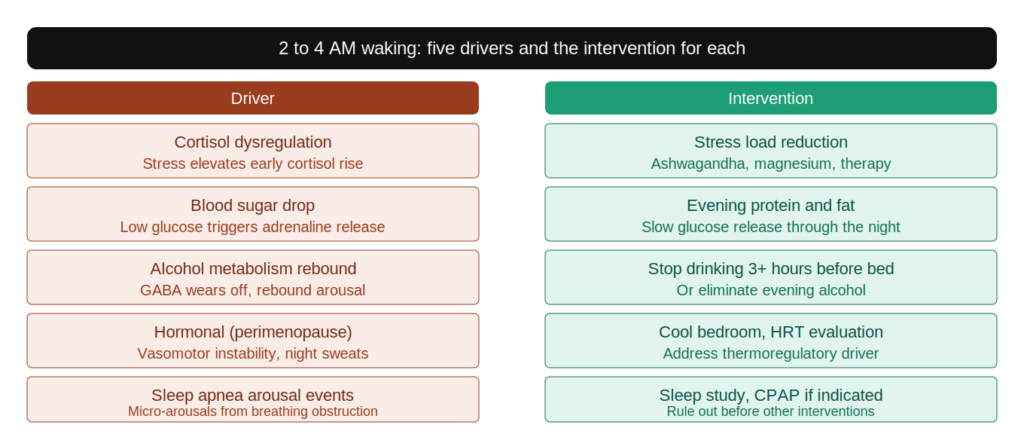
The problem of lying awake too long
Once awake at 3 AM, most people do the wrong thing: they stay in bed, trying to force sleep, getting increasingly anxious about the time. After 20 minutes of wakefulness in bed, the brain begins to associate the bed itself with being awake, frustrated, and alert. This is conditioned arousal, a core mechanism of chronic insomnia. The bed becomes a cue for wakefulness rather than sleep. Over weeks of repeated 3 AM lying-awake episodes, the association strengthens. The insomnia becomes self-perpetuating even after the original trigger resolves.
The CBT-I protocol for this is stimulus control: if you are not asleep within 20 minutes, get out of bed. Go to another room. Do something calm and non-stimulating in dim light. Return to bed only when sleepy. This feels wrong when you are exhausted at 3 AM. It is the most effective non-pharmacological intervention for maintenance insomnia in the evidence base.
The Livium recipe
Tool. Identify the driver before selecting the intervention. Keep a simple log for two weeks: time of waking, evening alcohol intake, evening meal timing and content, and stress level that day. The pattern usually identifies itself within 10 to 14 nights. If no clear pattern emerges, rule out sleep apnea with a home sleep test before pursuing behavioral interventions. For cortisol-driven waking: ashwagandha 300-600 mg taken at bedtime has RCT evidence for reducing cortisol and improving sleep continuity. Magnesium glycinate 300-400 mg at bedtime supports GABA activity and reduces nervous system reactivity during the 3 AM transition.
Behavior. For blood sugar-driven waking: eat a small snack with protein and fat before bed (a tablespoon of nut butter, a small handful of nuts, a hard-boiled egg). This slows overnight glucose release and blunts the hypoglycemic dip that triggers adrenaline release at 3 AM. For conditioned arousal: implement stimulus control strictly. Get up after 20 minutes of wakefulness. Stay out of bed until sleepy. Repeat consistently for at least two weeks. The short-term discomfort of this protocol produces the most durable long-term improvement in sleep continuity of any behavioral intervention.
Threshold. If waking at 3 AM is paired with loud snoring (reported by a partner), gasping, excessive daytime sleepiness, or waking with headaches, get a home sleep test before anything else. Sleep apnea produces exactly this presentation and is treated with CPAP, not sleep hygiene. Lofta provides home sleep testing and CPAP access without requiring an in-lab sleep study. If waking is paired with significant anxiety or rumination: a structured CBT-I program addresses both the conditioned arousal and the cognitive component that keeps people awake once they wake.
| When you wake at 3 AM | Do this | Do not do this |
|---|---|---|
| Still in bed | Stay only if drifting back within 20 min | Do not watch the clock |
| 20+ min awake | Get out of bed, go to another room | Do not stay in bed trying to force sleep |
| Out of bed | Read, listen quietly, dim light only | Do not use screens at full brightness |
| When sleepy again | Return to bed | Do not nap the next day extensively |
Source: Riemann et al., Clocks and Sleep 2023 — The Psychoneurobiology of Insomnia. CC BY 4.0.
Plan of action
- Start a two-week wake log tonight. Record time of waking, evening alcohol, dinner timing, and subjective stress. The driver is usually apparent within 10 nights.
- Address the highest-probability driver first. For most midlife adults who drink in the evenings and wake at 3 AM: eliminate evening alcohol for two weeks before anything else. If the waking resolves, you have your answer.
- Add magnesium glycinate at bedtime and a small protein-fat snack before sleep. These are low-risk, stackable interventions that address both cortisol and blood sugar drivers simultaneously.
- If waking persists past two weeks of addressing the identified driver: implement stimulus control strictly for 14 days. Keep a sleep diary during this period. Conditioned arousal responds to the protocol but requires consistency; partial application does not produce the same result.
Table of Content

Know your body better.
Trusted By Thousands Daily





FAQs
Is waking at 3 AM a sign of depression?
Early morning waking is one of the classic neurovegetative symptoms of depression, and the association is real. However, the same symptom is produced by five different drivers with no depressive component, as described above. Rule out alcohol, blood sugar, apnea, and hormones before concluding that the waking pattern is depression-driven. If mood symptoms are present alongside the waking pattern, both warrant clinical evaluation.
Should I take melatonin when I wake at 3 AM?
No. Melatonin signals sleep onset and circadian phase. By 3 AM, your circadian system is moving toward waking rather than sleep. Melatonin taken at 3 AM is unlikely to help and may produce grogginess the following day by shifting your circadian phase. Melatonin is a sleep onset tool, not a maintenance tool.
Will this pattern resolve on its own?
Sometimes, if the driver was temporary (e.g., a high-stress period or a medication change). If the pattern persists beyond three weeks, it has likely established conditioned arousal and will not resolve without active intervention. The longer it continues, the more entrenched the conditioning becomes, and the longer it takes to reverse.
Legal Disclaimer
The content published on Livium Health is for informational and educational purposes only. Nothing on this site constitutes medical advice, diagnosis, or treatment. Always consult a qualified healthcare provider before making decisions about your health, including changes to medications, supplements, diet, or exercise.
Livium Health is not a medical practice and does not have a patient-provider relationship with its readers. We do not sell supplements, medications, or treatments, and we have no financial relationship with the products or services we reference.
While we work to ensure the information we publish is accurate and up to date, health and medical guidance evolves. We make no guarantees about the completeness or currency of any content on this site. Reliance on any information provided by Livium Health is solely at your own risk.
If you are experiencing a medical emergency, call 911 or your local emergency services immediately.
We may receive compensation, free products, or affiliate commissions for products mentioned in this post. Opinions are our own.