
Share
Men's Health
Sleep
Women's Health
Weighted blankets for insomnia: What the randomized trial actually found
4 min read

Key takeaways
- A pilot randomized trial found greater subjective sleep-quality improvement with a weighted blanket than a normal blanket.
- Daytime sleepiness, stress, anxiety, fatigue, and pain also improved more in the weighted-blanket group.
- Objective actigraphy did not show the same clear advantage for awakenings.
- Weighted blankets are a reasonable comfort experiment, not a replacement for established insomnia treatment.
The weighted blanket data is better than the marketing
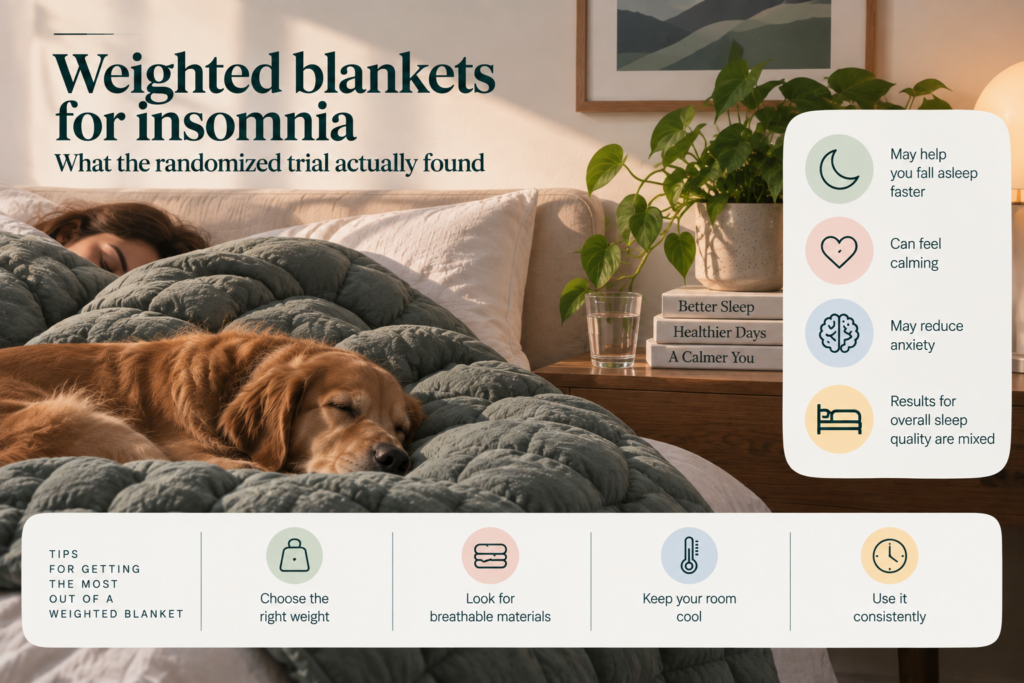
Weighted blankets have spent years in the awkward space between comfort product and health claim. The sensation is easy to understand: steady pressure can feel grounding. The harder question is whether that translates into measurably better sleep for people with insomnia.
A pilot randomized controlled trial published in 2024 assigned 102 adults with clinical insomnia to either a weighted blanket or a normal blanket for one month. The weighted-blanket group improved more on the Pittsburgh Sleep Quality Index, and researchers also reported improvements in daytime sleepiness, stress, anxiety, fatigue, and bodily pain.
The objective actigraphy results were less dramatic. That is important. People reported sleeping better, but the wearable data did not show a clear between-group improvement in awakenings. The signal is promising, not definitive.
Comfort and sleep are not the same outcome
A weighted blanket may make the bed feel calmer without changing every measurable feature of sleep. That is not a failure. Subjective sleep quality matters, especially in insomnia, but it should not be turned into a claim that deep pressure changes sleep architecture in a specific way.
The trial lasted one month and was designed as a pilot. Larger studies are still needed. The right conclusion is that weighted blankets are a reasonable non-drug option to test, not that everyone with insomnia needs 15 pounds on the bed.
If you want to experiment, use a cooling weighted blanket that feels comfortable rather than choosing the heaviest option you can tolerate. More pressure is not automatically more therapeutic.
The Livium recipe
Tool. Treat the blanket as a comfort intervention. If you already sleep hot, monitor the temperature problem instead of burying it under more fabric. A room thermometer can tell you whether the bedroom itself is drifting warm overnight.
Behavior. Test the blanket for at least several nights rather than judging one unusually good or bad night. Keep bedtime, caffeine, and room temperature as stable as practical so you can tell whether the blanket changes anything.
Threshold. If the pressure feels restrictive, makes you hotter, worsens pain, or makes it harder to move comfortably, stop. A sleep mask may be a better low-burden environmental tool if light is the actual problem.
| What changed in the trial | Weighted blanket | Normal blanket |
|---|---|---|
| Subjective sleep quality | Improved more | Improved less |
| Daytime sleepiness | Improved | Less improvement |
| Stress and anxiety | Improved | Less improvement |
| Objective awakenings | No clear between-group advantage | No clear advantage |
Source: Yu et al., BMC Psychiatry, 2024.
Who should be cautious
A weighted blanket is not appropriate for everyone. Anyone who cannot remove the blanket independently, has significant breathing or mobility limitations, or has a condition that makes added weight unsafe should get individualized guidance rather than experimenting.
Heat matters too. If you already wake sweaty, adding weight and insulation may solve one comfort problem while creating another. A cooling cap can feel soothing during a wind-down routine, but it does not make an overheated sleep environment physiologically ideal.
What success should look like
Do not judge the blanket by whether your tracker awards more deep sleep. Judge it by the outcomes the trial actually supports: perceived sleep quality, daytime sleepiness, and whether the bedtime experience feels easier.
If insomnia remains severe after a month of changing bedding, the bedding is probably not the main treatment target. Cognitive behavioral therapy for insomnia remains the first-line behavioral treatment, and persistent insomnia deserves more than another bedroom purchase.
The comfort effect can still matter
Insomnia is partly defined by the experience of poor sleep and its daytime consequences. A tool that makes bedtime feel safer or less tense can be useful even if actigraphy does not show a dramatic change in awakenings. The mistake is converting that subjective benefit into a biological claim the study did not establish.
Run the experiment around comfort. Ask whether you settle more easily, whether the blanket stays comfortable through the night, and whether you feel more restored the next day. If the answer is no, the blanket does not earn a permanent place on the bed simply because it is marketed for sleep.
Do not let pressure become another sleep rule
Some people love the sensation immediately. Others feel trapped or overheated. Neither response is a moral victory, and there is no reason to train yourself to tolerate a blanket that makes bedtime worse.
The point of a non-drug comfort tool is lower friction. If you spend the night adjusting it, pushing it away, or worrying whether it is positioned correctly, it has failed that job.
Plan of action
- Choose comfort over maximum weight.
- Keep the room temperature stable while testing the blanket.
- Track how rested you feel, not only wearable sleep stages.
- Stop if the blanket feels restrictive, hot, or uncomfortable.
Table of Content

Know your body better.
Trusted By Thousands Daily








FAQs
Do weighted blankets improve insomnia?
A pilot randomized trial found better subjective sleep-quality improvement after one month, but larger studies are needed.
How heavy should a weighted blanket be?
The trial does not establish one ideal weight for everyone. Comfort, mobility, heat, and the ability to remove the blanket safely matter.
Can a weighted blanket replace CBT-I?
No. It may be a useful comfort tool, but it is not a replacement for first-line insomnia treatment.
Legal Disclaimer
The content published on Livium Health is for informational and educational purposes only. Nothing on this site constitutes medical advice, diagnosis, or treatment. Always consult a qualified healthcare provider before making decisions about your health, including changes to medications, supplements, diet, or exercise.
Livium Health is not a medical practice and does not have a patient-provider relationship with its readers. We do not sell supplements, medications, or treatments, and we have no financial relationship with the products or services we reference.
While we work to ensure the information we publish is accurate and up to date, health and medical guidance evolves. We make no guarantees about the completeness or currency of any content on this site. Reliance on any information provided by Livium Health is solely at your own risk.
If you are experiencing a medical emergency, call 911 or your local emergency services immediately.
We may receive compensation, free products, or affiliate commissions for products mentioned in this post. Opinions are our own.