
Share
Men's Health
Sleep
Women's Health
What your sleep tracker is not telling you about your deep sleep
7 min read
Key takeaways
- Consumer sleep trackers estimate sleep stages using accelerometry (movement) and heart rate variability, not brain activity. They are reasonably accurate at distinguishing sleep from waking and light from deep sleep at a population level. At the individual level, the error margin is significant on any given night, particularly for slow-wave sleep.
- Slow-wave sleep (SWS), which trackers call deep sleep, is the most metabolically and cognitively restorative sleep stage. It declines measurably with age, falling from roughly 20 to 25 percent of total sleep in young adults to 5 to 10 percent in adults over 60. This decline is real and consequential. Whether your tracker is accurately measuring it is a separate question.
- The numbers that matter most on a sleep tracker are total sleep duration, consistency of sleep and wake time, and resting heart rate or HRV as recovery proxies. The sleep stage percentages are directionally useful over weeks to months but not reliably accurate on any single night.
- Behaviors that genuinely improve slow-wave sleep: consistent sleep schedule, resistance training, alcohol elimination in the evening, cool sleep environment, and magnesium glycinate at bedtime. None of these requires tracker validation to implement.
Your Oura ring says you got 43 minutes of deep sleep
You woke up feeling terrible. The tracker says deep sleep was 43 minutes, down from your 68-minute average. The app tells you your sleep score is 71. You feel vindicated. There is data to explain why you feel this way.
Or: you slept 7.5 hours, the tracker says 89 minutes of deep sleep and gives you a score of 88. You feel completely wrecked. The tracker disagrees. Who is right?
Both scenarios happen regularly. The tracker is not lying. It is estimating. The difference between estimating and measuring matters for how much weight to put on any single night’s data.
What trackers actually measure
Clinical sleep staging requires electroencephalography (EEG), which uses electrodes placed on the scalp to directly measure brain electrical activity. Slow-wave sleep is defined by high-amplitude, low-frequency delta waves (0.5 to 4 Hz) visible on the EEG trace. REM sleep is defined by a specific EEG pattern, muscle atonia, and rapid eye movements. These are brain measurements.
Consumer trackers measure movement and heart rate from the wrist or finger and use machine learning models trained on polysomnography data to infer which sleep stage the brain is probably in based on those peripheral signals. The models are good. They are not the same as EEG. A 2019 validation study by Chinoy et al. in SLEEP found that consumer wearables correctly identified sleep stages about 60 to 70 percent of the time at the epoch level, compared to simultaneous polysomnography. They performed best at detecting REM and light sleep, and worst at distinguishing slow-wave sleep from light NREM sleep.
This does not mean trackers are useless. It means their value differs from what most users assume. Trends over weeks are more meaningful than any single night. Relative changes are more meaningful than absolute numbers.
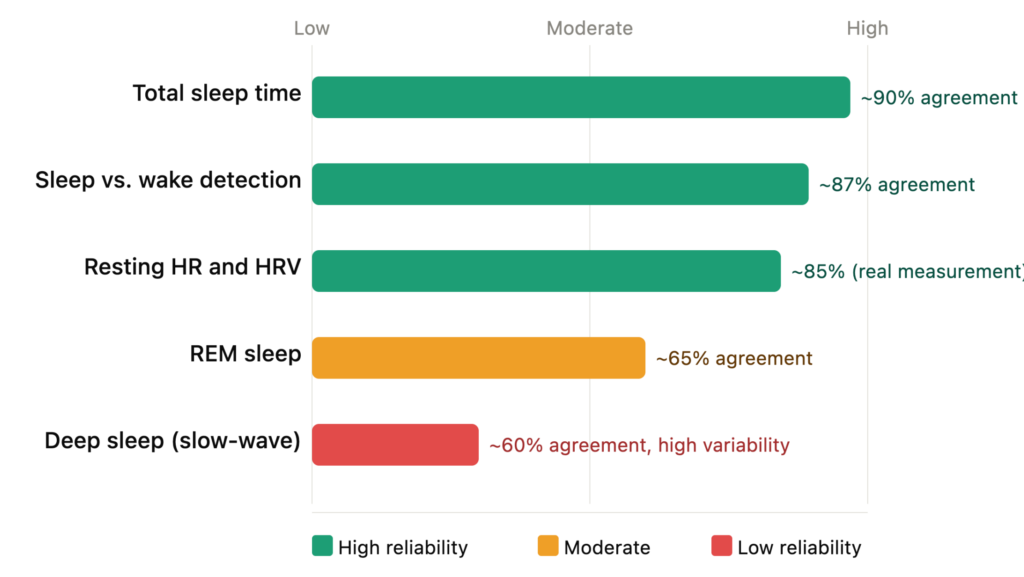
Consumer trackers measure total sleep time and sleep versus wake detection reliably. Deep sleep is the least accurate metric and the most variable between devices. The stage that matters most for recovery is also the hardest to estimate from heart rate and movement alone. Source: de Zambotti et al., Journal of Clinical Medicine 2023 — Wearable Sleep Trackers: Promises and Limitations. CC BY 4.0.
What slow-wave sleep actually does
Slow-wave sleep is when the brain clears metabolic waste via the glymphatic system, a fluid drainage network that is most active during SWS. Amyloid-beta and tau proteins, which accumulate in Alzheimer’s disease, are cleared at the highest rate during this stage. Memory consolidation of declarative memories (facts, events) also occurs predominantly during SWS. Growth hormone is secreted almost entirely during the first slow-wave cycle of the night. Tissue repair, immune function, and metabolic reset all peak during SWS.
SWS declines with age more than any other sleep stage. Young adults spend 20 to 25 percent of their sleep in SWS. By age 60, this has typically dropped to 5 to 10 percent, roughly half of the most restorative phase. This decline is one of the reasons that sleep at 55 feels less restorative than the same duration at 30, and why the consequences of sleep restriction become more severe with age: you are starting from a lower SWS baseline and losing it faster.
What to actually use tracker data for
Total sleep duration. This is the most reliably accurate metric consumer trackers provide. If your tracker consistently shows less than 6.5 hours of sleep despite 8 hours in bed, you have a sleep-onset or maintenance problem that warrants investigation. If it consistently shows 7.5-8 hours and you feel terrible, the problem may be sleep quality rather than quantity.
Consistency metrics. Sleep regularity index, how consistent your bedtime and wake times are, is increasingly recognized as an independent predictor of health outcomes. A tracker that shows you going to bed at 10:30 PM one night and 1:30 AM the next is telling you something real about circadian disruption.
Resting heart rate and HRV trends. These are physiological measurements, not inferences about sleep stage. Your resting HR during sleep and your morning HRV are real numbers that reflect autonomic recovery state. A resting HR that is 5 to 10 bpm above your baseline after a stressful week tells you something accurate about your recovery state regardless of what the sleep stage pie chart says.
Deep sleep trends over weeks. A consistent pattern of very low deep sleep percentages across 3 to 4 weeks, even with tracker measurement error, is a signal worth investigating. The error is random; a consistent pattern below the expected range is not random.
The Livium recipe
Tool. Use your tracker for trends, not daily verdicts. Export or screenshot your data weekly, and look at 7-day averages rather than the last night’s data. If you do not have a tracker, a sleep-tracking ring or wristband provides useful longitudinal trend data at a price point that has dropped significantly in the past two years. For adults who want to understand their actual sleep architecture: a home EEG headband (Dreem, Muse S) provides the closest consumer approximation to clinical EEG, though it is significantly more expensive and less comfortable than a wrist or ring tracker.
Behavior. The interventions with the strongest evidence for improving slow-wave sleep specifically: elimination of alcohol within three hours of sleep (alcohol dramatically suppresses SWS in the first half of the night), a consistently cool bedroom (65 to 68°F / 18 to 20°C), resistance training three or more times per week, and a consistent sleep schedule. Magnesium glycinate 300-400 mg at bedtime has moderate evidence for improving sleep quality and slow-wave sleep duration through GABAergic mechanisms. These are not tracker hacks. They are physiological interventions. Whether your tracker accurately captures the improvement is secondary to whether the improvement is real.
Threshold. If your tracker consistently shows total sleep time under 6.5 hours despite spending 8 hours in bed, or if it shows very low REM (under 15 percent) consistently, or if your morning HRV is persistently depressed below your baseline: these are signals that warrant clinical investigation rather than more tracker optimization. A home sleep test through Lofta rules out OSA. If OSA is excluded, a sleep medicine consultation for insomnia, circadian rhythm disorder, or other sleep pathology is the next step.
| Tracker metric | Reliability | How to use it |
|---|---|---|
| Total sleep duration | High | Trust nightly; track weekly average |
| Sleep onset and wake time | High | Use for schedule consistency; flag large day-to-day variation |
| Resting HR and HRV | High (real measurement) | Best recovery proxy; track trends not daily numbers |
| REM sleep percentage | Moderate | Directional over weeks; not reliable single-night |
| Deep sleep percentage | Low to moderate | Most error-prone stage; use multi-week trends only |
Source: de Zambotti et al., JCM 2023 — Wearable Sleep Trackers: Promises and Limitations. CC BY 4.0.
Plan of action
- Stop reading your sleep tracker every morning and making behavioral decisions based on single-night data. Look at 7-day and 30-day trends instead. The signal-to-noise ratio is dramatically better at the weekly level.
- Focus on the metrics your tracker measures accurately: total sleep duration, sleep schedule consistency, and resting HR or HRV. These are the numbers with the strongest evidence base for health outcomes and the highest measurement reliability.
- Eliminate evening alcohol if you care about slow-wave sleep. This is the single highest-leverage behavioral change for SWS quality, and the tracker will eventually confirm it; alcohol suppression of SWS is large enough to be visible even through the noise of consumer tracker error.
- If you have been optimizing your sleep tracker data for months without feeling better: the tracker is not the problem, and it is not the solution. Get a clinical sleep evaluation. A home sleep test rules out OSA. A sleep specialist addresses everything else. A blue-light-blocking lamp for the bedroom is a lower-cost first step if circadian phase is the suspect.
Table of Content
Know your body better.
Trusted By Thousands Daily
FAQs
Which consumer tracker is most accurate?
Oura Ring and WHOOP have the most published validation data and generally perform comparably in head-to-head studies. The Fitbit and Apple Watch are validated for total sleep time and reasonable for REM but are less reliable for slow-wave sleep. The differences between leading consumer devices are smaller than the difference between any consumer device and clinical polysomnography. Pick the one you will wear consistently; compliance is more important than brand.
Should I be concerned about orthosomnia?
Orthosomnia, anxiety about achieving good tracker scores that, in turn, impairs sleep, is a documented clinical phenomenon coined by sleep researchers at Rush University in 2017. If checking your tracker score in the morning causes anxiety that affects your sleep that night, the tracker is producing net negative sleep outcomes. In that case: delete the app for two weeks and rely on subjective assessment. The subjective feeling of sleep quality correlates with health outcomes about as well as the tracker score in most studies.
How do I increase slow-wave sleep?
The interventions with the strongest evidence are: eliminate alcohol within 3 hours of sleep (alcohol dramatically suppresses SWS, even in small amounts), keep the bedroom cool (65 to 68°F), do resistance training regularly, maintain a consistent sleep schedule, and consider magnesium glycinate at bedtime. Some research supports enhancing acoustic slow-wave sleep (e.g., with pink noise or auditory stimulation timed to slow-wave oscillations), and apps exist that attempt to do so. The evidence is promising but not yet robust enough for a confident clinical recommendation.
Legal Disclaimer
The content published on Livium Health is for informational and educational purposes only. Nothing on this site constitutes medical advice, diagnosis, or treatment. Always consult a qualified healthcare provider before making decisions about your health, including changes to medications, supplements, diet, or exercise.
Livium Health is not a medical practice and does not have a patient-provider relationship with its readers. We do not sell supplements, medications, or treatments, and we have no financial relationship with the products or services we reference.
While we work to ensure the information we publish is accurate and up to date, health and medical guidance evolves. We make no guarantees about the completeness or currency of any content on this site. Reliance on any information provided by Livium Health is solely at your own risk.
If you are experiencing a medical emergency, call 911 or your local emergency services immediately.
We may receive compensation, free products, or affiliate commissions for products mentioned in this post. Opinions are our own.