
Share
Men's Health
Nutrition
Women's Health
Whole grains are more than fiber: What the randomized evidence says about metabolic health
4 min read
Key takeaways
- A 2025 umbrella review synthesized 25 systematic reviews and meta-analyses of randomized whole-grain trials.
- The evidence covered glucose control, lipids, blood pressure, body weight, inflammation, and appetite.
- Benefits are not explained by fiber alone because whole grains retain a broader food matrix of nutrients and bioactive compounds.
- Whole grain does not mean every grain-based packaged food is metabolically equivalent.
Fiber is only one reason whole grains behave differently
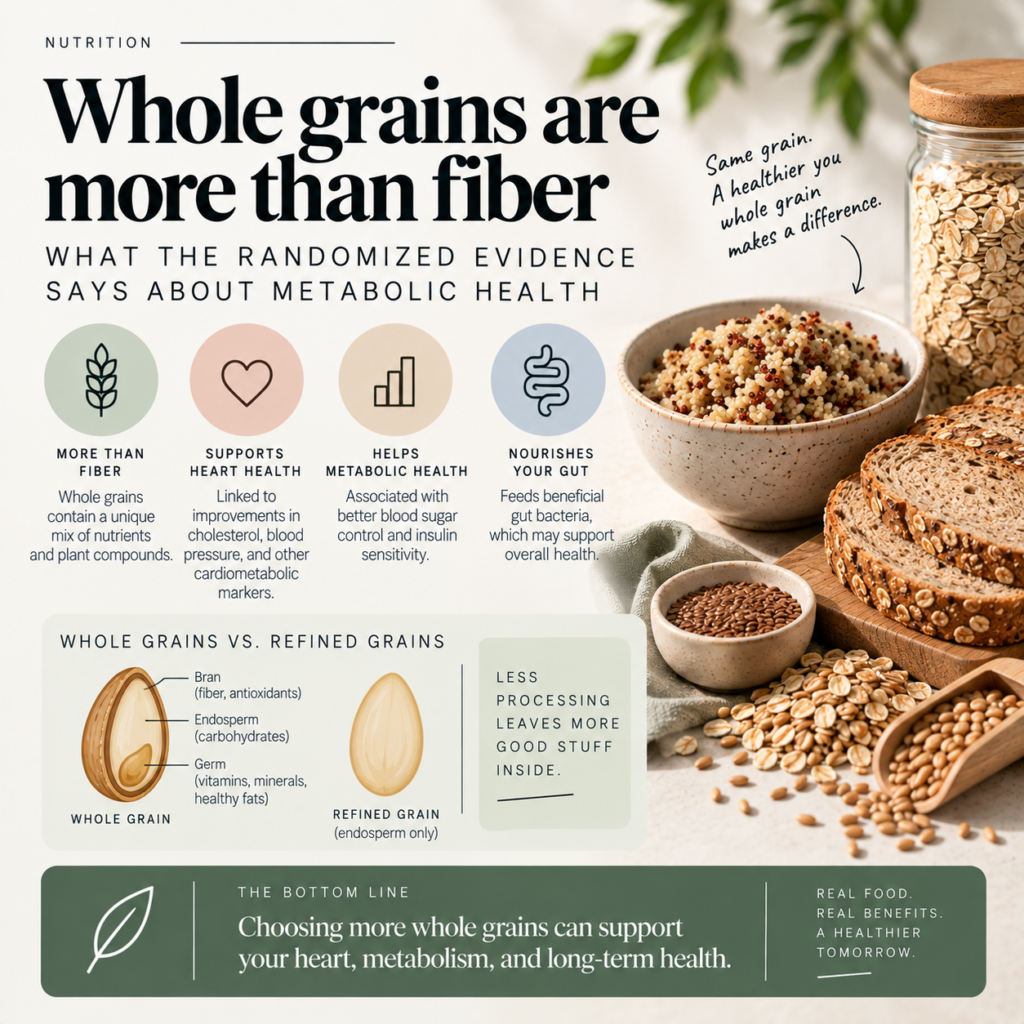
Whole grains are usually sold with one number: grams of fiber. That misses much of the food. Keeping the bran and germ changes the physical structure and preserves minerals, vitamins, lipids, and bioactive compounds that refined grains lose.
A 2025 umbrella review examined 25 systematic reviews and meta-analyses of randomized controlled trials, covering 113 metabolic outcomes. The evidence spanned glycemic control, lipid metabolism, body weight, blood pressure, inflammation, appetite, and energy intake.
The evidence is broader than a bowel-health claim
Across the included reviews, whole-grain consumption showed beneficial effects in several domains relevant to diabetes and cardiovascular health. The authors concluded that increasing whole grains generally did more good than harm for metabolic health, while noting the need for stronger trials across more populations.
An umbrella review sits above individual trials, but it also inherits their differences. Oats, rye, wheat, brown rice, barley, and mixed whole-grain interventions are not one identical food.
A grain storage container can make oats, barley, or brown rice easier to keep visible and usable instead of letting the intention disappear behind packaged snacks.
Processing still matters inside the whole-grain category
A grain can retain all three anatomical components and still be milled very finely. Particle size, cooking, extrusion, and the surrounding meal can change how quickly starch is accessible to digestive enzymes.
That is why a whole-grain label should not be treated as a guarantee of a flat glucose curve. Intact or minimally disrupted kernels often behave differently from finely milled products, even when both contain whole grain.
A digital kitchen scale can help you learn dry grain portions for a few recipes, while a kitchen timer makes longer-cooking grains less annoying on weeknights.
Make the swap where refined grains are already routine
The easiest way to increase whole grains is not to add a wellness bowl on top of everything else. Replace a refined grain you already eat with a whole-grain version that you genuinely like.
Try oats instead of a refined breakfast cereal, brown rice or barley in a grain bowl, or a bread where whole grain is a primary ingredient. A meal-planning notebook can help you identify the two grain meals that repeat most often.
Do not force a grain that causes symptoms. People with celiac disease need gluten-free choices, and some digestive conditions change which grains and portions are comfortable.
Whole grain is a category, not a single dose
The amount and type used in randomized trials varies, which is one reason umbrella reviews are useful and imperfect at the same time. They can show whether the overall evidence leans in one direction while hiding some of the details that matter at breakfast.
A practical target is therefore substitution and variety rather than chasing one magic grain. Oats one day, barley another, and whole-grain bread when convenient can build a pattern without requiring a special product or an exact gram target from a single study.
Look beyond the front-of-package claim
Products labeled multigrain, wheat, or made with whole grains are not automatically mostly whole grain. Ingredient lists can help distinguish a genuinely whole-grain staple from a refined product sprinkled with seeds or bran.
At the same time, do not let label reading become a perfection exercise. A mostly whole-grain bread you enjoy and buy repeatedly is more useful than an ideal product that stays uneaten.
The Livium recipe
Tool. Keep one or two whole grains stocked that you already know how to cook.
Behavior. Replace refined grains rather than simply adding more calories.
Threshold. If gluten or gastrointestinal symptoms are a concern, choose grains according to the underlying condition rather than assuming every whole grain is appropriate.
| Evidence area in the 2025 review | Share of outcomes assessed | Overall direction |
|---|---|---|
| Diabetes-related outcomes | 43% | Generally favorable |
| Lipid metabolism | 21% | Generally favorable |
| Blood pressure | 9% | Generally favorable |
| Inflammation | 10% | Generally favorable |
| Appetite and energy intake | 5% | Beneficial signals reported |
Source: Umbrella review of whole-grain randomized-trial evidence, 2025.
Plan of action
- Choose one refined grain you eat often and test a whole-grain replacement.
- Keep preparation simple enough to repeat.
- Remember that whole-grain processing can still affect digestion.
- Judge the whole dietary pattern, not one label claim.
Table of Content

Know your body better.
Trusted By Thousands Daily








FAQs
What counts as a whole grain?
A whole grain retains the bran, germ, and endosperm in the same relative proportions as the intact kernel.
Are whole grains better for blood sugar?
The umbrella review found beneficial randomized-trial evidence across several diabetes-related outcomes, although effects vary by grain, processing, and population.
Is whole-grain bread the same as intact grains?
Not necessarily. Both can qualify as whole grain, but particle size and processing can change digestion and the post-meal response.
Legal Disclaimer
The content published on Livium Health is for informational and educational purposes only. Nothing on this site constitutes medical advice, diagnosis, or treatment. Always consult a qualified healthcare provider before making decisions about your health, including changes to medications, supplements, diet, or exercise.
Livium Health is not a medical practice and does not have a patient-provider relationship with its readers. We do not sell supplements, medications, or treatments, and we have no financial relationship with the products or services we reference.
While we work to ensure the information we publish is accurate and up to date, health and medical guidance evolves. We make no guarantees about the completeness or currency of any content on this site. Reliance on any information provided by Livium Health is solely at your own risk.
If you are experiencing a medical emergency, call 911 or your local emergency services immediately.
We may receive compensation, free products, or affiliate commissions for products mentioned in this post. Opinions are our own.