
Share
Men's Health
Sleep
Women's Health
Why you can’t fall asleep before midnight: Delayed sleep phase after 40
6 min read
Key takeaways
- Delayed sleep phase disorder (DSPD) and subclinical circadian drift are far more common in adults over 40 than clinicians recognize. The presentation: difficulty falling asleep before 11 PM to 1 AM despite genuine tiredness, normal sleep architecture once asleep, and significant difficulty waking at socially required times. It is not anxiety. It is biology.
- The human circadian clock naturally shifts later during adolescence and then progressively earlier through adulthood. But chronic light exposure after dark, irregular schedules, and evening screen use can arrest this shift or reverse it, keeping the circadian clock anchored to a late schedule regardless of age or intention.
- Morning bright light exposure is the most powerful tool for advancing a delayed circadian phase. Ten to thirty minutes of outdoor light, or a 10,000-lux light box within 30 minutes of waking, shifts the clock earlier by measurable amounts within days to weeks.
- Low-dose melatonin taken 5 to 6 hours before target sleep onset advances the circadian clock pharmacologically. This is the correct use of melatonin; not as a sedative at bedtime, which has minimal effect on the clock, but as a chronobiotic taken in the afternoon or early evening.
You went to bed an hour ago. Your brain didn’t get the memo
You went to bed at 10:30 PM because you need to be up at 6 AM and you know what eight hours looks like on paper. You lay there. You are tired. You are not anxious about anything specific. You are simply awake in a way that feels biological rather than psychological. By 12:30 AM, sleep finally arrives, and when the alarm goes off at 6, you feel like you have been hit by something.
On weekends, given the option, you would sleep from 1 AM to 9 AM without difficulty. The sleep quality is fine. The quantity is fine. The timing is the problem.
This is a circadian problem, not a sleep problem. Treating it as insomnia with sleep hygiene advice is the wrong intervention for the wrong mechanism.
What delayed sleep phase actually is
The circadian clock is a roughly 24-hour biological oscillator driven by the suprachiasmatic nucleus (SCN) in the hypothalamus. It controls the timing of melatonin release, core body temperature rhythm, cortisol secretion, and dozens of other physiological processes. For sleep, the critical output is dim-light melatonin onset (DLMO) — the point in the evening when melatonin begins to rise in darkness, signaling that the body should begin preparing for sleep. DLMO typically occurs about 2 hours before habitual sleep onset.
In delayed sleep phase disorder, DLMO is shifted to a later clock time than socially functional. A person whose DLMO occurs at 1 AM cannot fall asleep at 10:30 PM without a sedative, because the biological machinery for sleep onset has not been triggered yet. The body is not ready. This is the same mechanism as jet lag, except the misalignment is not between time zones; it is between the internal clock and the external schedule.
Full DSPD is a diagnosable circadian rhythm disorder. Subclinical delayed phase, a DLMO shifted an hour or two later than optimal, producing real-world sleep-onset difficulty without meeting full diagnostic criteria, is far more common and largely unrecognized.
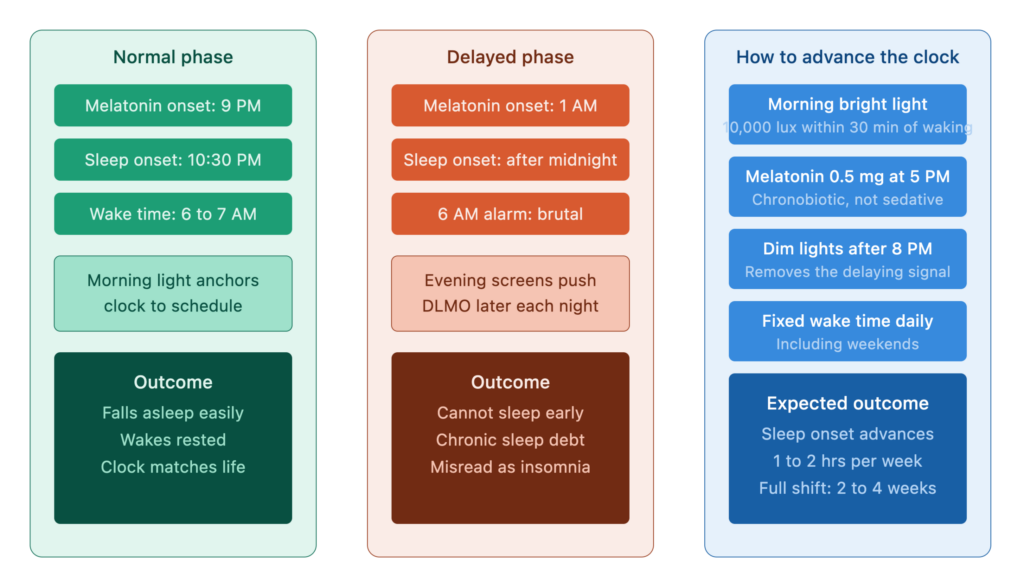
Delayed sleep phase is not insomnia. The clock is anchored to the wrong time. Evening light exposure pushes dim-light melatonin onset progressively later. Morning bright light, low-dose afternoon melatonin, and a fixed wake time are the tools that advance it back. Source: Guigoz & Vellas (eds.), Clocks and Sleep 2023 — Pharmacological Treatments of Sleep-Wake Disorders. CC BY 4.0.
What drives it after 40
Evening light exposure. The SCN is reset daily by light falling on intrinsically photosensitive retinal ganglion cells (ipRGCs) that project directly to the clock. Light in the morning advances the clock (makes it run earlier). Light in the evening delays it (pushes it later). Blue-wavelength light (peak sensitivity around 480 nm) is the most potent stimulus. Phone and laptop screens deliver exactly this in the hours before sleep, shifting the clock progressively later with each evening of use.
Irregular schedules. The circadian clock is robust when anchored by consistent light-dark cycles and meal timing. Variable wake times, weekend sleep-ins, and shift work all weaken the entraining signals that keep the clock locked to a functional schedule. An inconsistent schedule in a midlife adult with reduced circadian amplitude (the clock’s signal strength, which declines with age) is particularly destabilizing.
Reduced circadian amplitude with age. The strength of the circadian signal, how powerfully the clock drives the physiological rhythms it controls, declines measurably from midlife onward. A weaker clock is more susceptible to phase shifts from environmental inputs and slower to re-entrain when disrupted. This is why a week of late evenings at 45 produces a more entrenched phase delay than the same week at 25.
The Livium recipe
Tool. Morning bright light is the primary tool. A 10,000 lux light therapy lamp used for 20 to 30 minutes within 30 minutes of waking delivers the clock-advancing signal that outdoor morning light provides. In summer at lower latitudes, outdoor exposure achieves the same effect. In winter, in northern climates, or for people who wake before dawn, a lamp is the practical tool. Low-dose melatonin taken 5 to 6 hours before target sleep onset is the pharmacological complement: melatonin 0.5 mg (not 5 or 10 mg; lower doses are more chronobiologically appropriate) taken at 5 PM for a target sleep of 11 PM. Blue-light-blocking glasses worn after 8 PM reduce the evening light input that delays the circadian clock. A sleep tracker provides objective data on actual sleep-onset time throughout the intervention period.
Behavior. Fix the wake time first. This is counterintuitive when the problem is falling asleep, but the morning wake time is the strongest anchor for the circadian clock. A consistent wake time, even on weekends, within 30 minutes of the target keeps the clock from drifting later. Expose yourself to bright light immediately on waking, before coffee, before screens. Dim the environment aggressively after 8 PM: overhead lighting down, screen brightness down, warm-color bulbs only. Eat dinner before 7 PM where possible; late eating shifts the peripheral circadian clocks in the liver and gut later, reinforcing the central clock’s delayed phase.
Threshold. Two weeks of consistent morning light plus evening light reduction produces a measurable phase advance in most subclinically delayed adults. The early evenings will feel like tiredness arrives earlier; that is the clock moving. If the phase delay is severe (cannot sleep before 2 or 3 AM) or has been present for years without improvement from lifestyle interventions, a sleep medicine specialist who can measure DLMO and manage a structured chronotherapy protocol is the next step.
| Intervention | Mechanism | Timing | Evidence |
|---|---|---|---|
| Morning bright light (10,000 lux, 20–30 min) | Advances SCN clock directly via ipRGCs | Within 30 min of waking | Strong (multiple RCTs) |
| Low-dose melatonin (0.5 mg) | Phase-advances DLMO chronobiologically | 5–6 hours before target sleep | Strong (phase-shifting dose established) |
| Fixed wake time (7 days/week) | Anchors circadian entrainment | Daily, including weekends | Strong |
| Evening light reduction (after 8 PM) | Removes clock-delaying light signal | 2–3 hours before target sleep | Strong |
Source: AASM Clinical Practice Guidelines for Circadian Rhythm Sleep-Wake Disorders.
Plan of action
- Set your wake time and hold it for two weeks. Pick the time you need to be up for work on the worst day of the week. Every day. The consistency is the intervention.
- Get light in your eyes within 30 minutes of waking. Go outside if you can. If you cannot, use a 10,000 lux lamp while you drink your coffee. Twenty minutes is sufficient.
- If sleep onset before midnight is the goal: take melatonin 0.5 mg at 5 to 6 PM, not at bedtime. The timing is what produces the phase advance. Bedtime melatonin is a sedative, not a chronobiotic.
- After 8 PM: screens in night mode, overhead lighting off, blue light blocking glasses if you cannot avoid screens. Dim warm light only. The environment should look like sunset, not midday.
Table of Content

Know your body better.
Trusted By Thousands Daily




FAQs
Is this the same as being a night owl?
Evening chronotype (being a night owl) and delayed sleep phase disorder sit on the same spectrum. Evening chronotype is a heritable trait with a biological basis; DSPD is the clinical extreme of that spectrum, in which the phase delay is severe enough to impair functioning. Many adults who self-identify as night owls and struggle with early morning performance have subclinical delayed phase rather than a fixed personality trait. The distinction matters because delayed phase is treatable.
Does melatonin at higher doses work better?
No. For phase advancement, lower doses (0.5 mg) are as effective as or more effective than higher doses (5 mg or 10 mg) and produce fewer next-day side effects. High-dose melatonin at bedtime acts as a mild sedative but does not reliably shift the circadian clock. Most over-the-counter melatonin products in the US are significantly higher than the phase-shifting dose used in research. The dose on the label is not the dose with the best evidence.
How long does it take to shift the clock earlier?
With consistent morning light and reduced evening light, most people notice a shift in sleep onset within 5 to 10 days. The full target advance may take 2 to 4 weeks. The clock can only advance about 1 to 2 hours per week under optimal conditions. If the starting delay is significant (sleeping at 2 or 3 AM), a multi-week structured protocol is realistic. Reverting is fast: a few late nights with evening light exposure will reset the clock. The intervention needs to become a maintained habit, not a one-time reset.
Legal Disclaimer
The content published on Livium Health is for informational and educational purposes only. Nothing on this site constitutes medical advice, diagnosis, or treatment. Always consult a qualified healthcare provider before making decisions about your health, including changes to medications, supplements, diet, or exercise.
Livium Health is not a medical practice and does not have a patient-provider relationship with its readers. We do not sell supplements, medications, or treatments, and we have no financial relationship with the products or services we reference.
While we work to ensure the information we publish is accurate and up to date, health and medical guidance evolves. We make no guarantees about the completeness or currency of any content on this site. Reliance on any information provided by Livium Health is solely at your own risk.
If you are experiencing a medical emergency, call 911 or your local emergency services immediately.
We may receive compensation, free products, or affiliate commissions for products mentioned in this post. Opinions are our own.