
Share
Energy & Focus
Men's Health
Women's Health
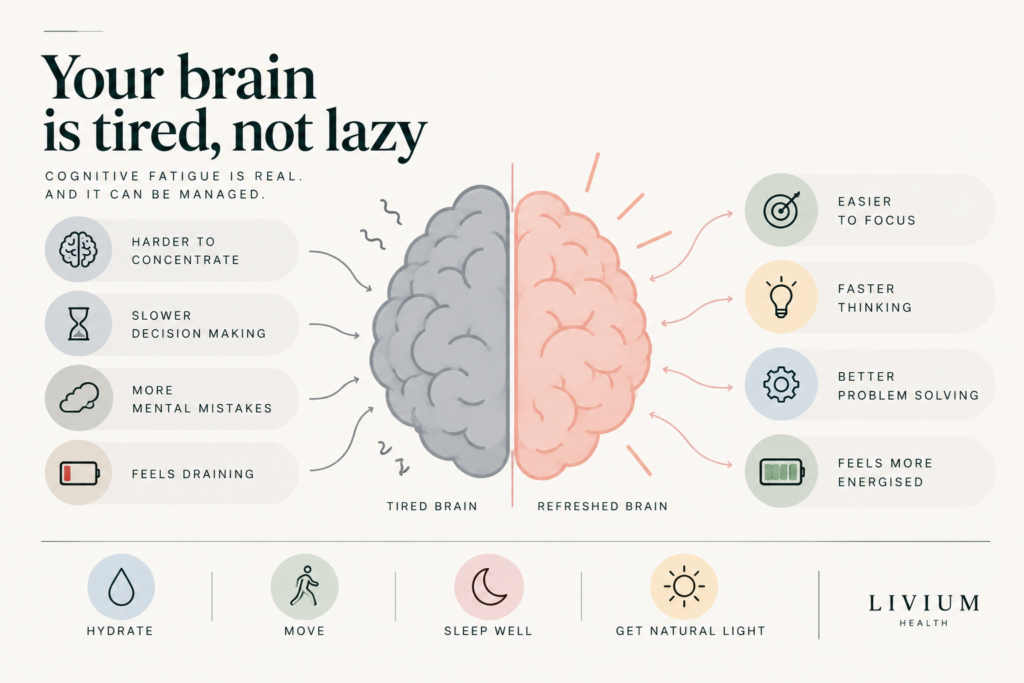
Your brain is tired, not lazy
4 min read

Key takeaways
- Cognitive fatigue changes the cost of sustained mental control, not just motivation.
- More time at the desk does not guarantee more high-quality attention.
- A useful break lowers cognitive demand instead of replacing work with another information stream.
- Persistent all-day fatigue deserves a broader explanation.
Mental fatigue is a real performance state
After a few hours of demanding work, an easy task can feel weirdly expensive. You reread the same paragraph, postpone a small decision, or suddenly become interested in anything except the task in front of you. That experience is often dismissed as low motivation. Cognitive-fatigue research suggests something more complicated is happening.
A 2025 review in Trends in Cognitive Sciences describes cognitive fatigue as a state that can emerge after prolonged mobilization of cognitive-control systems. Performance does not always collapse immediately. Instead, effort starts to feel more costly, motivation shifts, and the brain becomes more likely to favor actions that require less control.
That distinction matters because chair time is a bad proxy for useful work. You can remain at the desk long after the quality of your attention has changed.
Watch quality, not the clock
The most useful signals are often mundane: rereading, avoidable errors, impulsive tab switching, difficulty holding the next step in mind, or choosing an easy administrative task over the demanding task you intended to finish.
There is no universal focus interval established by this research. A difficult analysis and routine inbox cleanup do not impose the same control demands. Instead of stopping because a timer says so, learn the point where your own work becomes noticeably more expensive.
Make the current task visually finite with one sticky note naming the outcome. One visible target reduces the temptation to keep renegotiating what you are supposed to be doing.
A break should actually reduce demand
Scrolling a different stream of information is still information processing. Switching from a spreadsheet to social media can feel easier while giving attention very little actual rest. A better reset lowers cognitive demand for a few minutes.
If noise is part of the problem, foam earplugs can reduce environmental distraction without adding another audio stream. During the break, walk, stretch, look outside, or do a simple physical task.
Later in the day, normal hydration from a reusable bottle removes another avoidable variable. If the room is dim and sleepiness is mixed into the fatigue, a bright daytime lamp can support alertness. Neither product treats cognitive fatigue itself.
The Livium recipe
Tool. One visible outcome, one low-input break, and one environmental fix are enough. Do not build a focus system so complicated that maintaining it becomes another cognitive task.
Behavior. Work until you notice a real change in quality, then step away from high-input information for 5 to 10 minutes. Return by identifying the next concrete action before reopening everything.
Threshold. If fatigue is present from the start of the day, survives weekends, or is accompanied by significant sleepiness, low mood, breathlessness, or other symptoms, stop treating it as a productivity problem.
| Signal | What it may mean | Better response |
|---|---|---|
| Rereading | Control is getting costly | Low-input break |
| Tab switching | Task value is dropping | Define one outcome |
| Simple errors | Quality is slipping | Stop before cleanup grows |
| Sleepiness | Not purely cognitive fatigue | Check sleep and light |
Source: Pessiglione et al., Trends in Cognitive Sciences, 2025.
What progress looks like
Progress is not eight perfect hours of concentration. It is noticing the quality drop sooner and protecting the hours when your work is genuinely good. For one week, note the approximate time when rereading, tab switching, and simple errors reliably rise.
If the pattern is consistent, place a lower-demand task or a real break before that point instead of after it. You are not trying to eliminate fatigue. You are trying to stop spending your most fatigued minutes as though they are equivalent to your best ones.
Persistent exhaustion is different. Sleep disorders, depression, anemia, thyroid disease, medication effects, and other medical issues can produce fatigue that no work-break system will solve.
Do not confuse friction with failure
Some tasks are simply hard. Feeling resistance does not automatically mean you need a break. The useful distinction is whether you are still producing new work at an acceptable quality or merely repeating, correcting, and switching.
A five-minute reset is also not a reward you have to earn. It is a way to change the demand on the system before another 40 minutes becomes mostly cleanup. If you return and quality immediately improves, that is useful feedback about how the prior block ended.
Plan of action
- Choose one demanding task for your first high-focus block.
- Write one visible outcome, not a full to-do list.
- Take a low-input break when quality clearly drops.
- If fatigue is present all day, look beyond productivity tactics.
Table of Content

Know your body better.
Trusted By Thousands Daily




FAQs
Is mental fatigue the same as sleepiness?
No. They can overlap, but cognitive fatigue can appear after demanding work even when you are not sleepy.
How long should a focus block be?
There is no universal interval. Use errors, rereading, and task switching to learn your pattern.
Does scrolling count as a break?
It may feel easier, but it still demands attention. A lower-input break is more likely to reduce cognitive load.
Legal Disclaimer
The content published on Livium Health is for informational and educational purposes only. Nothing on this site constitutes medical advice, diagnosis, or treatment. Always consult a qualified healthcare provider before making decisions about your health, including changes to medications, supplements, diet, or exercise.
Livium Health is not a medical practice and does not have a patient-provider relationship with its readers. We do not sell supplements, medications, or treatments, and we have no financial relationship with the products or services we reference.
While we work to ensure the information we publish is accurate and up to date, health and medical guidance evolves. We make no guarantees about the completeness or currency of any content on this site. Reliance on any information provided by Livium Health is solely at your own risk.
If you are experiencing a medical emergency, call 911 or your local emergency services immediately.
We may receive compensation, free products, or affiliate commissions for products mentioned in this post. Opinions are our own.