
Share
Men's Health
Sleep
Women's Health
Your sleep is fine. Your sleep timing is not
6 min read
Key takeaways
- Social jetlag, the gap between biological sleep timing and the sleep timing required by work and school schedules, affects an estimated 70 percent of the working population to some degree.
- Getting 7.5 hours of sleep but at the wrong time for biology produces measurably worse health outcomes than getting 7.5 hours at the biologically appropriate time.
- Delayed sleep phase, the tendency to be naturally alert late and sleepy late, is partially genetic and partially behavioral. The behavioral component is more tractable than most people assume.
- The three highest-leverage interventions for shifting a delayed sleep phase earlier are morning light, evening light elimination, and low-dose melatonin timed to the target sleep window rather than to bedtime.
Seven and a half hours. Goes to bed at 1 AM. Gets up at 8:30
By the numbers, that is adequate sleep. By the biology, it is not. The human circadian clock is anchored to the solar day. Cortisol, growth hormone, insulin, testosterone, melatonin, body temperature regulation — all of them follow a timing sequence that is calibrated to a roughly sunrise-to-sunset biological day. A person sleeping from 1 AM to 8:30 AM is getting sufficient duration but misaligned timing. The downstream hormonal and metabolic effects of that misalignment are measurable and independent of sleep duration.
Social jetlag, the term coined by chronobiologist Till Roenneberg, describes the discrepancy between biological chronotype and socially required schedule. Someone whose body clock wants to sleep from 1 AM to 9 AM but who has to be at work by 8:30 AM is experiencing the equivalent of two to three time zones’ jet lag every weekday. They partially recover on weekends by sleeping in, which resets their clocks later and makes Monday morning worse.
A 2019 study in Current Biology found that each hour of social jetlag was associated with a 33 percent increase in the odds of being overweight or obese, a 22 percent increase in smoking, and measurably higher rates of depression and anxiety independent of total sleep duration. The timing problem is not just a sleep quality problem. It is a metabolic and mental health problem.
How to know if timing is the problem
Two questions. First: on a completely free schedule with no alarm, no obligations, and no artificial light restriction, what time does sleep naturally come, and what time does natural waking occur? That is the biological window. Second: what time does the work schedule require waking? The gap between those two answers is the social jetlag number. One hour of gap is manageable. Two hours is significant. Three or more hours is clinically relevant.
Wearing a device to track sleep onset time over two to three weeks (noting which nights had no alarm) provides the same information more precisely. Most people who believe they are night owls by nature turn out to have some combination of genetic chronotype and environmentally reinforced late habits. The genetic component determines the window of possibility. The behavioral component determines where within that window the clock actually settles.
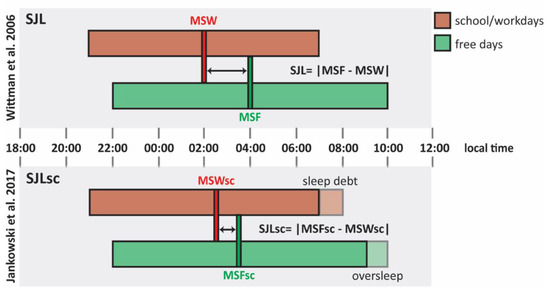
Caliandro et al., Nutrients 2021 — Social Jetlag and Related Risks for Human Health. CC BY 4.0.
How the clock shifts and what it responds to
The suprachiasmatic nucleus (SCN), the brain’s master circadian clock, is synchronized primarily by three inputs: light, meal timing, and physical activity. Of these, light is the most powerful by a significant margin. The SCN receives direct retinal input and uses the light-dark cycle to set the phase of the biological clock. Morning light pushes the clock earlier. Evening light pushes it later.
Someone with a delayed sleep phase who is exposed to artificial light until midnight has been reinforcing the delay every night. The phone, the television, the laptop, and the overhead LED lights all signal to the brain that the day is still continuing. Melatonin onset, which should begin around 9 PM for a person sleeping by 11 PM, is being suppressed by that light exposure until 11 PM or later. The sleep window shifts accordingly.
The behavioral piece of chronotype is not fully understood but is meaningfully large. Studies on populations without electricity, and on individuals who camp for a week without artificial light, show substantial phase advancement. The natural light-dark cycle pulls the clock 2 to 3 hours earlier than modern artificial light environments allow.
The Livium recipe
Tool. A sunrise alarm clock that produces a gradual light-based wake signal rather than an acoustic alarm. The Hatch Restore 3 simulates dawn 30 minutes before target wake time. This is the morning light exposure that phase-advances the clock, delivered at the exact moment it is most useful. Pair with complete blackout in the sleep environment using blackout curtain clips that seal the edges of existing curtains without requiring new window treatments.
Behavior. Three simultaneous changes for two weeks. First: no screens after 9 PM. Not dimmed, not night mode. Off. The retinal response to blue light is not sufficiently blunted by software filters on bright screens. A physical blue-light-blocking screen overlay for a tablet or laptop is an alternative if screens are unavoidable after 9 PM. Second: consistent wake time every day, including weekends. The same wake time is the anchor signal to the SCN. Weekend sleeping in undoes the phase advancement achieved during the week. Third: morning outdoor light exposure within 20 minutes of waking. Bright outdoor light, even on a cloudy day, is significantly more potent than indoor light.
Threshold. After two weeks of consistent light discipline and fixed wake time, sleep onset should advance by 30 to 60 minutes. This is not fast. The circadian clock shifts approximately one hour per week under consistent light discipline. A two-hour phase advance takes roughly two weeks of strict compliance. Low-dose melatonin, when timed correctly, accelerates this: Life Extension Melatonin 500 mcg, taken 5 hours before the target sleep time (not at bedtime), acts as a chronobiotic phase-advance signal rather than a sedative. At target sleep time minus 5 hours. Not later.
Light discipline: what shifts the clock and what does not
| Intervention | Phase effect | Potency | Timing |
|---|---|---|---|
| Outdoor morning light | Phase advance (earlier) | Very high | Within 20 min of waking |
| Sunrise alarm clock | Phase advance | Moderate | 30 min before target wake |
| Screen elimination after 9 PM | Phase advance (removes delay signal) | High | Consistently after 9 PM |
| Screen night mode only | Phase advance (partial) | Low to moderate | Better than nothing; not as good as off |
| Low-dose melatonin (0.3–0.5 mg) | Phase advance (chronobiotic) | Moderate | 5 hours before target sleep onset |
| Evening bright artificial light | Phase delay (later) | High | Avoid after 9 PM |
Source: Livium editorial synthesis based on NHLBI Sleep-Wake Cycle research and Burgess et al., Journal of Biological Rhythms (2003), Phase-advancing the human circadian clock.
Plan of action
- Calculate social jetlag: mid-sleep on free days minus mid-sleep on work days. If the gap is more than one hour, timing is a meaningful problem worth addressing before adding any other sleep intervention.
- Set a consistent wake time today and hold it every day, including weekends, for two weeks. This single change is the highest-leverage circadian intervention available.
- Get outdoor light within 20 minutes of waking. On days that it is impossible, the Hatch Restore 3 sunrise simulation is the next best option.
- All screens off by 9 PM for two weeks. Seal the bedroom with blackout curtain clips so that morning light does not enter before the target wake time. The light discipline runs in both directions.
- If the phase advance is not moving after two weeks of light discipline, add Life Extension Melatonin 500 mcg taken 5 hours before the target sleep time. The timing is counterintuitive but essential. This is a chronobiotic, not a sedative.
Table of Content

Know your body better.
Trusted By Thousands Daily


FAQs
Is being a night owl genetic?
Partially. Chronotype has a heritability of approximately 50 percent. The remaining 50 percent is environmental, primarily driven by light exposure patterns. Most people who identify as night owls have a genetic predisposition toward an intermediate or moderately late chronotype that has been behaviorally reinforced by years of exposure to artificial light and late-night screens. The truly extreme evening chronotypes, those who cannot function before noon regardless of the environment, are a smaller proportion of the night-owl self-identifier population.
Does chronotype change with age?
Yes, in a predictable U-shape. Children are naturally early types. Teenagers shift toward the latest chronotype among all age groups (the biological basis of teenage sleep patterns). Adults drift earlier through their 20s and 30s. After 50, the shift toward earlier sleep timing accelerates, particularly in women. Adults in their 50s and 60s who feel they have become morning people are largely experiencing a normal chronotype shift rather than a lifestyle change.
Can sleep timing misalignment cause weight gain even without changing calories?
Yes. The metabolic consequences of circadian misalignment include reduced insulin sensitivity, altered leptin and ghrelin signaling, and higher ghrelin levels (the hunger hormone) in the evening. People with delayed sleep timing eat more in the late evening when metabolic processing of food is least efficient. The calorie content of the diet may not change but the timing of when those calories arrive relative to the circadian clock changes the metabolic outcome. This is one of the most consistent and underappreciated findings in chronobiology.
Legal Disclaimer
The content published on Livium Health is for informational and educational purposes only. Nothing on this site constitutes medical advice, diagnosis, or treatment. Always consult a qualified healthcare provider before making decisions about your health, including changes to medications, supplements, diet, or exercise.
Livium Health is not a medical practice and does not have a patient-provider relationship with its readers. We do not sell supplements, medications, or treatments, and we have no financial relationship with the products or services we reference.
While we work to ensure the information we publish is accurate and up to date, health and medical guidance evolves. We make no guarantees about the completeness or currency of any content on this site. Reliance on any information provided by Livium Health is solely at your own risk.
If you are experiencing a medical emergency, call 911 or your local emergency services immediately.
We may receive compensation, free products, or affiliate commissions for products mentioned in this post. Opinions are our own.