
Share
Longevity & Aging
Men's Health
Women's Health
You should be wearing earplugs more often than you think
10 min read
Key takeaways
- The ringing you drive home with after a loud concert is not good. It is your ears telling you cells died. Hair cells in the cochlea do not grow back. Damage compounds silently for years before it shows up on an audiogram.
- The WHO estimates over 1 billion young adults worldwide are at risk of permanent, avoidable hearing loss from recreational noise. In the US, 1 in 9 working adults already have hearing difficulty. Hearing loss is now the third most common chronic condition after high blood pressure and arthritis.
- A pair of Loop Experience 2 earplugs is about $30. They filter noise by 17 dB and keep music and speech clear. Keep them in your pocket. Wear them anywhere you have to raise your voice to be heard, and definitely anywhere a kid is present with fireworks or a bounce house going.
The ringing on the drive home
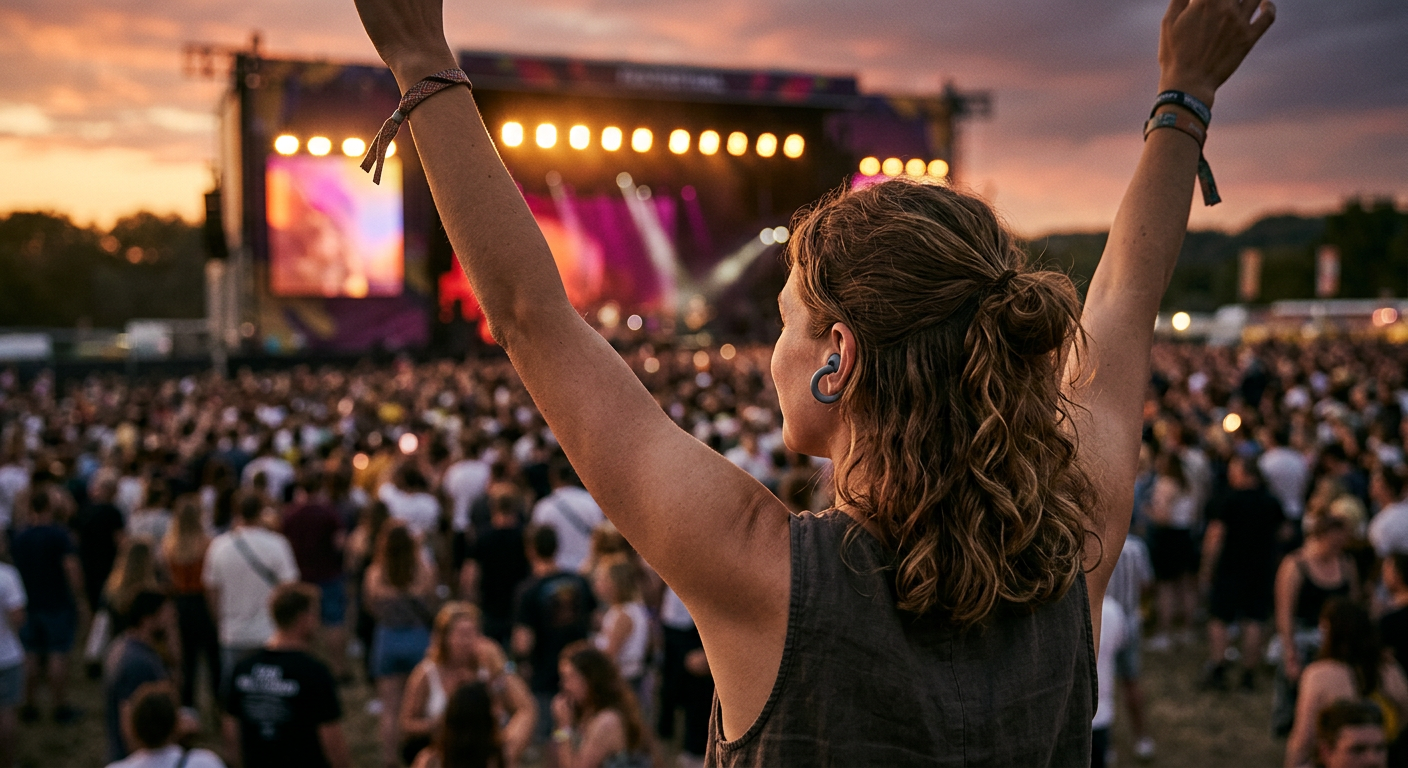
You know the moment. You are in the Uber leaving the concert, or driving home from the sports bar, or lying down at the end of a wedding, and there is a high-pitched sound in your ears that was not there this morning. It fades over the next few hours. You think of it as normal. It is not normal. It is your inner ear reporting damage.
Hearing works by way of about 15,000 tiny sensory hair cells in the cochlea, each one tuned to a specific frequency. Loud noise physically damages them. Some of that damage is temporary. Much of it is not. What the ringing (tinnitus) after a loud event actually represents is a chunk of your hair cell inventory dying and not being replaced. Human hair cells do not regenerate. Every unprotected exposure to loud sound withdraws from a savings account you cannot refill. And as the Livium article on hidden hearing loss explains, modern research from Mass Eye and Ear shows this damage accumulates for years, sometimes decades, before any of it shows up on a standard hearing test. Your audiogram is fine at 40. Your ears are already less resilient at 40 than they were at 25. The audiogram just cannot see it yet.
The public-health numbers on this are worse than most people realize. The World Health Organization estimates that over 1 billion young adults, ages 12 to 35, are at risk of permanent hearing loss due to recreational exposure to loud sound. The CDC and NIOSH report that 1 in 9 US working-population adults already have hearing difficulty, and about 27 million US workers are exposed to hazardous noise on the job every year. Hearing loss is the third most common chronic condition in US adults, behind high blood pressure and arthritis. And unlike those two, the version caused by noise exposure is preventable in a way that costs less than dinner.
What actually damages your hearing
Two variables matter: how loud, and for how long. NIOSH sets 85 dBA as the safe-exposure ceiling for eight hours a day at work. Every 3 dB above that halves the safe exposure time. At 88 dB, four hours. At 91 dB, two hours. At 100 dB (an average concert), about fifteen minutes. Sound intensity is logarithmic, so those numbers are not typos. A 10 dB increase is a ten-fold increase in sound energy. A rock concert at 110 dB delivers more energy in one minute than a normal restaurant delivers in an hour.
The other thing worth knowing. What matters is the total dose over time, not any single event. Two hours at a moderately loud gym class every day for a decade will accumulate more damage than one loud concert per year. The routine exposures are what most people underestimate. The blender, the mower, the subway platform, the crowded restaurant on a Friday, the movie theater during an action sequence, the SoulCycle class, the youth soccer game where the parents scream. None of these individually will make you deaf. Across your 40s, 50s, and 60s, they add up to real hearing loss.
Where earplugs actually belong
Rule of thumb. If you have to raise your voice to talk to the person next to you, the environment is loud enough to be damaging your ears. Here is a decibel ladder to make that concrete.
| Sound level | What that looks like | Livium take |
|---|---|---|
| 70-80 dB | Normal restaurant, city traffic, hair dryer, vacuum cleaner | Uncomfortable but not damaging. Earplugs not necessary. |
| 85 dB | Busy restaurant at peak, heavy urban traffic, gym class with music | NIOSH safe-exposure ceiling for 8 hours a day. If you eat dinner every night in a room this loud, that is chronic exposure worth dealing with. |
| 90-95 dB | Motorcycle, subway train passing, movie theater action scene, food processor, lawn mower | Damage risk in about 2 to 4 hours. Wear earplugs for the mower, the motorcycle ride, and any movie theater loud enough that you notice. |
| 100-110 dB | Chainsaw, rock concert at reasonable volume, sporting event stadium at peak, nightclub, kids birthday arcade or bounce house | Damage risk in 15 minutes to under an hour. Loop Experience 2 (or equivalent) belongs in your pocket for everything at this level. |
| 120-130 dB | Standing near stage speakers at a loud concert, ambulance siren up close, jackhammer at 3 feet, marching band up close | Damage risk in under a minute of unprotected exposure. Never attend a concert this loud without earplugs. Ever. |
| 140+ dB | Fireworks up close, gunshots, jet engine at takeoff, close-range firecrackers | Permanent hearing damage from a single unprotected exposure. Kids at Fourth of July: use ear protection. Not optional. |
Source: Livium editorial synthesis of NIOSH occupational hearing loss guidance (85 dBA safe-exposure ceiling) and CDC noise-induced hearing loss data. Sound-level ranges are typical, not certified measurements. Individual venues vary.
What to buy
The category leader is Loop. Two Belgian founders started the company in 2016 because they both had tinnitus from music and nightlife. They have sold to 14 million customers, filed enough acoustic research to earn a #1 wellness ranking from TIME100, and normalized earplugs as fashion in a way no company had before. The reason the shift matters is that the entire hearing-protection category used to be construction workers and professional musicians. The shift Loop drove is that concert-goers, parents, restaurant-goers, and city commuters became a market. Their acoustic engineering is legit and the product design is deliberately not clinical.
The specific product to start with is the Loop Experience 2 at about $30. It filters noise by 17 dB (SNR) and keeps music and speech clear. That last part is the key trade-off versus foam plugs. Foam earplugs work, but they muffle everything, and once music and conversation are muffled, most people take the earplugs out. Loop’s design uses an acoustic channel that reduces overall volume without turning the music into mud, so a concert still sounds like a concert. That is the reason people actually wear them.
| Tier | Product | Best for |
|---|---|---|
| Pocket everyday | Loop Experience 2 (~$30). Filters noise by 17 dB and keeps music and speech clear. | Concerts, festivals, restaurants, sporting events, kids birthday parties, subway commutes. The one to keep on you. |
| Audiophile | Etymotic ER20XS (~$20). Flat 20 dB attenuation across frequencies. | Live music where sound fidelity matters and you do not mind slightly less-comfortable stems. |
| Musicians and repeat exposure | Custom-molded earplugs from an audiologist ($150-300). Interchangeable filter attenuations (9, 15, 25 dB). | Working musicians, DJs, anyone with regular high-decibel exposure. Ordered through an audiologist, molded to your ear canal. |
| Kids | Loop Engage Kids 2 (ages 6-12). Loop Cocoon baby earmuffs (0-2). | Fireworks, weddings, birthday parties, arcades, movie theaters. Little ears are more vulnerable than adult ears. |
| Sleep and focus | Loop Quiet 2 (~$22) or Loop Dream (~$50). | Not hearing protection in the primary-prevention sense, but the same brand ecosystem and worth having if you sleep next to a snorer. |
Source: Livium editorial synthesis based on Loop Earplugs product pages, Etymotic Research product data, and general audiology guidance on custom-molded hearing protection.
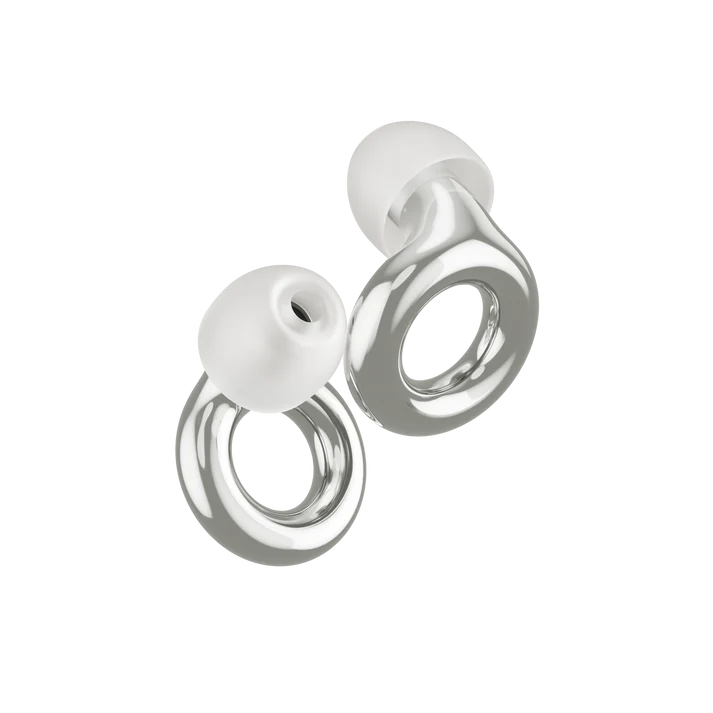
Loop Experience 2, about $30. Filters noise by 17 dB while keeping music and speech clear. The one to keep in your pocket.
The kids angle
Little ears are more vulnerable than adult ears. Ear canals are shorter, which means sound pressure at the eardrum is higher for the same source volume. Kids also cannot tell you what is wrong the way adults can. They will not tell you the fireworks are too loud until after the damage is done, and they will not tell you the arcade is uncomfortable until you notice they are covering their ears with their hands.
The three environments that matter most for kids. Fireworks, without qualification. The Fourth of July or a New Year’s Eve show puts kid ears at 140 to 150 dB when close to the launch site. That is single-exposure permanent damage territory. Second, indoor kid entertainment (arcades, trampoline parks, bounce house venues, indoor pools with echoey acoustics) frequently reaches 100 to 110 dB. A two-hour birthday party at that level is exceeding an adult’s safe exposure limit multiple times over. Third, movie theaters. Kids’ movies at chain theaters routinely hit 100+ dB during action sequences. Ear protection for kids is not overkill. It is the minimum for these three environments.
Loop makes a kids-specific product (Loop Engage Kids 2 for ages 6 to 12) and a baby earmuff (Loop Cocoon) for infants and toddlers. Cheaper alternatives include Alpine Muffy Kids and 3M Peltor Kids, both of which are pediatric-fit over-ear muffs. Any of these are better than none, and none of them require your kid to sit still or complain quietly. They fit and they stay on.
What noise cancellation is not
A note on AirPods Pro and other active noise cancellation headphones. They are useful for reducing ambient noise on a flight, in an open office, or on a subway. They are not certified hearing protection. Active noise cancellation works by generating an inverse waveform to cancel low-frequency continuous noise (engine hum, HVAC drone, subway roar). It does not meaningfully protect against the sudden, high-decibel, transient noise of a concert, a firework, or a gunshot. If you are relying on AirPods Pro at a concert, and you are also playing music through them at 70 percent volume to drown out the crowd, you are not protecting your hearing. You are adding to the noise dose your ears are absorbing. Wear real earplugs.
Foam earplugs are the other thing worth naming. They actually do work, and if you have foam plugs in a drawer and no Loop, use the foam plugs. But most people do not, because foam plugs squash sound flat and eliminate the joy of the concert or the ability to hear a conversation over dinner. The reason to invest $30 in Loop instead is that you will actually wear them.
The Livium take
Every other article in the Livium hearing category is written for someone who already has hearing loss and needs to know what to do about it. This one is written for the reader who has all their hearing and can keep it. That is a rare category on this site, and it is worth naming because the return on effort is huge. Thirty dollars, kept in your pocket, deployed 10 to 20 times a year at concerts, restaurants, fireworks, and kid events, meaningfully changes how well you hear at 65. It is the cheapest longevity move in this whole category. The hearing-dementia link article puts the upstream stakes at roughly 8 percent of dementia risk (Lancet Commission 2024). Protecting your hearing in your 30s and 40s is not just protecting your hearing. It is protecting your brain.
Here is how to think about it. Do not think of earplugs as reducing your enjoyment of an experience. Think of them as extending the number of years you get to enjoy that kind of experience. The concert you wear earplugs at is the concert you still get to hear at 65.
The Livium recipe
The short version. Buy one pair of Loop Experience 2. Keep them in your pocket, your bag, or your car console. Wear them anywhere you have to raise your voice to talk, anywhere fireworks are going, and anywhere a kid is present in a loud room. Buy the kids their own pair.
Plan of action
- Order Loop Experience 2 and put them in the pocket you use every day.
- If you go to concerts, festivals, or loud sporting events more than a few times a year, this pair pays for itself in one night.
- If you have kids under 12 and take them to fireworks, arcades, bounce house parties, or movie theaters, buy them their own kid-sized ear protection. Loop Engage Kids 2 for ages 6-12, Loop Cocoon or 3M Peltor Kids muffs for infants and toddlers.
- If you already have tinnitus, ringing after loud events, or a family history of noise-related hearing loss, the hidden hearing loss article and the sudden hearing loss article cover what to do next. Ear protection is upstream of both.
Table of Content
Know your body better.
Trusted By Thousands Daily


Do AirPods Pro or Bose noise-cancelling headphones count as hearing protection?
No. Active noise cancellation reduces steady low-frequency ambient noise (jet engines, HVAC, subway roar). It does not protect against sudden loud events like concerts, fireworks, or gunshots. Also, most people use active noise cancellation with music playing, and the volume of that music can independently damage hearing. If you want to enjoy a concert with your hearing intact, wear real, rated earplugs.
How much damage does one loud concert without earplugs actually do?
Enough to matter, not enough to notice on a hearing test the next day. Three hours at 100-110 dB destroys a measurable number of cochlear hair cells and can leave temporary threshold shifts (that muffled hearing the next morning) plus transient tinnitus. Most of the deficit recovers within 24 to 48 hours. A meaningful fraction does not. Repeat that pattern 20 times a year for a decade and you have hidden hearing loss that will not appear on an audiogram until it is more advanced. This is the whole reason wearing earplugs now pays off so much later.
Will I still enjoy the concert if I am wearing earplugs?
Yes. This is why Loop and Etymotic exist and foam earplugs mostly do not get worn. Modern hearing-protection earplugs reduce the overall volume without muffling the music. Vocals, drums, and lead instruments still come through clearly. You will notice the bass and the crowd shouting are less overwhelming, which most people find is an improvement, not a loss. The trade-off used to be real when foam was the only option. That trade-off is over.
Legal Disclaimer
The content published on Livium Health is for informational and educational purposes only. Nothing on this site constitutes medical advice, diagnosis, or treatment. Always consult a qualified healthcare provider before making decisions about your health, including changes to medications, supplements, diet, or exercise.
Livium Health is not a medical practice and does not have a patient-provider relationship with its readers. We do not sell supplements, medications, or treatments, and we have no financial relationship with the products or services we reference.
While we work to ensure the information we publish is accurate and up to date, health and medical guidance evolves. We make no guarantees about the completeness or currency of any content on this site. Reliance on any information provided by Livium Health is solely at your own risk.
If you are experiencing a medical emergency, call 911 or your local emergency services immediately.
We may receive compensation, free products, or affiliate commissions for products mentioned in this post. Opinions are our own.