
Share
Longevity & Aging
Men's Health
Women's Health
AirPods Pro as a hearing aid: The killer feature nobody’s using
12 min read
Key takeaways
- Apple’s Hearing Aid feature debuted on AirPods Pro 2 with iOS 18 and FDA marketing authorization in September 2024. It has since extended to AirPods Pro 3 and, based on Apple’s product roadmap pattern, is expected to continue across every future AirPods Pro model. When this article says AirPods Pro, it means the current-generation Pro line: Pro 2, Pro 3, or whatever ships next. Any current AirPods Pro model with the latest firmware paired with an iPhone or iPad running iOS 18 or later supports the full hearing feature set.
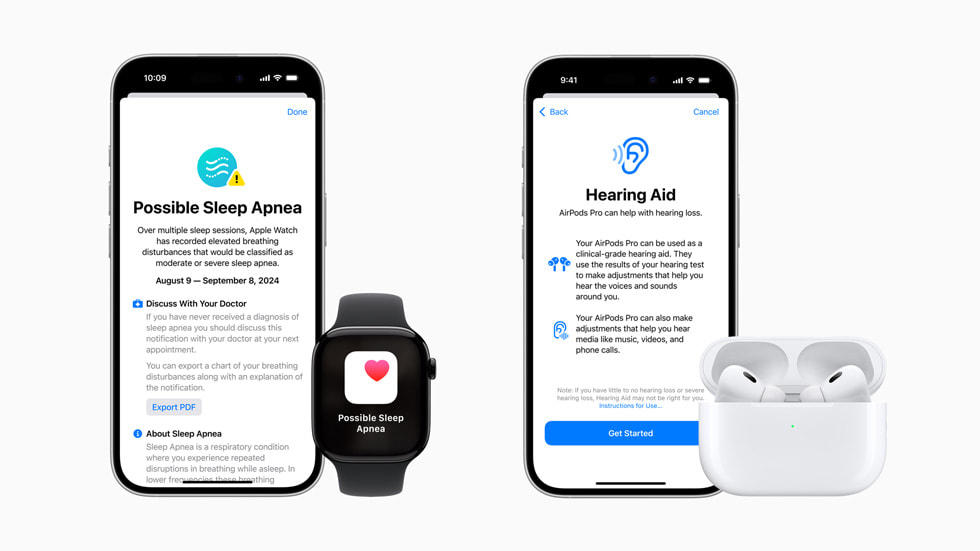
- The feature has three parts. Hearing Protection actively reduces loud environmental noise while preserving what you are listening to. Hearing Test is a five-minute clinical-grade audiogram based on pure-tone audiometry that runs entirely on your iPhone. Hearing Aid turns the AirPods into a personalized hearing device, boosting speech and ambient sound in real time based on your test results, and applies the same profile to music, calls, and video.
- Apple ran a randomized clinical validation study comparing the AirPods self-set hearing aid to an audiologist-fit hearing aid and found the self-set feature performed on par with the audiologist-fit setup. That is a genuine clinical benchmark, not a marketing claim. The audiogram method is the standard clinical approach.
- This is not a full replacement for dedicated all-day OTC hearing aids for every reader. Current AirPods Pro models run about six hours of active use before the case charge is needed, they are not optimized for continuous wear across a full workday, and the ear tips are not as unobtrusive as a modern behind-the-ear hearing aid. For the reader deciding whether to invest in hearing tech at all, though, this is the cheapest legitimate test drive available.
iOS 18 quietly turned $249 earbuds into a clinical-grade hearing aid. Most AirPod Pro owners have not turned it on.
In September 2024, Apple announced a set of hearing health features for AirPods Pro 2. Three features under one banner — Hearing Protection, Hearing Test, and Hearing Aid — all launching that fall with iOS 18. The company’s press release framed it as the world’s first all-in-one hearing health experience built into a consumer earbud, and specifically the world’s first clinical-grade over-the-counter hearing aid running as software on a device most people already own. Apple has since extended the same feature set to AirPods Pro 3, and Apple’s product roadmap pattern points to continued support on every future AirPods Pro model.
It was one of the biggest healthcare products of the year. It did not get the attention it deserved.
Most AirPods Pro owners have not enabled the Hearing Aid feature. Most have not taken the Hearing Test. Most did not read the Apple announcement or the Health app prompts about it. The feature has been sitting in iOS the entire time, free, waiting to be turned on.
This is the piece to fix that. For the reader who already owns any current AirPods Pro and an iPhone, the total additional cost of the entire hearing health capability is zero dollars. For the reader who does not own AirPods Pro but is thinking about hearing aids for the first time, AirPods Pro currently start at $249 at full retail (the AirPods Pro 3 price at Apple’s official store), and sale prices below that are common, especially on AirPods Pro 2. They are sold at every Apple Store, Best Buy, Costco, and Target in the country. Whichever price a reader ends up paying, this is the cheapest legitimate hearing aid on the market. The math has changed and most primary care doctors are not surfacing it.
What Apple actually did
The three-part hearing feature is worth walking through, because most coverage collapses it into one thing (the hearing aid part) and misses that Apple built a whole hearing health system into iOS.
Hearing Protection. AirPods Pro use the H2 chip to actively reduce loud environmental noise 48,000 times per second while preserving the audio you are listening to. This is on by default across all listening modes. In practice, that means concerts sound natural and vibrant while the peak decibel spikes that damage hair cells get pulled down. The Apple Hearing Study (run jointly with the University of Michigan School of Public Health and the World Health Organization) found one in three people is regularly exposed to loud environmental noise that can damage hearing. Wearing AirPods Pro in loud environments becomes preventive hearing health, not just consumer audio.
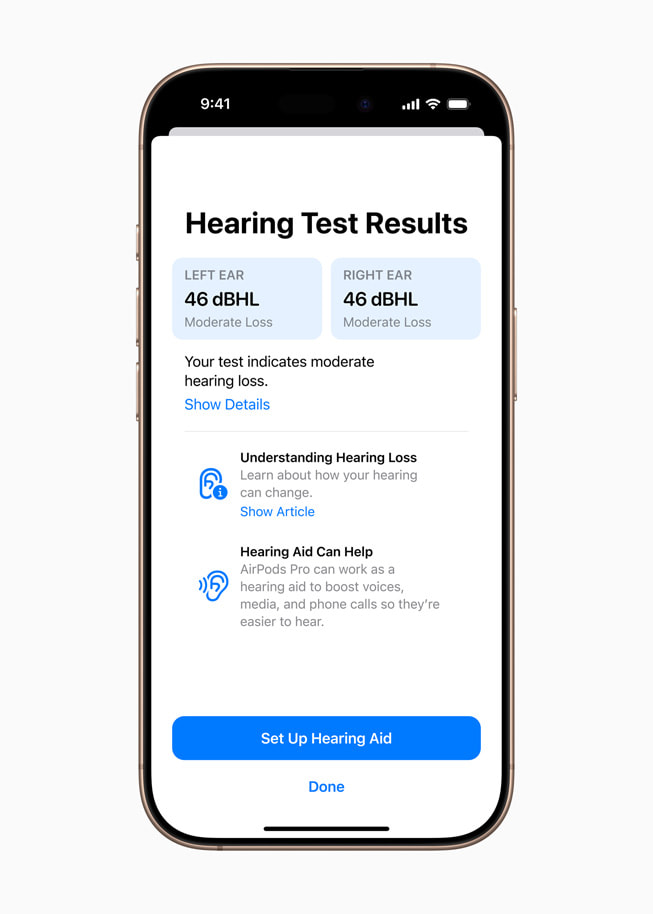
Hearing Test. A five-minute audiogram run at home with AirPods Pro and an iPhone or iPad. The test uses pure-tone audiometry, which is the same clinical standard an audiologist uses in an office visit. Results include a hearing-loss classification (normal, mild, moderate, moderately severe, severe, profound), a per-ear number, an audiogram chart, and recommendations. Everything gets stored in the Health app and can be exported as a PDF for a healthcare provider. Apple validated the test against clinical pure-tone audiometry and reports strong agreement with the professional test.
Hearing Aid. For adults with perceived mild to moderate hearing loss, AirPods Pro become a functional over-the-counter hearing aid. The personalized hearing profile from the Hearing Test drives real-time dynamic adjustments that boost speech and ambient sound around you. The same profile applies to music, video, phone calls, and Siri across paired Apple devices without any additional configuration. Apple clinically validated the feature in a randomized controlled study comparing the self-set AirPods hearing aid to an audiologist-fit setup and found the self-set feature performed on par with the professional fit. Available in more than 100 countries.
Who this actually helps
Two distinct groups get real value from this feature. The right way to think about it depends on which group a reader is in.
The “I have AirPods Pro and I might have some hearing loss but I have never done anything about it” reader. This describes a large percentage of midlife adults. Hearing loss usually starts in the 40s and progresses gradually over decades. Eighty percent of American adults have not had their hearing checked in the past five years. If a reader already owns AirPods Pro and an iPhone, taking the Hearing Test is a five-minute investment that answers a question they have probably been putting off for years. Even if the result is “no loss,” now the reader has a baseline audiogram on file to compare against every year. That baseline is worth having.
The “my hearing is definitely off and I want to try a hearing aid but I do not want to spend $2,000 on something I might return” reader. This is where AirPods Pro shine. At current retail (starting at $249, often less on sale), they are the cheapest OTC hearing aid on the market, they are widely available, and Apple’s return policy is 14 days. If the AirPods Hearing Aid feature clearly helps, the reader has real information about how much benefit they are getting and can step up to a dedicated device like Sennheiser All Day Clear or Jabra Enhance Select if the improvement is significant. If it does not help, the reader knows something more is going on and can see an audiologist instead of blowing $2,000 on a mistake.
This connects directly to the hearing loss and dementia case that opened this category. Untreated hearing loss is the single largest modifiable dementia risk factor at midlife. For the reader who was on the fence about whether hearing aids were worth the investment, sub-$250 AirPods Pro with the Hearing Aid feature turned on is the smallest possible commitment to the intervention.
The real limits
AirPods Pro are a legitimate hearing aid for a subset of the hearing-loss population. They are not a full replacement for dedicated OTC or prescription hearing aids for everyone. Being clear about the limits keeps this honest.
- Battery life. AirPods Pro run about six hours of active use on a single charge, then the case delivers roughly 30 hours of total playback with recharges. For a reader who wants hearing assistance during a two-hour restaurant dinner or a work meeting, that is more than enough. For a reader who needs 12 hours of continuous hearing support across a workday, dedicated OTC hearing aids like the Jabra Enhance Select 700 that run all day on a single charge are a better fit.
- Form factor. The AirPods case in the ear is visible in a way a modern behind-the-ear hearing aid is not. For readers who want to be discreet about wearing hearing tech, this is a real consideration. Culturally, most people accept earbuds without a second thought, and that may actually be the AirPods advantage rather than a disadvantage — a reader who would feel self-conscious about a hearing aid may feel nothing about a pair of AirPods.
- Severity of loss. The Hearing Aid feature is FDA-cleared for adults with perceived mild to moderate hearing loss. If a reader’s Hearing Test comes back moderately severe, severe, or profound, AirPods will not amplify enough. That is not a limit specific to Apple — every OTC hearing aid tops out at moderate loss. Above that threshold, a prescription hearing aid from an audiologist is the right path.
- Wear time comfort. Multi-hour continuous ear-tip wear is not for everyone. Some readers find the seal fatiguing or uncomfortable after a few hours. Ear-tip fit matters, so run through Apple’s ear-tip fit test in Settings and try the different tip sizes before deciding.
- Ecosystem dependency. The feature only works with an iPhone or iPad. Readers on Android or Windows-only workflows cannot use the Hearing Test or Hearing Aid feature at all. For readers considering AirPods Pro primarily for hearing assistance, an iPhone is a hidden requirement.
None of these limits are dealbreakers for the right reader. They are dealbreakers for the wrong reader. Knowing which reader you are before you buy is the whole game.
When to step up to dedicated OTC hearing aids
Three specific signals point a reader toward dedicated OTC hearing aids instead of AirPods Pro. First, the reader tries the AirPods Hearing Aid feature for a couple of weeks, gets a real benefit, but is frustrated by battery life or the visibility of the AirPods for all-day wear. Second, the reader’s Hearing Test result comes back at the upper end of moderate loss or higher, where the AirPods amplification is not quite enough. Third, the reader wants ongoing licensed audiology support that Apple does not offer. In all three cases, the OTC hearing aid buyer’s guide covers the shopping framework. Sennheiser All Day Clear at $799.95 and Jabra Enhance Select at $1,195 to $1,995 are the two brands worth considering.
The step-up is not a failure of AirPods. It is a natural next move for readers whose hearing needs are more than AirPods can deliver on a full-time basis. The AirPods take may still be useful as a backup and for streaming music.
The Livium take
The hearing aid in your pocket. That is the reframe. For the reader with mild loss who already owns AirPods Pro, the answer to “do I need to buy a hearing aid?” may honestly be no. Turn on the feature that Apple gave you for free. If it helps, keep using it. If it does not, escalate.
For everyone else, AirPods Pro starting at $249 (often less on sale) are the cheapest legitimate hearing aid test drive on the market. Not a substitute for real audiological workup if the reader has red flags (sudden loss, tinnitus in one ear, drainage, dizziness), but a low-friction way to answer “do hearing aids actually help me?” before committing to a $2,000 purchase.
Apple did not build this feature as a gimmick. They ran the FDA clearance process, ran the randomized clinical trial, ran the audiogram against pure-tone audiometry standards, and shipped a real hearing aid inside an earbud most people already own. The industry has not caught up to what happened here. Neither has most of primary care.
If a reader owns AirPods Pro and an iPhone, opening the Settings app right now and running the Hearing Test is the single highest-leverage midlife longevity move available. Cost, zero. Time, five minutes. Downside, none.
The Livium recipe
Tool. If you own a current AirPods Pro model (Pro 2 or Pro 3), open Settings on your iPhone, go to AirPods, and run the Hearing Test. Five minutes. The result gives you a baseline audiogram and, if you have mild-to-moderate loss, a hearing profile that runs the Hearing Aid feature. If you do not own AirPods Pro, Apple currently sells them starting at $249 for the AirPods Pro 3 at full retail, with the older AirPods Pro 2 often available for less on sale. Costco, Best Buy, Target, and Amazon carry them too. Regardless of which retailer, verify you are getting a Pro model (not the older AirPods 3 or the standard AirPods 4, neither of which has the hearing features). Baseline midlife biomarkers through Function Health remain useful for the fuller picture on brain-health runway.
Behavior. Turn Hearing Protection on and leave it on. This is the free preventive hearing health layer. At concerts, on the subway, mowing the lawn — the AirPods are actively reducing your cumulative noise exposure without you doing anything. If the Hearing Test flags mild-to-moderate loss, actually use the Hearing Aid feature in real listening situations. Take it to a restaurant. Take it to a family dinner. Take it to a work meeting. Notice how much less effort the conversation requires. If you catch yourself smiling because you actually followed what someone said across a noisy table for the first time in years, that is data.
Threshold. The Hearing Aid feature is FDA-cleared for adults with perceived mild to moderate hearing loss. In audiogram terms, roughly 26 to 60 dB HL. If your Hearing Test result is at the upper end of moderate (55 to 60 dB HL) or you find yourself pushing the amplification to the top of the range and still struggling, that is the signal to step up to dedicated OTC hearing aids or see an audiologist. Age-wise, take a baseline Hearing Test at 45. Retake it every one to two years. If the numbers move meaningfully in either ear from year to year, that is worth flagging to a primary care doctor or ENT. Do not wait for a symptom.
Plan of action
- If you own AirPods Pro with iOS 18 or later, take the Hearing Test today. Settings > AirPods > Hearing Test. Five minutes.
- Turn on Hearing Protection and leave it on. Settings > AirPods > Hearing Protection.
- If the Hearing Test flags mild-to-moderate loss, turn on the Hearing Aid feature and use it in real listening situations for two weeks. Restaurants, family dinners, work meetings.
- If you do not own a current AirPods Pro and you are on iPhone, buy them from Apple starting at $249 for the Pro 3, with the Pro 2 often on sale for less (also at Best Buy, Costco, Target, Amazon). Take the Hearing Test the day they arrive.
- If you are on Android or Windows-only, AirPods Pro are not the right tool for you. See the OTC hearing aid buyer’s guide for verified alternatives that work on any smartphone.
- If your Hearing Test result comes back at the upper end of moderate or worse, or if you have any red-flag symptoms (sudden loss, tinnitus in one ear, drainage, dizziness), see an audiologist or ENT. AirPods amplification is not a substitute for a professional workup in those cases.
- Track your baseline. Retake the Hearing Test every one to two years. The Health app keeps the history. Meaningful changes year over year are actionable data.
Table of Content

Know your body better.
Trusted By Thousands Daily



Which AirPods models have the hearing aid feature?
The current AirPods Pro line. AirPods Pro 2 (launched 2022, feature added with the September 2024 firmware update and iOS 18) and AirPods Pro 3 (launched 2025) both support the Hearing Test, Hearing Aid, and Hearing Protection features. Any future AirPods Pro model is expected to carry the features forward. What does not support them: the older standard AirPods line (AirPods 2, AirPods 3, AirPods 4) and the first-generation AirPods Max. The feature is a Pro-line capability. Requires the latest firmware on the AirPods and an iPhone or iPad running iOS 18 or later.
Do I need an iPhone or can I use it with Android?
iPhone or iPad only. The Hearing Test lives in the Health app on iOS and iPadOS. The Hearing Aid feature runs the personalized profile through iOS. On Android or a Windows-only workflow, the feature is unavailable. Readers on those platforms should look at other OTC hearing aids that work with any smartphone.
How accurate is the Apple Hearing Test compared with an audiologist?
Apple validated the test against clinical pure-tone audiometry (the professional audiologist standard) and reports strong agreement. That is the same test method an audiologist runs in an office, adapted for AirPods Pro and a controlled testing environment. For a screening-level assessment, it is genuinely clinical-grade. For a diagnostic workup with an unusual audiogram, an in-person audiologist evaluation is still the gold standard.
Can I use my HSA or FSA for AirPods Pro?
Yes, when purchased for hearing assistance with documentation. HSA and FSA rules require a letter of medical necessity for consumer electronics used for medical purposes. If your Apple Hearing Test flags mild-to-moderate loss, your primary care doctor can write the letter and you can submit for reimbursement. Even at the $249 full-retail price for the current Pro 3, the cost is well within most HSA/FSA balances.
Do they hurt for long-term wear?
For most people, no. Apple ships four ear-tip sizes (XS, S, M, L) and the AirPods Pro firmware runs an ear-tip fit test that tells you whether you have a good seal. If the fit is right, most people can wear them for hours without discomfort. If the fit is wrong, they get uncomfortable fast. Try all four sizes and pick the one that passes the fit test.
How does the AirPods hearing aid compare to a $2,000 dedicated OTC hearing aid?
For active listening moments (restaurant, meeting, TV, phone call), the AirPods deliver amplification and clarity in the same ballpark as a dedicated OTC hearing aid for mild-to-moderate loss. Apple’s clinical validation study showed on-par performance versus an audiologist-fit setup. Where dedicated OTC hearing aids clearly win: all-day continuous wear (better battery, more comfortable long-term), discreet form factor (behind-the-ear vs earbud), and included licensed audiology support (Jabra Enhance Select in particular). For a reader who wants hearing assistance most of the waking day, dedicated OTC hearing aids remain the better tool. For a reader who wants it in the specific moments that matter, AirPods are enough.
Legal Disclaimer
The content published on Livium Health is for informational and educational purposes only. Nothing on this site constitutes medical advice, diagnosis, or treatment. Always consult a qualified healthcare provider before making decisions about your health, including changes to medications, supplements, diet, or exercise.
Livium Health is not a medical practice and does not have a patient-provider relationship with its readers. We do not sell supplements, medications, or treatments, and we have no financial relationship with the products or services we reference.
While we work to ensure the information we publish is accurate and up to date, health and medical guidance evolves. We make no guarantees about the completeness or currency of any content on this site. Reliance on any information provided by Livium Health is solely at your own risk.
If you are experiencing a medical emergency, call 911 or your local emergency services immediately.
We may receive compensation, free products, or affiliate commissions for products mentioned in this post. Opinions are our own.