
Share
Longevity & Aging
Men's Health
Women's Health
Hidden hearing loss: The diagnosis your audiologist hasn’t told you about
11 min read

Key takeaways
- Cochlear synaptopathy — the medical name for hidden hearing loss — was identified in 2009 by Sharon Kujawa and Charles Liberman at Mass Eye and Ear and Harvard Medical School. Standard hearing tests measure whether the hair cells inside your cochlea can pick up pure tones. This condition damages the synapses that connect those hair cells to the auditory nerve. Different problem, different mechanism, same audiogram result of ‘normal.’
- If you fail in noisy environments but pass the beeps-in-a-quiet-booth test, you probably have this. Prevalence estimates put hidden hearing loss at roughly 10 to 15 percent of the general population. Most audiology practices still do not screen for it, even though better testing tools exist and have existed for over a decade.
- The causes are more ordinary than most readers realize. Cumulative noise exposure (concerts, headphones cranked, power tools, motorcycles), aging, ototoxic medications (some chemotherapy drugs, high-dose aspirin), and even sound deprivation (chronic ear infections, single-sided hearing loss) all damage the nerve synapses first — sometimes years before the hair cells themselves fail.
- What to actually do: ask your audiologist to run a speech-in-noise test (QuickSIN is the most common) instead of accepting a standard audiogram as the whole story. If they do not offer it, get referred to an academic center or a modern audiology practice that does. Standard audiograms are not a bad test — they are the wrong test for a whole category of problem.
Your audiogram was normal. You still cannot follow a conversation in a restaurant.
Your audiogram came back normal. Your primary care doctor and your audiologist both told you your hearing is fine. And yet you cannot follow a conversation in a restaurant. You blame the acoustics. You blame the ambient music. You blame the fact that everyone talks over each other now. You may not be blaming what is actually going wrong.
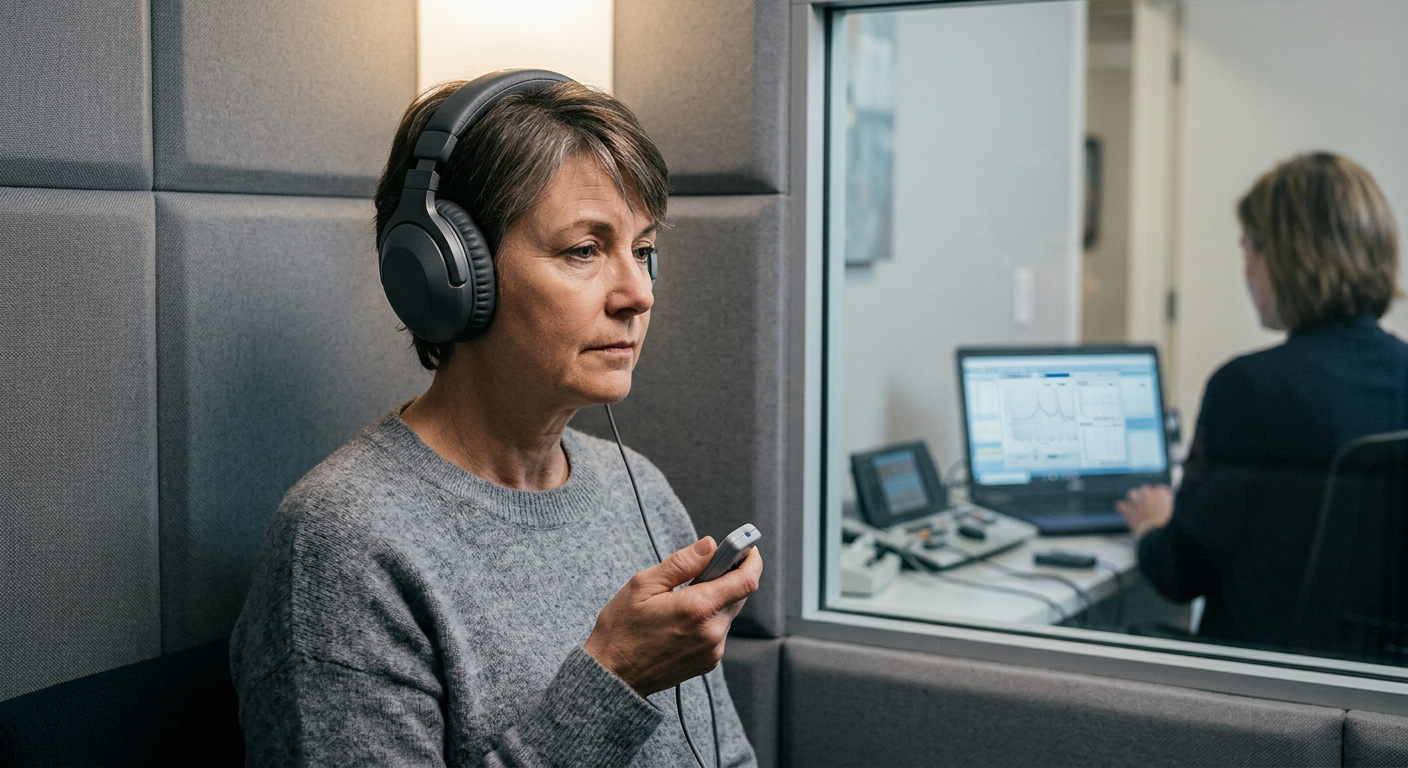
The hearing test your audiologist ran on you was designed in the 1950s. It plays pure tones at various frequencies into your ear and asks whether you can hear them. It measures one specific mechanism. Do the hair cells inside your cochlea respond to sound? Yes or no. If yes, you pass. If no, you fail.
The problem is that hair cells are not the only place hearing breaks down. In 2009, a team of researchers at Mass Eye and Ear and Harvard Medical School published a landmark paper in the Journal of Neuroscience showing something the audiology field had not yet caught. Between your hair cells and the auditory nerve that carries signals to your brain, there is a synapse. These synapses, they discovered, are among the first structures to break down. Before the hair cells fail. Sometimes years before.
They named the condition cochlear synaptopathy. The popular term is hidden hearing loss. And it is one of the more consequential quiet discoveries of the past two decades of hearing research, because it changes what a “normal” audiogram actually means.
What hidden hearing loss actually is
Hearing happens in stages. Sound waves hit your eardrum. The eardrum moves three tiny bones in your middle ear. Those bones push fluid inside your cochlea (a snail-shaped structure filled with fluid and thousands of specialized hair cells). The hair cells convert fluid motion into electrical signals. Synapses at the base of the hair cells hand those signals off to the auditory nerve. The nerve carries the signals to your brain, which turns them into what you experience as sound.
A standard audiogram tests one part of that chain. It confirms whether the hair cells are converting sound waves into electrical signals. It does not test whether the synapses at the base of the hair cells are still passing those signals along to the auditory nerve. It does not test whether the nerve is delivering a clean signal to the brain.
The Kujawa and Liberman research showed that noise and aging first damage the synapses. The hair cells can be intact and still responsive. The synapses connecting them to the nerve can already be dropping information. On a standard audiogram, the reader looks normal. In a restaurant, the reader cannot make out what their spouse is saying across the table. Same person. Different tests. Different answers. The Hearing Health Foundation walks through the mechanism and the 2009 paper in detail.
The reason this matters more than a technical distinction. Standard hearing loss is progressive, gradual, and predictable. Cochlear synaptopathy is different. It can happen fast. A single loud concert can measurably damage synapses. A summer of headphones cranked up on a run every day can do it. And because the audiogram does not catch it, most people who have it do not know they have it. They just quietly stop going to restaurants they used to enjoy.
Why standard audiograms miss it
The audiogram was standardized in the mid-1950s. It was designed to answer a specific question. Can this person hear a set of pure tones at set volumes? The question made sense at the time. Most identifiable hearing loss came from either hair cell damage (noise, aging) or middle ear problems (infections, otosclerosis). A test that checked hair cell function caught most of what mattered.
Sixty-eight years later, the audiogram is essentially unchanged. It still plays pure tones. It still asks the same yes-or-no question about hair cell response. The problem is that we now know a whole category of hearing dysfunction happens upstream of the hair cells (in the synapses) and downstream of them (in the auditory nerve). The old test does not touch either area. It is not that the audiogram is a bad test. It is that the audiogram is the wrong test for one specific class of hearing problem — and that class is common.
The tests that do catch hidden hearing loss are not experimental. They are already in clinical use. They just have not fully diffused through the audiology field.
Standard audiogram vs speech-in-noise testing
The differences between what a standard audiogram measures and what a speech-in-noise test measures are worth spelling out.
| Feature | Standard audiogram (pure-tone) | Speech-in-noise testing |
|---|---|---|
| What it tests | Pure tones at 250-8000 Hz | Comprehension of speech in background noise |
| Testing environment | Silent sound-treated booth | Speech with added background noise |
| What it measures | Hair cell function only | Auditory nerve + brain processing together |
| Catches hidden hearing loss | Very rarely (“normal” result even when synapses are damaged) | Yes (detects cochlear synaptopathy) |
| Common test names | PTA (Pure-Tone Audiometry) | QuickSIN, AzBio, BKB-SIN, SPIN-R |
| Duration | 5-10 minutes | 10-15 minutes |
| Availability | Every audiology practice | Some audiologists, growing rapidly |
| Age of standard | Established roughly 1957 | Newer clinical adoption (2010s onward) |
Source: Livium editorial synthesis based on the Hearing Health Foundation’s hidden hearing loss reference, Mass Eye and Ear’s 10-year retrospective on cochlear synaptopathy, and NIDCD guidance on age-related hearing loss.
Who has it and why
Prevalence estimates put hidden hearing loss at roughly 10 to 15 percent of the general population, based on research published in eLife in 2020 and earlier work at Mass Eye and Ear. If a reader has ever attended concerts without earplugs, worked around loud machinery, cranked headphones on a run, or fired a gun, the odds are meaningful. The damage accumulates and it does not undo itself.
The causes track with the kind of noise exposure a lot of midlife adults have accumulated without thinking about it.
- Cumulative noise exposure. Concerts, live music venues, headphones used at high volume during exercise or commutes, power tools, motorcycles, subway platforms, industrial machinery. Peak decibel spikes damage synapses even when the average volume feels tolerable. A single evening at a loud rock concert has been shown to produce measurable synaptic damage in animal models.
- Age. Even without significant noise exposure, cochlear synapses degrade over time. The Kujawa and Liberman work shows synaptic loss begins in animal models well before hair cell loss, and human autopsy studies suggest the same pattern in people. This is a substantial contributor to why midlife adults start to lose speech-in-noise ability years before their audiograms show any change.
- Ototoxic medications. Some chemotherapy drugs (cisplatin, carboplatin), certain aminoglycoside antibiotics used for serious infections, high-dose aspirin, and some diuretics can damage the inner ear. The synapses are often the first structure affected.
- Sound deprivation. This one is under-recognized. Research at Mass Eye and Ear by Stéphane Maison found that underuse of an ear (from chronic ear infections, unilateral conductive hearing loss, or single-sided hearing loss left untreated) can lead to synaptic damage similar to what noise exposure causes. Worth taking seriously if a reader has a history of ear infections or has had persistent hearing asymmetry between ears.
Related recent finding. A 2023 paper in Scientific Reports (Nature portfolio) by Maison, Jung, and colleagues at Mass Eye and Ear identified auditory nerve fiber loss in people with chronic tinnitus that standard audiograms could not detect. Chronic tinnitus and hidden hearing loss share underlying neural damage. If a reader has one, they may have the other.
The Livium take
Here is the Livium take. Your audiogram is not a bad test. It is a 1957 test running on a 2025 problem. The Kujawa and Liberman discovery was published sixteen years ago. The clinical tools to catch cochlear synaptopathy (QuickSIN, AzBio, BKB-SIN) have been available for well over a decade. And yet the standard midlife audiology visit still consists of tones in a booth and a chart on the way out that says everything looks fine. It is the medical equivalent of running a full-body physical without checking blood pressure. The test that catches the actual problem simply is not being run.
The reader who leaves an audiology visit with a normal audiogram and persistent trouble in noisy environments should not accept that as a resolution. Ask for speech-in-noise testing. If your audiologist does not offer it, find one who does. Academic medical centers (Mass Eye and Ear, university-affiliated audiology clinics) have been running these tests routinely for years. So have a growing number of private practices catching up to the research. The Hearing Health Foundation’s hearing tests page is a useful starting point for understanding what tests exist and what they measure.
The bigger longevity point connects to something already covered in the hearing-dementia link piece. Untreated hearing loss is the largest modifiable dementia risk factor at midlife. Hidden hearing loss is a category of untreated hearing loss that specifically affects the ability to follow conversations in real-world environments (which is when the brain does the hardest work). Missing it because the audiogram came back normal is missing the diagnosis at the exact stage a midlife reader can still act on it.
The Livium recipe
Tool. Ask your audiologist for speech-in-noise testing at your next visit. The most common tests are QuickSIN (about 10 minutes), AzBio, and BKB-SIN. They should be routine adds to a standard audiogram, especially for anyone reporting difficulty in noisy environments. If your audiologist does not offer them, ask for a referral to a practice that does. Academic medical centers like Mass Eye and Ear have been running these tests routinely for years. Also ask about extended high-frequency audiometry, which tests hearing up to 16 kHz (standard audiograms stop at 8 kHz) and catches some noise-induced damage that stops just above the standard range. Baseline midlife biomarkers through Function Health remain useful for the fuller cardiovascular and metabolic picture that intersects hearing health per the ACHIEVE trial findings.
Behavior. Protect the synapses you still have. Wearing high-fidelity attenuator earplugs at concerts and sporting events is a longevity move at any age. Turn headphone volume down. The rule of thumb from audiology research is that if the person next to you can hear what you are listening to through your earbuds, the volume is too high. Also, do not opt out of noisy environments preemptively. Social withdrawal is a real driver of cognitive decline, and if hidden hearing loss is making restaurants harder, the answer is to test for it and address it, not to stop going.
Threshold. Numbers worth knowing. QuickSIN scores are reported as a Signal-to-Noise Ratio Loss (SNR loss). Normal hearing is roughly 0 to 3 dB SNR loss. Mild difficulty is 3 to 7 dB. Moderate is 7 to 15 dB. Severe is above 15 dB. If your QuickSIN result is above 3 dB SNR loss and your standard audiogram was normal, that is textbook hidden hearing loss. Age-wise, ask for the test at 45, retest every two to three years, or sooner if your subjective ability to follow conversations in noise clearly worsens. Do not wait for the audiogram to also fail. The audiogram is running behind the actual problem.
Plan of action
- At your next audiology visit, ask specifically for speech-in-noise testing (QuickSIN, AzBio, or BKB-SIN). Do not accept a standard audiogram as the whole picture if you are having trouble in noisy environments.
- Also ask for extended high-frequency audiometry (testing up to 16 kHz). Standard audiograms stop at 8 kHz, which misses noise-induced damage that shows up first in the higher frequencies.
- If your audiologist does not offer speech-in-noise testing, ask for a referral to a practice that does. Academic medical centers and university-affiliated audiology clinics are the safest bet. The Hearing Health Foundation maintains educational resources on where to find advanced hearing evaluation.
- Protect the hearing you still have. Wear high-fidelity attenuator earplugs (Loop, Etymotic, Vibes) at concerts and live sports. Wear real hearing protection with power tools. Keep headphone volume moderate. NIDCD’s noise-induced hearing loss page walks through the ordinary sources of damaging noise most people underestimate.
- If you have persistent tinnitus in addition to trouble in noisy environments, the two conditions share underlying neural damage per the 2023 Nature paper. Bring both concerns to your audiologist. Do not treat them as separate visits.
- Track your midlife baselines. Function Health biomarkers plus a QuickSIN result on file gives you the fullest picture. Retest speech-in-noise every two to three years, or sooner if daily conversation feels meaningfully harder.
- For the fuller case on why hearing loss at midlife is a brain-health intervention, not a nice-to-have, see the hearing-dementia link piece. For where hearing aids fit if a speech-in-noise test flags trouble, the OTC hearing aids buyer’s guide and the AirPods Pro hearing aid deep dive cover the treatment side.
Table of Content

Know your body better.
Trusted By Thousands Daily





What is the difference between hidden hearing loss and normal hearing loss?
Normal hearing loss (the kind an audiogram catches) is a decline in hair cell function. Sound comes in and the hair cells cannot convert it to signals as reliably as they used to. Hidden hearing loss is a decline in the synapses between the hair cells and the auditory nerve. The hair cells still work fine. The signal handoff to the nerve does not. The audiogram catches the first kind and misses the second.
How common is it, actually?
Prevalence estimates in the research literature put hidden hearing loss at roughly 10 to 15 percent of the general population, with higher rates in people who have had significant noise exposure. Because it does not get tested for routinely, most people who have it do not know they have it. They just quietly find noisy environments frustrating.
Can hidden hearing loss be reversed?
Not yet. Research on synapse regeneration is active (gene therapy, drug-delivery approaches from the Mass Eye and Ear group and others), and animal models have shown that synapses can be partially regrown after damage. Human treatments are in earlier stages. What matters today is diagnosing the condition, protecting the hearing you have from further damage, and using amplification (hearing aids, AirPods Pro 2 or 3 with the Hearing Aid feature, or dedicated OTC hearing aids) to help with the specific listening situations where the difficulty shows up.
Do OTC hearing aids help with hidden hearing loss?
Sometimes yes, sometimes not enough. OTC hearing aids amplify sound, which helps if the underlying problem is that the reader is not getting enough signal. Hidden hearing loss is primarily a signal-processing problem in the nerve, so amplification alone does not fully solve it. The Apple AirPods Pro Hearing Aid feature (and dedicated OTC hearing aids from Jabra Enhance, Sennheiser, and similar) include noise reduction and speech-boost modes that specifically target the restaurant scenario. Worth trying. Also worth pairing with a proper QuickSIN test to see how much improvement the amplification actually delivers in noisy conditions.
My audiologist told me my hearing is fine. Should I get a second opinion?
If you are having persistent difficulty following conversations in noisy environments and your standard audiogram was normal, yes. Ask specifically for speech-in-noise testing and extended high-frequency audiometry. A modern audiology practice will run both. If the answer to your request is ‘we do not offer that here,’ that is not a critique of your audiologist, it is a signal to find a practice that runs the current standard of care.
What does a QuickSIN test cost?
Speech-in-noise testing is often included as part of a comprehensive audiology evaluation, with the whole workup running $150 to $400 depending on the practice and insurance. Some clinics run it as an add-on for $50 to $100. It is well within the range of a normal audiology visit copay for most readers with insurance. Uninsured, expect to pay closer to the higher end.
Legal Disclaimer
The content published on Livium Health is for informational and educational purposes only. Nothing on this site constitutes medical advice, diagnosis, or treatment. Always consult a qualified healthcare provider before making decisions about your health, including changes to medications, supplements, diet, or exercise.
Livium Health is not a medical practice and does not have a patient-provider relationship with its readers. We do not sell supplements, medications, or treatments, and we have no financial relationship with the products or services we reference.
While we work to ensure the information we publish is accurate and up to date, health and medical guidance evolves. We make no guarantees about the completeness or currency of any content on this site. Reliance on any information provided by Livium Health is solely at your own risk.
If you are experiencing a medical emergency, call 911 or your local emergency services immediately.
We may receive compensation, free products, or affiliate commissions for products mentioned in this post. Opinions are our own.