
Share
Longevity & Aging
Men's Health
Women's Health
Cochlear implants: The eligibility math just changed in your favor
9 min read

Key takeaways
- The FDA and Medicare quietly expanded who qualifies for a cochlear implant in 2022. Roughly 50 percent more adults now meet the criteria than did five years ago. Almost none of them have been told. Less than 10 percent of adults who could benefit from a cochlear implant currently have one, according to the international consensus statement led by Dr. Craig Buchman at Washington University.
- The old mental model was that cochlear implants are for people who cannot hear at all. That was true 20 years ago. Today they are for adults whose hearing aids no longer restore speech clarity, adults with single-sided deafness, and adults with age-related loss that turned amplification-only into a Charlie Brown teacher on the phone.
- The surgery is outpatient, takes about an hour, and preserves residual hearing when possible via hybrid electroacoustic systems. The bigger question is not whether it works. It is whether your ENT has told you it is now an option.
The Charlie Brown teacher on the phone
Dr. Craig Buchman, who heads otolaryngology at Washington University in St. Louis and led the 2020 international consensus statement on adult cochlear implantation, uses a specific analogy for when a hearing aid stops being enough. He points out that hearing aids amplify sound, which works fine when what you need is louder. But as hearing loss deepens, people start losing clarity, not just volume. “Making unclear speech louder does not help with comprehension,” he told WashU Medicine’s news team. “People start to sound like the teacher who mumbles in the Charlie Brown cartoon.”
That is the moment. It is not silence. It is the phone call where your daughter is telling you about something and you can hear that words are being spoken but you cannot resolve them into meaning. It is the restaurant where you keep saying “what” until you give up. It is the volume on the hearing aid cranked to a level that fills your head with noise but still does not deliver the actual sound of a consonant.
Buchman’s number is the one most people find shocking. Less than 10 percent of adults in the United States who would benefit from a cochlear implant have one. “Even though cochlear implants have been approved by the FDA since 1985,” he told WashU, “there may be a misconception that cochlear implants are only for young children born with profound hearing loss.” That misconception is the reason your ENT probably has not brought them up. It is not because you would not qualify. It is because the referral culture has not caught up with the eligibility criteria the FDA and Medicare expanded in 2022.
What changed
Two things changed in the same year and neither got much popular coverage. First, in January 2022, the FDA approved Cochlear Nucleus Implants for unilateral hearing loss and single-sided deafness (SSD), meaning that for the first time, adults with severe or profound loss in one ear and normal or near-normal hearing in the other became eligible for a cochlear implant. Roughly 60,000 US adults acquire SSD every year, often after a sudden hearing loss event or a neurologic cause. Before 2022, their options were a CROS-style hearing aid (which routes signal from the deaf side to the good side) or nothing. Neither restored the ability to localize sound or to hear cleanly in noise. Cochlear implantation on the deaf side does.
Second, in September 2022, the Centers for Medicare and Medicaid Services (CMS) expanded coverage by raising the aided-speech-recognition threshold from 40 percent to 60 percent. This is the technical way of saying that the bar for qualifying dropped meaningfully. The Johns Hopkins Cochlear Implant Center described the CMS change as “a significant improvement in access to care for those with moderate to profound sensorineural hearing loss.” Rough estimate is that 50 percent more adults are now eligible on paper.
The gap between eligibility on paper and referrals in practice is where most patients live. Primary care doctors do not always run comprehensive hearing tests, patients get used to their hearing aid even when it is no longer effective, and ENTs may not be tracking the change. Livium’s read is that if your hearing aid has stopped feeling like enough, the correct next step is a candidacy evaluation at a cochlear implant program, not a stronger hearing aid.
Who qualifies now that did not before
A rough map. Not a diagnostic tool. If any of these rows describe you or someone in your family, ask for the referral.
| Your situation | Old criteria (pre-2022) | Current criteria |
|---|---|---|
| Moderate to profound hearing loss in both ears, hearing aids do not restore speech clarity | Aided speech recognition below 40 percent to qualify (Medicare) | Aided speech recognition up to 60 percent qualifies. Roughly 50 percent more adults now meet the bar. |
| Severe or profound hearing loss in one ear, near-normal hearing in the other (single-sided deafness) | Not FDA-approved for cochlear implantation. Choices were CROS hearing aid or nothing. | FDA-approved since January 2022. About 60,000 US adults per year acquire SSD, most eligible. |
| Sudden sensorineural hearing loss did not recover after steroids and left you with severe loss in that ear | Wait years and then be evaluated for CROS or accept the loss | Direct referral to a cochlear implant program is now the standard path in most centers. |
| Some usable residual low-frequency hearing but sharply reduced high frequencies | Cochlear implant destroys residual hearing, so you often had to wait | Hybrid electroacoustic systems preserve low-frequency hearing while implanting the high-frequency portion. |
| You are over 65 and your hearing aid stopped feeling like enough | Age was a soft barrier to referral; many were told they were too old | Adults in their 80s and 90s are being implanted routinely. Outcomes are strong when general health supports outpatient surgery. |
Source: Livium editorial synthesis of the 2022 FDA approval for single-sided deafness (Cochlear), the September 2022 CMS coverage expansion, and the 2020 international consensus statement in JAMA Otolaryngology led by Dr. Craig Buchman at Washington University.
What the surgery is actually like
This is where the mental model matters. Most patients still picture cochlear implantation as a major operation. It is not. “Cochlear implants can be implanted in an outpatient procedure that typically takes about an hour,” Buchman told WashU. Same-day discharge is common. Recovery is measured in days. Activation happens a few weeks after surgery. Rehabilitation therapy, especially for adults, is important and improves outcomes, but it is auditory training and coaching, not physical rehab in the joint-replacement sense.
The technology itself has also changed. The cochlear implant is no longer just a signal-and-processor system that destroys any residual hearing you had. Modern hybrid electroacoustic systems preserve low-frequency natural hearing in patients who still have some. Newer implants like the Cochlear Nucleus Nexa system (covered in the earlier Livium article on assistive hearing tech) have updatable firmware, so the implant itself receives audio-processing improvements over its lifetime without another surgery. Sound-processor options include off-ear button-style designs that are practically invisible and behind-the-ear designs that are the world’s smallest.
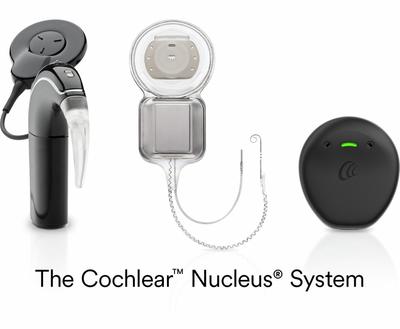
“The Cochlear Nucleus system was FDA-approved for single-sided deafness in January 2022, expanding eligibility to about 60,000 US adults per year. Newer Nexa versions have updatable firmware and Auracast built in.”
Where to actually go
Not every ENT is a cochlear implant surgeon and not every hospital runs a program. The workup requires audiology testing that is more specialized than a regular hearing test, and the surgery is done at established centers. Four of the largest and most-published adult programs in the US are the Johns Hopkins Cochlear Implant Center in Baltimore (formerly known as The Listening Center, founded 1991), the Vanderbilt Bill Wilkerson Center in Nashville (Dr. René Gifford’s group, the largest program in the country at about 300 surgeries per year), the Washington University program in St. Louis (Dr. Craig Buchman), and the NYU Langone program in New York. There are also strong regional programs at Iowa, UNC, University of Miami, Mass Eye and Ear, and dozens of academic medical centers. If you are within driving distance of a major academic ENT department, you are probably within driving distance of a cochlear implant program.
Insurance is generally straightforward for adults who meet criteria. The surgery is coded under CPT 69930 and the device under HCPCS L8614. Medicare covers cochlear implants for beneficiaries who meet the current 60 percent aided-speech-recognition threshold. Private insurers largely mirror the FDA criteria. Coverage varies on the periphery (rehabilitation therapy sessions, replacement sound processors down the line), so verifying benefits is worth doing before you schedule surgery.
The Livium take
The story of cochlear implants today is not a new device story. It is a referral story. The devices have been steadily better for a decade. The criteria expanded in 2022. What has not caught up is the practical clinical culture around when to route a patient from the hearing-aid track to the cochlear-implant track.
If you are a Livium reader who has been steadily turning up your hearing aid volume for the past three years, and speech in noise is a losing battle, and phone calls are the Charlie Brown teacher, that is the signal. Get evaluated at a cochlear implant center. If you or a family member had sudden hearing loss in one ear that never recovered (see the Livium article on sudden hearing loss), the same signal applies. If a parent has stopped calling because phone conversations are exhausting and the hearing aid did not fix it (see the article on the daily cognitive tax of unaddressed hearing loss), the referral is worth pursuing. The upstream benefit, as Buchman and multiple ACHIEVE-adjacent researchers keep pointing out, is that hearing loss is the single largest modifiable dementia risk factor at midlife. Restoring hearing is not just a quality-of-life move. It is a brain-health move.
The Livium recipe
The short version. If your hearing aid is no longer restoring speech clarity, ask for a cochlear implant candidacy evaluation. Do not wait until you cannot hear at all. Do not accept “you are not deaf enough” without a fresh workup against the current criteria. Bring the phrase “my aided speech recognition is not 60 percent” to the appointment if you want to sound like you already know the criteria.
Plan of action
- If your hearing aid is not delivering speech clarity anymore, request an audiogram and an aided speech-recognition test from an audiologist. These are the numbers a cochlear implant candidacy evaluation is built around.
- Ask your ENT or audiologist for a referral to a cochlear implant program. If they hesitate, name one directly (Johns Hopkins, Vanderbilt, WashU, NYU Langone, Iowa, UNC, Miami, Mass Eye and Ear are all strong).
- If a family member has single-sided deafness after a sudden hearing loss event and never got back the affected ear, they are now FDA-eligible. This is a real conversation worth having with them.
- If hearing aids are still working and are just not maximally effective, the OTC hearing aids buyer’s guide and the assistive tech article (Auracast, captioning glasses, broadcast microphones) may deliver the last bit of function before considering the surgical route.
Table of Content

Know your body better.
Trusted By Thousands Daily



Am I too old for a cochlear implant?
Very unlikely. Adults in their 80s and 90s are routinely implanted. What matters is general health for the outpatient surgery (about an hour, general anesthesia) and cognitive engagement for the auditory rehabilitation phase. If a candidate can tolerate other outpatient procedures at their age, they can tolerate this one. The rehabilitation is the harder part, and it is easier when there is family support and daily practice. Age has moved from being a reason to say no to being a factor in program planning.
Will I be able to enjoy music again?
Honest answer. Music through a cochlear implant is not the same as music through natural hearing. The signal encoding is optimized for speech and single-melody-line clarity, and complex layered music sometimes reads as flatter than it did with your original hearing. Newer implants and processing algorithms have narrowed the gap significantly, and many recipients report meaningful enjoyment of music after training. But if music was a central part of your identity and you are on the fence about implanting, ask the candidacy team specifically about music-listening outcomes. A hybrid electroacoustic implant, which preserves your residual low-frequency hearing, is often the right choice for a music-forward patient.
What happens to my "good" ear if I get an implant in my worse ear?
Nothing bad. The surgery is on the target ear only, and the other ear is unaffected. For single-sided deafness, this is the whole idea. You keep your natural hearing on the good side and gain an implanted hearing pathway on the deaf side. What returns is the ability to localize sound and to hear cleanly in noise, both of which require input from both sides of the head. Many patients describe the return of binaural hearing as the biggest quality-of-life change.
Legal Disclaimer
The content published on Livium Health is for informational and educational purposes only. Nothing on this site constitutes medical advice, diagnosis, or treatment. Always consult a qualified healthcare provider before making decisions about your health, including changes to medications, supplements, diet, or exercise.
Livium Health is not a medical practice and does not have a patient-provider relationship with its readers. We do not sell supplements, medications, or treatments, and we have no financial relationship with the products or services we reference.
While we work to ensure the information we publish is accurate and up to date, health and medical guidance evolves. We make no guarantees about the completeness or currency of any content on this site. Reliance on any information provided by Livium Health is solely at your own risk.
If you are experiencing a medical emergency, call 911 or your local emergency services immediately.
We may receive compensation, free products, or affiliate commissions for products mentioned in this post. Opinions are our own.