
Share
Longevity & Aging
Men's Health
Women's Health
Beyond the hearing aid: The assistive tech nobody told you about
8 min read
Key takeaways
- Meta shipped captioning glasses in September 2025. Ray-Ban Display at $799 puts live subtitles directly in the lens as people talk. This is a mainstream consumer product that also happens to be a working assistive-hearing device.
- Auracast is a new Bluetooth broadcast standard rolling out in airports, theaters, and public venues. It lets your hearing aid or earbud tap into an announcement or a movie soundtrack at broadcast quality, with no pairing. If you are shopping for hearing aids in 2026 or later, this is the spec to check.
- Two big cochlear implant events. Cochlear’s Nucleus Nexa system (2025) is the first smart CI with updatable firmware and Auracast. Envoy Medical’s Acclaim, the first fully implantable cochlear implant with no external processor, finished pivotal-trial enrollment in March 2026 with an FDA submission pending.
Start with what is free
Before you buy anything, use what you already have. On iPhone, turn on Apple Live Captions under Settings > Accessibility > Live Captions. On Android, do the same for Google Live Transcribe. Both are free, run on-device, and caption anything the phone can hear (video calls, in-person conversations, streaming media). For meetings and higher-stakes conversations, Ava is the accessibility-first app of choice with a hybrid AI-plus-human service that delivers about 99 percent accuracy. Otter’s OtterPilot is the corporate standard for Zoom, Teams, and Google Meet.
If those tools land in the environments you struggle with, you know a hardware upgrade will pay off. The categories below are the upgrades. If you have not caught the earlier launch pieces on OTC hearing aids, AirPods Pro as a hearing aid, or hidden hearing loss, start there. This piece covers everything else.
Captioning glasses put subtitles in the lens
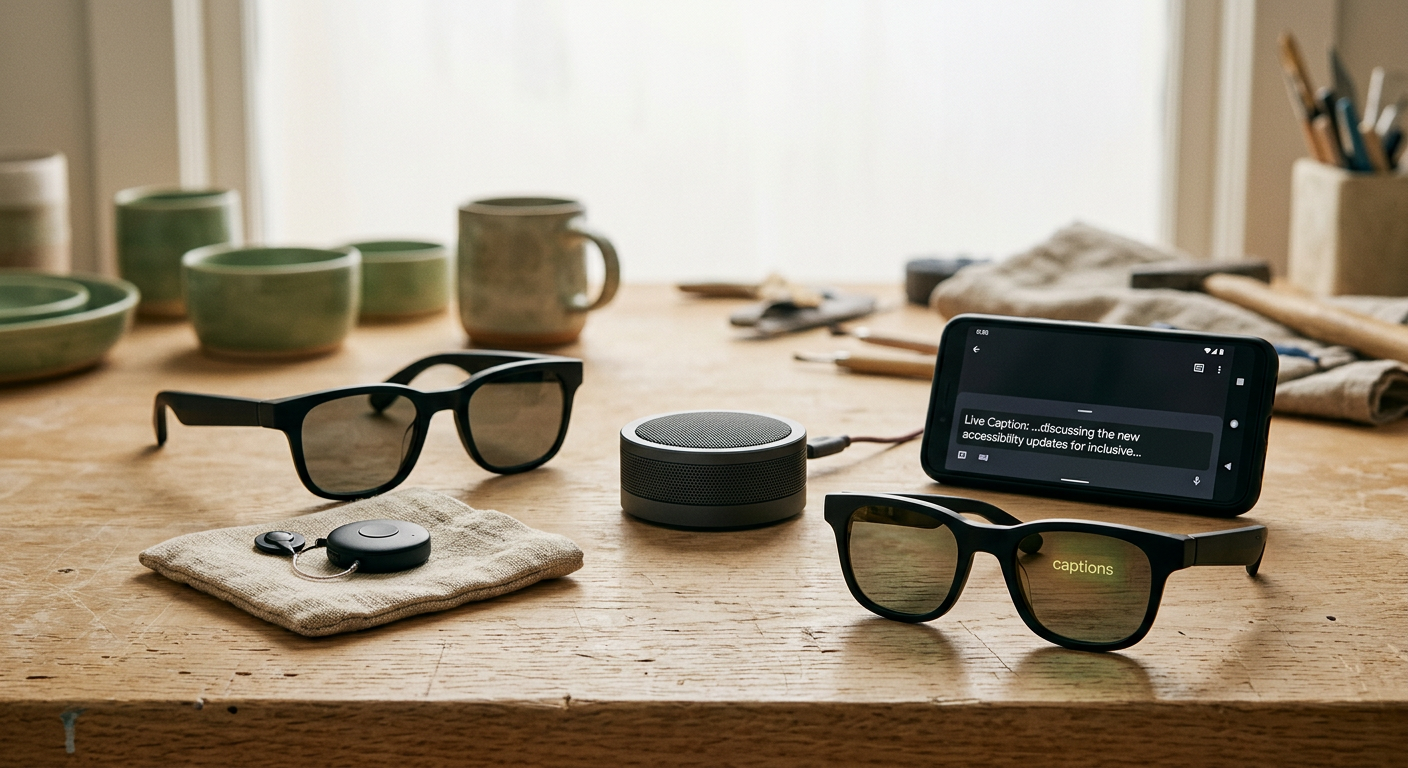
The biggest launch of the year in this space is Meta Ray-Ban Display. Meta shipped these on September 30, 2025 at $799. They look like Ray-Bans. The right lens has a small display. When someone talks to you, live captions appear directly in the lens. Real-time translation across four languages. Phone-call captions arrived in a February 2026 update. A mainstream product from Meta is a working assistive-hearing device in a Ray-Ban wrapper. This is genuinely new.
Three accessibility-focused competitors are shipping alongside. XRAI Glass is a captioning-glasses platform that works with third-party AR glasses. Xander ships standalone offline-first captioning glasses built on the Vuzix Shield hardware, with a privacy-first design. TranscribeGlass is a Stanford-founded startup that ships a transparent-display captioning device. Hearing Tracker’s roundup is the buying guide worth reading.
Auracast is the biggest hearing-accessibility upgrade in 50 years
Auracast is a Bluetooth broadcast standard. In plain terms, it lets an airport gate, a theater, a lecture hall, or a house of worship broadcast its audio directly to any compatible hearing aid, cochlear implant, or earbud in range. No pairing. No knob. No adapter. The single hardest listening environment for anyone with hearing loss (public spaces with background noise and PA announcements) is being systematically solved.
Frankfurt Airport already deployed Auracast in 2026. Major US airports are running pilots. Some concert venues and houses of worship have quietly wired it in. The Hearing Loss Association of America tracks deployments and pushes venue adoption. Practically, if you are shopping for hearing aids in 2026 or later, Auracast compatibility is a spec to verify. Most new hearing aids from ReSound, Cochlear, Phonak, Widex, and Starkey either ship with it or will get it via firmware update.
The cochlear implant quietly became a smart device
Cochlear implants are for severe-to-profound hearing loss, not most Livium readers directly. But the category matters because the pace of change matters. In 2025, Cochlear launched the Nucleus Nexa system as the world’s first smart cochlear implant. The implant itself has updatable firmware, so future audio-processing improvements can be pushed without another surgery. Auracast is built in. Two processor form factors are offered, a behind-the-ear version and a button-style off-the-ear version that sits over the implant magnet with nothing over the ear.
The bleeding-edge story is Envoy Medical’s Acclaim, the first fully implantable cochlear implant. No external processor. No magnet on the scalp. Nothing behind the ear. Pivotal trial enrollment completed with all 56 patients activated by April 2026, and Envoy is now collecting 12-month follow-up data for a Premarket Approval submission to the FDA. If approvals go as planned, US market availability could land in late 2027 or 2028. The trajectory is the same one pacemakers went through in the 1980s and 1990s. External to partially implanted to fully implanted, with the device becoming essentially invisible.
Bone conduction implants for the narrower use case
This one applies to a specific population most readers have never heard of. Bone conduction systems bypass the outer and middle ear and transmit sound as vibration through the skull directly to the cochlea. They work for people with conductive hearing loss (chronic ear infections, malformations) and for single-sided deafness after sudden loss or surgery. Cochlear’s Osia system is the current bleeding edge, an active osseointegrated implant that sits fully under the skin with piezoelectric stimulation. If a family member has developed sudden hearing loss in one ear or has a lifelong conductive loss, this is a real solve most general audiologists do not proactively raise.
Personal broadcast microphones (the underused hack for hearing aid users)
Most hearing aid users would benefit from a broadcast microphone and do not know they exist. These are small devices (about the size of a large lapel pin or a hockey puck) that a user hands to their spouse across the dinner table, places at a lecture, or clips on a presenter. The microphone captures speech at the source and streams it directly to the hearing aids at broadcast quality, cutting through background noise. Phonak Roger On is the market leader. Widex Sound Assist is a strong competitor that also acts as a partner mic, Bluetooth streamer, and telecoil bridge in one palm-sized unit. If a parent or grandparent wears hearing aids and has given up on family dinners, one of these is often more life-changing than a hearing aid upgrade.
The device landscape at a glance
Seven categories. Livium’s read on who each applies to and what it costs. This table is the answer if you only remember one thing from the piece.
| Category | Lead product | Who it is for | Price |
|---|---|---|---|
| Captioning glasses | Meta Ray-Ban Display | Anyone who wants live captions in the lens | $799 |
| Auracast broadcast | Any Auracast-ready hearing aid or earbud | Public spaces with PA announcements | Free at venue |
| Smart cochlear implant | Cochlear Nucleus Nexa | Cochlear implant candidates | Insurance |
| Fully implantable CI | Envoy Medical Acclaim | Severe-to-profound loss, no external processor wanted | Pending PMA |
| Bone conduction implant | Cochlear Osia | Conductive loss, single-sided deafness | Insurance |
| Broadcast microphone | Phonak Roger On, Widex Sound Assist | Hearing aid users in noise | $700-$1300 |
| Free captioning apps | Apple Live Captions, Google Live Transcribe, Ava | Every reader with a smartphone | Free |
Source: Livium editorial synthesis. Prices are approximate US retail as of July 2026 and vary by fitting, insurance, and channel.
The Livium take
The hearing aid is not the whole toolkit anymore. It is the anchor. Around it sit captioning glasses that look like Ray-Bans, a Bluetooth broadcast standard that turns airports into hearing-friendly spaces, cochlear implants that will soon be invisible, and a stack of free captioning apps sitting on the phone in your pocket. The look-based stigma argument is running out. The awkward-in-noisy-restaurants argument has a $700 answer. The nothing-for-severe-loss argument has an FDA submission pending. This is quietly the best moment in the history of consumer hearing accessibility.
Two anchor points. First, the hearing-dementia link piece is why acting matters at midlife regardless of pipeline news. Second, the gene therapy piece from earlier in the launch is the drug side of the future. This piece is the hardware side. They run together.
The Livium recipe
Tool. Turn on Apple Live Captions or Google Live Transcribe today. Test them in the environments you struggle in. If they land, consider Meta Ray-Ban Display for a mainstream captioning-glasses layer. If you already wear hearing aids, ask your audiologist about a Phonak Roger On or Widex Sound Assist. If you are shopping for new hearing aids in 2026, verify Auracast compatibility.
Behavior. Update the mental model. The hearing aid is the anchor, not the whole toolkit. Every hard listening environment now has a purpose-built tool that can help. Try one at a time in the setting you struggle in most.
Threshold. For a captioning glasses layer, the threshold is avoiding social settings or work meetings because you cannot follow conversations. For a broadcast microphone, the threshold is wearing hearing aids and still struggling in noisy environments you can name. For a fully implantable cochlear implant, the threshold is severe-to-profound loss plus willingness to be an early adopter of a device that is not yet FDA-approved.
Plan of action
- Turn on the free captions on your phone this week. Apple Live Captions or Google Live Transcribe.
- If you or a family member is not ready for hearing aids and wants captions available in daily life, look at Meta Ray-Ban Display ($799 mainstream) or the accessibility-focused platforms (XRAI, Xander, TranscribeGlass). Hearing Tracker’s roundup is the buying guide.
- If you already wear hearing aids and struggle in noisy settings, ask your audiologist about a broadcast microphone (Roger On or Widex Sound Assist). If you are shopping for new hearing aids, verify Auracast compatibility.
- For cochlear implant candidates, ask your surgeon about the Cochlear Nucleus Nexa system (available now, Auracast built in) and about the Envoy Medical Acclaim (FDA submission pending). For conductive or single-sided loss, ask about the Cochlear Osia.
- Support the infrastructure. The Hearing Loss Association of America is the leading US advocacy organization pushing venue Auracast adoption. Donations to the Hearing Health Foundation fund the research pipeline.
- Read more of our articles on hearing. The hearing-dementia link piece frames the stakes. The OTC hearing aids buyer’s guide, the AirPods Pro deep dive, the Lenire tinnitus piece, the hidden hearing loss piece, and the gene therapy piece round out the picture.
Table of Content

Know your body better.
Trusted By Thousands Daily





Do Meta Ray-Ban Display glasses replace hearing aids?
No, and Meta does not claim they do. They put captions in the lens. For someone with mild loss who is not ready for hearing aids, they can substitute in specific situations. For moderate or severe loss, they complement hearing aids. Think of the glasses as a display, not an amplifier.
What is the difference between Auracast and a hearing loop?
Both broadcast audio from a venue to a listener’s hearing device. Hearing loops (installed since the 1970s) use an electromagnetic field and require a hearing aid with a telecoil. Auracast (2022 standard) uses Bluetooth LE Audio and works with any modern LE-Audio-compatible receiver (hearing aid, cochlear implant, earbud, or smartphone). Auracast has higher audio quality and supports more languages in the same venue. Both will coexist for the next decade.
Is the Envoy Medical Acclaim available now?
Not yet. Envoy holds an FDA Breakthrough Device Designation. Pivotal trial enrollment completed in March 2026 with all patients activated by late April 2026. Envoy is collecting 12-month follow-up data for a Premarket Approval submission. General commercial availability could land in late 2027 or 2028. Candidates should ask their ENT about clinical-trial or expanded-access eligibility.
Legal Disclaimer
The content published on Livium Health is for informational and educational purposes only. Nothing on this site constitutes medical advice, diagnosis, or treatment. Always consult a qualified healthcare provider before making decisions about your health, including changes to medications, supplements, diet, or exercise.
Livium Health is not a medical practice and does not have a patient-provider relationship with its readers. We do not sell supplements, medications, or treatments, and we have no financial relationship with the products or services we reference.
While we work to ensure the information we publish is accurate and up to date, health and medical guidance evolves. We make no guarantees about the completeness or currency of any content on this site. Reliance on any information provided by Livium Health is solely at your own risk.
If you are experiencing a medical emergency, call 911 or your local emergency services immediately.
We may receive compensation, free products, or affiliate commissions for products mentioned in this post. Opinions are our own.