
Share
Men's Health
Sleep
Women's Health
Zepbound for sleep apnea: The first FDA-approved drug for OSA isn’t a sleep drug
9 min read
Key takeaways
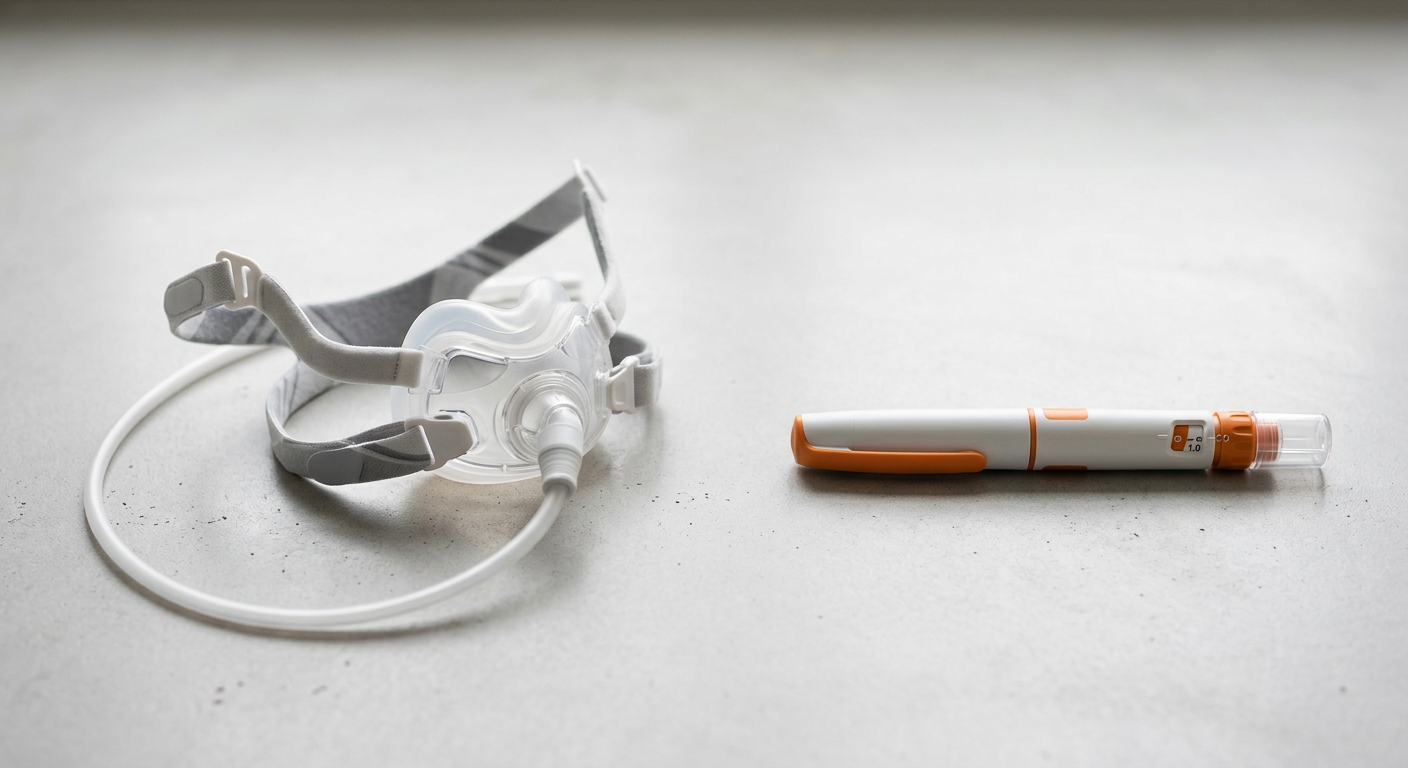
- In December 2024, the FDA approved tirzepatide (Zepbound) for moderate-to-severe obstructive sleep apnea in adults with obesity. It is the first non-CPAP, non-surgical drug ever approved for OSA, and the biggest change in sleep medicine in forty years.
- The mechanism is not direct sedation or airway support. Tirzepatide drives weight loss (about 20 percent over a year in trials), which reduces fat around the upper airway and abdomen. Less fat in those places means less collapse during sleep and easier diaphragm work. The drug treats the cause; CPAP treats the symptom.
- In the SURMOUNT-OSA Phase 3 trials, about half of participants on tirzepatide saw their OSA drop from moderate-to-severe down to mild or no OSA at all, after 52 weeks. CPAP still wins on speed (works night one). Zepbound wins on the question of whether you still need a machine in three years.
- Eligibility is specific. BMI 30 or higher, moderate-to-severe OSA confirmed on a sleep study, no contraindications (personal or family history of medullary thyroid cancer or MEN 2). Cost is real ($1,000-1,400 monthly without insurance). Many insurers are updating coverage now that there is an OSA-specific indication.
Your sleep doctor just opened a drawer that did not exist last year.
For forty years, the only first-line answer for moderate-to-severe sleep apnea was a CPAP machine, worn every night, indefinitely. In December 2024, the FDA approved a second option. Tirzepatide, sold under the name Zepbound, became the first drug ever approved for obstructive sleep apnea in adults with obesity. CPAP is still the standard. It works the first night you use it, and it keeps working as long as you wear it. Zepbound does not replace it. It is a parallel choice for patients whose apnea is being driven by the 30 to 50 pounds they are carrying.
The news got smaller coverage than it deserved. Most people heard about Zepbound as a weight-loss drug. It is the same molecule (tirzepatide) that Eli Lilly sells under the name Mounjaro for type 2 diabetes. What most people missed is that the FDA approved Zepbound for sleep apnea specifically, based on two Phase 3 trials called SURMOUNT-OSA. That distinction matters for insurance. Many plans that did not cover Zepbound for weight loss are now writing policies for the OSA indication.
If you have not read the apnea piece, Sleep apnea after 40: when snoring is a longevity problem covers the basics. Who has it (about 25 percent of midlife men, around half that for women), and why untreated OSA is one of the biggest unaddressed cardiovascular and cognitive risks in adulthood. The short version. Your airway collapses during sleep, oxygen drops, your heart releases stress hormones, and you partially wake to breathe. Then it happens again, 30 to 60 times an hour. The downstream costs add up fast.
Why a weight-loss drug works on sleep apnea
The connection is not mysterious. Obesity drives a significant share of OSA cases through two related paths. Fat deposits in the soft tissues around the upper airway (tongue, soft palate, neck) physically narrow the breathing passage. When you fall asleep and your throat muscles relax, the already-narrow passage collapses more easily. Separately, abdominal fat presses up on the diaphragm and increases the work of breathing. Both effects get worse at night, when you are horizontal and your muscle tone drops.
Tirzepatide reduces both. It is a dual GIP and GLP-1 (glucose-dependent insulinotropic polypeptide and glucagon-like peptide-1) receptor agonist, which means it activates two appetite-suppressing and metabolic pathways at once. In the obesity trials (SURMOUNT-1 and SURMOUNT-3), participants lost about 20 percent of body weight over 72 weeks at the highest dose. In the SURMOUNT-OSA trials, the weight loss in patients with sleep apnea was similar, and the AHI (apnea-hypopnea index, the standard measure of OSA severity) dropped by roughly 50 percent over 52 weeks.
There is one more thing worth noticing. Tirzepatide also improves insulin sensitivity, which reduces some of the inflammation that makes airway tissue swell. So the drug is not only making the airway less crowded. It is also making it less inflamed. Two mechanisms, one weekly shot.
If you want the deeper read on how insulin sensitivity ties into all of this, Late dinners and bad sleep after 40: what a CGM actually shows you walks through the glucose-insulin-cortisol-sleep loop. The same dynamic that drives 2 AM cortisol wake-ups also drives some of the airway inflammation that makes OSA worse. Tirzepatide hits both ends of that loop.
CPAP and Zepbound, side by side
This is not a contest. CPAP is still the gold standard, and it works the first night you use it. Zepbound is a parallel tool for a specific patient. BMI 30 or higher, moderate-to-severe OSA, and willing to commit to a weekly injection and the metabolic changes that come with it. The right tool depends on the patient. Here is the comparison the conversation with your clinician should be built on.
| CPAP | Zepbound | |
|---|---|---|
| Approved for OSA | Standard since the 1980s | FDA-approved December 2024 (adults with obesity, moderate-to-severe OSA) |
| How it works | Positive air pressure forces the airway open while you sleep | Tirzepatide reduces body weight, lowering upper-airway fat and abdominal pressure on the diaphragm |
| Effective for | All OSA severities, regardless of weight | Moderate-to-severe OSA in adults with BMI 30 or higher |
| Time to effect | Immediate (night one) | Weeks to months as weight comes down |
| How you use it | Wear a mask connected to a machine, every night, indefinitely | One subcutaneous injection per week, dose-titrated up over weeks |
| Common side effects | Mask fit issues, dry mouth, claustrophobia, travel friction | Nausea, vomiting, diarrhea, constipation, especially during dose titration |
| Serious risks | Very few | Boxed warning for thyroid C-cell tumors; pancreatitis; gallbladder events; not for personal/family history of MTC or MEN 2 |
| Cost | $800-2,000 upfront plus supplies and replacement masks | $1,000-1,400 monthly without insurance; OSA approval is changing coverage |
| Stop when? | Indefinite use in most cases | Open question; weight loss often regained after stopping |
Source: Livium editorial synthesis based on the FDA approval announcement for tirzepatide for OSA (December 2024), the SURMOUNT-OSA Phase 3 trials (published in NEJM, 2024), the AASM Practice Guidelines, and the Sleep Foundation sleep apnea overview.
What you have probably already been told
If you have OSA, you have been told to use a CPAP. Maybe the doctor was direct about it; maybe a sleep tech walked you through mask fitting. Maybe you have used it consistently for years and your numbers look great. Or maybe you fought with it for six months and quietly stopped, like 30 to 50 percent of patients prescribed CPAP do. The conversation almost never opened with anything else.
Here is the Livium take. CPAP is the nightly workaround. It is a good workaround. The night you start using one, your AHI drops, your oxygen stabilizes, your cardiovascular risk profile improves. It works. But it works only while you are wearing it. The reason your airway collapses (anatomy, weight, or both) does not change just because the air is being forced through. Every morning when you take the mask off, you are back to the same airway you had before.
Zepbound is, for the right patient, the upstream fix. It does not force air through a collapsed airway. It changes the body so the airway does not collapse the same way. CPAP holds the door open every night with air pressure. Zepbound makes the door big enough that it stays open on its own. For an obese patient with moderate-to-severe OSA, this is the first real chance in 40 years to address the cause instead of compensating for it.
The Livium move is not to throw the CPAP away. It is to have the conversation. If you are CPAP-tolerant and your numbers are good, stay the course. If you are CPAP-intolerant, or if the prospect of needing a machine for the next 30 years bothers you, ask your sleep specialist about Zepbound. Most sleep doctors have not had this conversation with most of their patients yet. The approval is too new. You may need to bring it up first.
The Livium recipe
Tool. Confirm OSA first. A home sleep test from Lofta ($189) gives you the diagnosis and the severity grade you will need for any insurance conversation. If you are already diagnosed and have a recent AHI score, you have the data. Then full bloodwork through Function Health ($499 a year) to baseline A1c, fasting insulin, free testosterone, thyroid, and a lipid panel. For the meds themselves, the cleanest channel for Zepbound is Hims via telehealth, which can prescribe and ship without an in-person visit if you are eligible. If CPAP is the right call for you (CPAP-tolerant, lower BMI, anatomy doing more of the work than weight), Lofta’s ResMed AirSense 11 package is the standard.
Behavior. Whether you go CPAP, Zepbound, or both, the behavior layer matters as much as the tool. Caffeine cutoff at 2 PM (the standard Livium default; caffeine half-life is roughly 6 hours). Last meal 3 hours before bed. Last drink of alcohol 4 hours before bed, or none for 2 weeks as a test. Side sleeping reduces airway collapse versus back sleeping. If you snore on your back, train yourself to sleep on your side. A tennis ball sewn into the back of a sleep shirt is the cheapest hack. If you are starting Zepbound, the GI side effects during dose titration are real. Eat smaller meals, drink water, and do not lie down within 90 minutes of eating.
Threshold. 12 weeks for an initial Zepbound trial, with a follow-up sleep study at 6 to 12 months to confirm AHI improvement. The targets. 5 to 10 percent body weight loss by week 12, 15 percent or more by week 52. AHI down to the mild range (under 15 events per hour) or resolved. Daytime sleepiness scores noticeably better. If those targets are landing, keep going. If body weight is not moving by week 12 despite consistent dosing, talk to your prescriber about a dose change. The other question is whether your OSA driver is more anatomical than metabolic. If the answer is anatomical, CPAP or surgical options like Inspire become the conversation.
Plan of action
- This week: if you have not been formally diagnosed, order a home sleep test from Lofta ($189). Without an AHI score in hand, no Zepbound prescription, no CPAP, no surgical option.
- This week: order full bloodwork through Function Health (A1c, fasting insulin, thyroid, lipid panel, basic metabolic panel). Zepbound eligibility includes checking for contraindications; bloodwork makes the prescribing visit short.
- If diagnosed with moderate-to-severe OSA and BMI 30 or higher: talk to your sleep specialist about Zepbound. If your sleep specialist is unfamiliar with the December 2024 FDA approval, that is increasingly common. Bring the SURMOUNT-OSA trial up by name.
- For telehealth Zepbound prescription if eligible: Hims Kwikpen path. The Hims sleep team can also handle the CPAP-or-Zepbound conversation through Hims sleep care.
- If you are not a Zepbound candidate (BMI under 30, low-tolerance for GI side effects, or other contraindication): CPAP is still the gold standard. Lofta’s ResMed AirSense 11 package is the cleanest path.
- Months 1 to 3 on Zepbound: dose titration phase (2.5 mg per week, escalating). Expect GI side effects. Track weight and sleep quality. Most patients see early sleep improvements within 4 to 6 weeks even before significant weight loss.
- Month 6 to 12: follow-up sleep study to measure AHI change. This is the data that determines whether Zepbound has resolved your OSA, partially resolved it, or stalled. Bring the result to your next prescriber visit.
- Behavior baseline through the entire timeline: caffeine cutoff at 2 PM, last meal 3 hours before bed, alcohol moderation, side sleeping. These work whether you are on Zepbound, CPAP, both, or neither. See Sleep meds in 2026: what works, what’s habit-forming, what’s new for the broader behavior-first protocol.
Table of Content

Know your body better.
Trusted By Thousands Daily





Can I take Zepbound if I do not have OSA, just to improve my sleep?
Off-label use of Zepbound is happening, but the FDA approval for sleep apnea is specifically for adults with obesity (BMI 30 or higher) AND moderate-to-severe OSA. Many insurers will only cover Zepbound for the OSA indication if you have a documented sleep study. If you do not meet those criteria, the conversation with a prescriber is different, and the path is usually obesity-only (Zepbound for weight management) or diabetes (Mounjaro). Neither is OSA-specific, and neither carries the same coverage profile.
Is Zepbound the same as Ozempic or Mounjaro?
Zepbound and Mounjaro are both tirzepatide (a dual GIP/GLP-1 agonist), made by Eli Lilly. Zepbound is the brand name for the obesity and OSA indications. Mounjaro is the brand name for type 2 diabetes. Same molecule, different label. Ozempic and Wegovy are semaglutide (GLP-1 only), made by Novo Nordisk. Neither Ozempic nor Wegovy is currently FDA-approved for OSA. The SURMOUNT-OSA trial used tirzepatide specifically, and the FDA approval is specific to tirzepatide. Semaglutide may eventually get an OSA indication, but it is not there yet.
Will my insurance cover Zepbound for OSA?
Coverage is changing fast. Many insurers that have not covered GLP-1s for weight loss are updating policies for the new OSA indication. Medicare has been more restrictive on GLP-1s in general, but the OSA-specific indication is starting to crack that pattern. The practical move is to have your prescriber submit for the OSA indication specifically (with the sleep study attached) rather than for weight loss. Ask your insurance directly: ‘Is Zepbound covered for moderate-to-severe obstructive sleep apnea with a documented sleep study?’ The answer is increasingly yes, even from insurers that say no to GLP-1s for obesity.
Do I still need CPAP if I start Zepbound?
In the early months, yes. The weight loss takes time, the airway remodeling takes longer, and the SURMOUNT-OSA protocol kept many participants on CPAP through the trial. Most sleep specialists are recommending continued CPAP use while Zepbound takes effect, with a follow-up sleep study at 6 to 12 months to see whether CPAP can be stepped down or stopped. The honest answer for most patients is to bridge with CPAP, follow up with a sleep study, then decide. Stopping CPAP cold-turkey on day one of Zepbound is not the move.
What happens if I stop Zepbound?
The hard part of the GLP-1 story. Stopping the medication usually means regaining some or all of the weight, and the OSA risk profile tracks the weight back up. This is the open question of the whole class: is Zepbound a maintenance medication you take indefinitely, like a statin, or a kickstart to a sustainable behavior change? The honest answer for most patients is somewhere in the middle. Plan for at least 12 to 24 months on the drug to fully remodel the airway and stabilize the metabolic gains. Some patients can taper or stop after that with behavior changes holding the gains; many cannot. This is a real long-term decision and worth having with your clinician up front, not after the fact.
Should I just lose weight on my own first?
If you can lose 10 to 15 percent of body weight through behavior alone, your OSA likely improves significantly and you may not need either Zepbound or CPAP. That is the gold-standard answer. The reality for most adults with obesity-driven OSA is that behavior alone has not been sufficient (or you would not have the diagnosis), and the metabolic disadvantage that comes with age and insulin resistance makes the next 30 pounds harder than the last 30. Zepbound is not failure; it is a tool. The same diet and exercise behaviors still matter alongside it, and they matter more after, when you are trying to hold the loss.
When should I see a sleep specialist, not just my primary care doctor?
If you have moderate-to-severe OSA (AHI of 15 or higher), if CPAP is not working for you, if you want to discuss Zepbound or any of the newer interventions, or if your symptoms are not matching your numbers. Most primary care doctors are not yet up to speed on the December 2024 Zepbound for OSA approval. A board-certified sleep specialist is the right person to manage the conversation.
Legal Disclaimer
The content published on Livium Health is for informational and educational purposes only. Nothing on this site constitutes medical advice, diagnosis, or treatment. Always consult a qualified healthcare provider before making decisions about your health, including changes to medications, supplements, diet, or exercise.
Livium Health is not a medical practice and does not have a patient-provider relationship with its readers. We do not sell supplements, medications, or treatments, and we have no financial relationship with the products or services we reference.
While we work to ensure the information we publish is accurate and up to date, health and medical guidance evolves. We make no guarantees about the completeness or currency of any content on this site. Reliance on any information provided by Livium Health is solely at your own risk.
If you are experiencing a medical emergency, call 911 or your local emergency services immediately.
We may receive compensation, free products, or affiliate commissions for products mentioned in this post. Opinions are our own.