
Share
Men's Health
Sleep
Women's Health
Sleep meds in 2026: What works, what’s habit-forming, what’s new
11 min read
Key takeways
- Sleep meds split into six classes. Three of them are the right tools for the right job (DORAs, low-dose doxepin, trazodone off-label). Three are mostly the wrong tool for adults over 40 (Z-drugs long-term, Benadryl/diphenhydramine, melatonin at OTC doses). Most readers are using the wrong one.
- DORAs (dual orexin receptor antagonists: Quviviq, Dayvigo, Belsomra) are the newer class. They block the wake signal instead of forcing the off switch with a brain-wide sedative. Cleaner side-effect profile, no rebound insomnia, low dependence risk. The right starting point for most midlife sleep maintenance issues.
- Diphenhydramine (Benadryl, ZzzQuil, Unisom) is associated with increased dementia risk when used long-term after 50. Occasional use is fine. Nightly use for years is not.
- Most OTC melatonin bottles contain 3 to 10 mg per dose, which is 3 to 10 times more than research supports for adults. The right dose is 0.3 to 1 mg, taken 1 to 2 hours before bed, mostly useful for jet lag and shift changes. As a general sleep aid for adults with normal melatonin levels, the data is underwhelming.
- The Livium move: pair the right med (or no med) with the right diagnostic and the right behavior. Meds are a bridge, not a destination. If you still need the pill at 6 weeks, the underlying variable has not been solved.
It is 10:43 PM. You took the wrong thing.
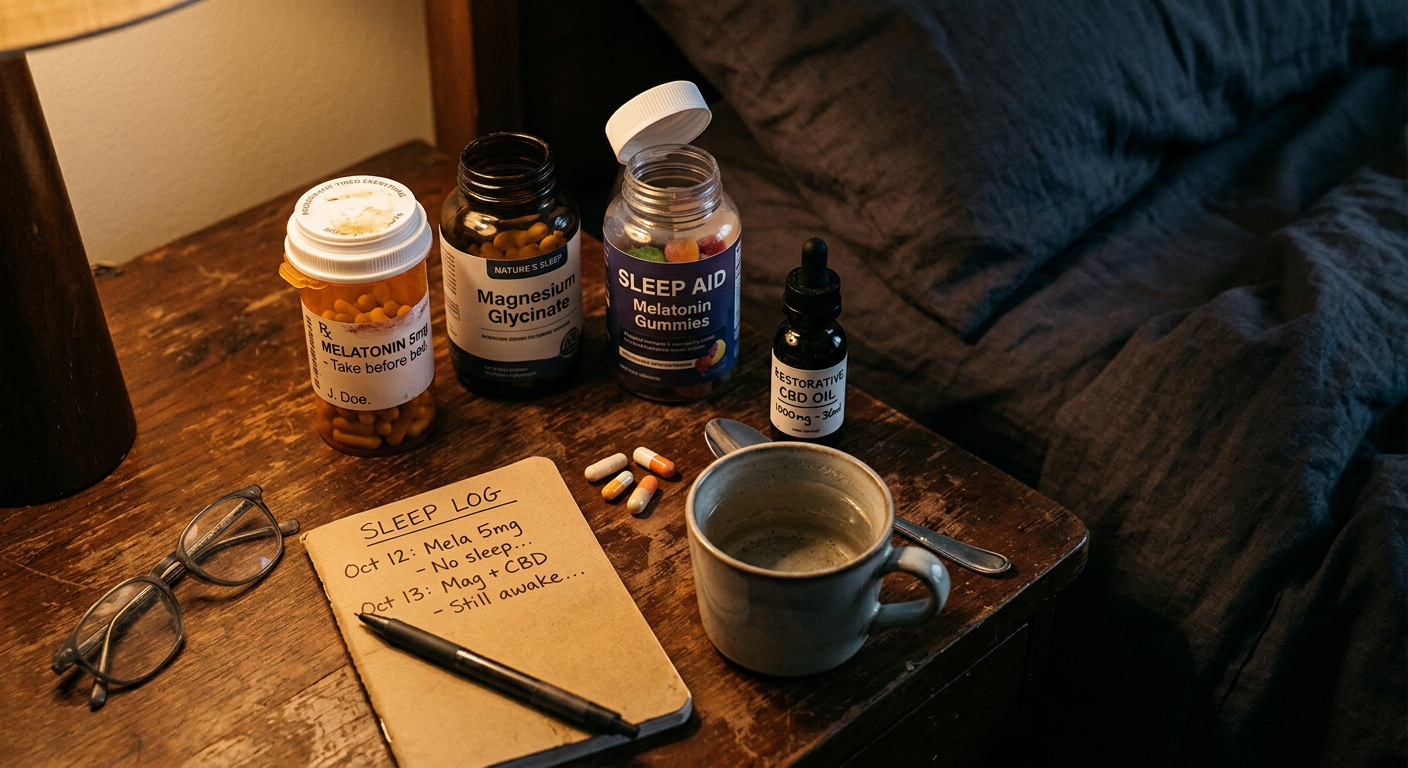
Maybe it was a 10 mg melatonin gummy. Maybe a Benadryl, since you read once that it helps with sleep. Maybe an Ambien left over from last summer’s trip to Tokyo. Maybe two glasses of wine, which you have stopped pretending is sleep medicine but which is functioning as sleep medicine. Whatever it was, the next morning you wake up feeling like your head is in a paper bag, and the night before is a low-resolution memory of unconsciousness, not sleep.
The sleep medication conversation is full of bad defaults. Most prescriptions for chronic insomnia get written for drugs the American Academy of Sleep Medicine (AASM) explicitly downgraded in its current guidelines. Most OTC sleep aids are doses 3 to 10 times above what the research supports. And the newer class of meds that actually solve the problem, dual orexin receptor antagonists (DORAs), most readers have never heard of.
Per the AASM Practice Guidelines, treatment of chronic insomnia in adults has shifted hard since 2017, with new combination-therapy guidance published in 2025 that puts targeted pharmacology alongside cognitive behavioral therapy for insomnia (CBT-I) as the standard of care. The supplement aisle and the leftover prescription bottle in your drawer are both behind by a decade. This article is the map.
Six classes. Most readers know two.
Pharmacology for sleep splits into six families. Each one acts on a different part of the brain. Knowing which is which is the difference between fixing a problem and accidentally creating a new one.
Dual orexin receptor antagonists (DORAs) are the newest class. Three drugs are FDA-approved: Belsomra (suvorexant, 2014), Dayvigo (lemborexant, 2019), and Quviviq (daridorexant, 2022). They work by blocking orexin, the wake-promoting neuropeptide in your brain. Instead of brute-force sedation, they remove the signal that tells you to stay awake. The result is sleep that looks more like normal sleep on a study, with less morning grogginess and far less dependence risk. Quviviq has the shortest half-life of the three, which means the cleanest morning. For adults over 40 with sleep maintenance issues, this is the class to know.
Low-dose doxepin (Silenor, 3 to 6 mg) is technically a tricyclic antidepressant, but at this low dose it only acts on histamine receptors involved in sleep maintenance. FDA-approved in 2010 specifically for staying asleep. No dependence. Minimal anticholinergic burden at this dose. Underused by most prescribers because the dose seems too small to do anything, but the data is strong for the right reader: light sleepers who fall asleep fine but wake up at 3 AM.
Trazodone is an older antidepressant prescribed off-label at low dose (25 to 100 mg) for sleep maintenance. Cheap, generic, widely used. The AASM 2017 guideline actually recommends against it for chronic insomnia, but most primary care physicians still write it because it works for many people, has a long track record, and does not have dependence risk. Real-world useful, formally underwhelming.
Z-drugs are the old guard of sleep prescriptions: Ambien (zolpidem) and Lunesta (eszopiclone). They activate the GABA-A receptor, which is the same site benzodiazepines target. Effective for falling asleep. Risky for everything else. Side effects include sleepwalking, sleep-driving, sleep-eating (the FDA added a boxed warning in 2019), dependence with chronic use, and severe rebound insomnia on withdrawal. The AASM rates them as weak recommendations FOR short-term use only. Most readers using them nightly should not be.
Antihistamines (diphenhydramine in Benadryl and ZzzQuil, doxylamine in Unisom) are the OTC default. The sedation is a side effect of blocking histamine, which the brain uses for both immune signaling and wake-promotion. Two problems. First, tolerance builds in days. Second, long-term use carries a serious cognitive cost.
A landmark JAMA Internal Medicine study (Gray et al., 2015) found that cumulative exposure to strong anticholinergic medications (diphenhydramine is the most commonly used one) was associated with a higher risk of dementia in older adults. The risk is dose- and duration-dependent. Occasional use is fine. Years of nightly Benadryl after 50 is not.
Melatonin and supplements are the last family. Melatonin is a hormone your pineal gland releases in response to darkness; supplementing it can shift your circadian phase (helpful for jet lag, shift work) but does not work like a sedative. The right adult dose is 0.3 to 1 mg, taken 1 to 2 hours before bed. Most OTC products contain 3 to 10 mg, which overshoots receptors and can cause vivid dreams, morning grogginess, and (over time) reduced endogenous production. Quality varies wildly in unregulated OTC products. Magnesium glycinate (300 to 400 mg before bed) has the best supplement evidence, mostly for muscle relaxation and a modest sleep effect. L-theanine, glycine, and ashwagandha have modest but real data. Cannabinoids (low-dose THC for onset, CBN/CBD for stress-related sleep) exist in a quality-unregulated middle ground.
What you have probably already tried
You took melatonin. You took Benadryl on top of melatonin. You tried magnesium. You had a glass of wine. You took half an Ambien that your friend gave you. You added L-theanine. None of it worked the way you wanted. Or it worked one night, then stopped.
Here is the Livium take. Most over-the-counter sleep aids and old-guard prescriptions are tripping the main breaker. The lights go off. So does the fridge, and the heat, and the smoke detector. You wake up unconscious but not rested, and the side effects (morning fog, memory issues, dependence, dementia risk over years) are the breaker doing what breakers do. The whole system shuts down because you blunted one signal too hard.
The DORAs and low-dose doxepin are the light switch in the bedroom. Targeted at the actual circuit that needs to flip, not the whole house. You go to sleep without taking your fridge offline. You wake up without a paper bag on your head. The reason these drugs were developed is that the old approach was treating sleep like an electrical problem when it is actually a signaling problem. Different tool. Different result.
This is what Livium is about: stop sledging your nervous system with a tool that turns everything off and start using the right circuit-level switch for the actual issue. Symptom-chasing with whatever is on the shelf is the long way around. Matching the med to the mechanism is the short way. And if no med matches your mechanism cleanly, the answer is a diagnosis, not a stronger sedative.
The Livium recipe
Tool. Two pieces of data before any med decision. First, a 2-week sleep journal: time you fall asleep, time you wake up in the night, how long it took to get back down, what you took, what you drank, what you ate after 7 PM. Two weeks of pattern reveals which sleep problem you actually have. Second, a full bloodwork panel through Function Health ($499 a year): TSH (thyroid, since hypothyroid mimics insomnia), cortisol, vitamin D, B12, ferritin, fasting glucose, A1c, and free testosterone. If snoring is in the picture, add a home sleep test from Lofta ($189). Apnea is a frequent root cause of “insomnia” that gets prescribed Ambien for years. For the meds themselves, the cleanest telehealth channel for the right prescriptions (low-dose doxepin, trazodone, DORAs when indicated) is Hims sleep care, which can prescribe and ship most of these without an in-person visit.
Behavior. Caffeine cutoff at 2 PM (the standard Livium default; caffeine half-life is roughly 6 hours). Last meal 3 hours before bed. Last drink of alcohol 4 hours before bed, or none for 2 weeks as a test. Hard lights-out at 10:30 PM for 2 weeks, regardless of whether you feel ready. The behavioral baseline matters more than any med, and most readers skip straight to pharmacology because behavior change is harder than swallowing a pill. The order is wrong. Behavior first, then targeted med if the gap is still there.
Threshold. 2 weeks of behavior baseline, then 4 to 6 weeks max on any sleep med while you solve the underlying variable. If you are still on the med at week 7 with no plan to taper, you have a sleep disorder, not an insomnia patch. Targets to hit before tapering: falling asleep within 20 minutes, fewer than 2 wake-ups over 30 minutes, waking before the alarm at least 3 days a week, and a morning where the first hour is functional. Once those land, taper. If they do not land in 6 weeks, the answer is more diagnosis, not more med.
The class map
Worth seeing them side by side. Some classes have the right risk profile for the wrong problem, and vice versa.
| Class | Examples | How it works | Habit-forming? | Best for | Watch out for |
|---|---|---|---|---|---|
| DORAs (newer) | Quviviq, Dayvigo, Belsomra | Blocks orexin (the wake signal) | Low | Trouble staying asleep, mid-life onset insomnia | Cost, insurance coverage |
| Low-dose doxepin | Silenor (3 to 6 mg) | Antihistamine at very low dose | No | Staying asleep, light sleepers | Morning grogginess in some users |
| Trazodone (off-label) | Generic, 25 to 100 mg | Antidepressant, sedating side effect | No | Sleep maintenance on a budget | AASM does NOT formally recommend; widely used anyway |
| Z-drugs | Ambien (zolpidem), Lunesta (eszopiclone) | GABA-A receptor activation | Yes, with rebound insomnia | Short-term sleep onset (under 4 weeks) | Parasomnias, dependence, FDA boxed warning |
| Antihistamines (OTC) | Benadryl, ZzzQuil (diphenhydramine), Unisom (doxylamine) | Blocks histamine, sedates as side effect | Tolerance in days; long-term cognitive risk | Occasional use only | Linked to higher dementia risk with long-term use after age 50 |
| Melatonin (OTC) | 0.3 to 1 mg appropriate; OTC bottles often 3 to 10 mg | Mimics the dim-light melatonin onset signal | No | Jet lag, shift work, circadian phase shift | Most OTC doses are 3 to 10x too high; quality varies wildly |
| Supplements | Magnesium glycinate, L-theanine, glycine, ashwagandha | Varies (relaxation, GABA support, cortisol modulation) | No | Adjunct support, not primary tool | Modest evidence; magnesium glycinate has the strongest |
| Cannabinoids | Low-dose THC, CBN, CBD | Acts on endocannabinoid receptors | THC yes (psychological) | Stress-related onset issues | THC suppresses REM; quality unregulated |
Source: Livium editorial synthesis based on the AASM Pharmacologic Treatment of Chronic Insomnia guideline, the AASM 2025 Combination Treatment of Chronic Insomnia guideline, and the Sleep Foundation insomnia treatment overview.
Which one for which problem
Sleep is not one problem. Falling asleep, staying asleep, waking too early, and waking too anxious are four different mechanisms with four different right answers. Pick the row that fits.
| Your problem | First-line | Second-line | Avoid |
|---|---|---|---|
| Can’t fall asleep | Magnesium glycinate, L-theanine, dim light by 10 PM | Low-dose THC (2 to 5 mg), Quviviq or another DORA | Ambien long-term, daily melatonin doses over 1 mg |
| Wake at 2 to 3 AM and can’t get back down | Rule out cortisol or glucose driver first | Low-dose doxepin (Silenor), DORA (Quviviq) | Z-drugs, Benadryl |
| Both: trouble falling and staying asleep | Sleep study to rule out apnea | DORA (Quviviq or Belsomra), CBT-I | Diphenhydramine, alcohol as a sleep aid |
| Jet lag or shift change | Melatonin 0.5 mg at target bedtime, bright light timing | DORA short-term | Daily melatonin at 5 to 10 mg doses |
| Anxiety-driven racing thoughts at bedtime | Magnesium glycinate, L-theanine, CBT for anxiety | Trazodone (off-label), low-dose doxepin | Z-drugs as anxiety mask |
| Stress and cortisol patterns | Ashwagandha, dialed-in wind-down ritual | Sleep study + bloodwork before adding a med | Ambien, Benadryl chronic use |
Source: Livium editorial mapping. Always confirm with a clinician before starting or stopping prescription medication.
Plan of action
- This week: start a 2-week sleep journal. Time-to-sleep, wake-ups, what you took, what you ate, last alcohol, last caffeine. Bring it to whatever appointment you book next.
- This week: order full bloodwork through Function Health (TSH, cortisol, vitamin D, B12, ferritin, fasting glucose, A1c, free testosterone). Sleep is downstream of these more often than people think.
- If you snore: order a home sleep test from Lofta ($189). Untreated apnea is the most common reason a prescribed sleep med stops working.
- Week 1 of the journal: behavior baseline. Caffeine cutoff at 2 PM. Last food 3 hours before bed. No alcohol. Lights-out at 10:30 PM. Magnesium glycinate 300 mg if you want a low-risk supplement to anchor the wind-down.
- Week 2 of the journal: hold the behavior, add or remove one variable. If the journal shows a clear pattern (carbs at 9 PM = 2 AM wake-up, or wine at any hour = fragmented sleep), the variable is environmental and the answer is not pharmacology.
- If the gap is still there at week 3 and the bloodwork is clean: book a telehealth visit with Hims to discuss low-dose doxepin (for staying asleep), trazodone (off-label, low-cost), or a DORA prescription (Quviviq is the current cleanest). Avoid asking for Ambien; the conversation should be about what mechanism the prescriber thinks is broken.
- Stop using Benadryl, ZzzQuil, and Unisom as nightly sleep aids. Switch to magnesium glycinate, low-dose doxepin (3 mg), or a DORA. The dementia association is enough to make the switch worth the effort.
- Cap melatonin at 0.5 mg if you use it. Use it 1 to 2 hours before bed, not at bedtime, and only for jet lag, shift changes, or genuine circadian phase issues.
- Re-evaluate at week 6 to 8. If you are still using the med daily with no plan, escalate the workup. A sleep specialist visit is the next step, not a different OTC bottle.
Table of Content

Know your body better.
Trusted By Thousands Daily




Should I take melatonin every night?
Probably not. Melatonin is best understood as a circadian-shifting tool, not a sedative. Daily use at OTC doses (3 to 10 mg) can reduce your own pineal production over time and is not what the molecule was designed to do. If you use it, use 0.3 to 1 mg, take it 1 to 2 hours before bed, and reserve it for jet lag or shift-work adjustment. For most midlife insomnia, the right answer is somewhere else on this list.
Is Ambien really that bad?
It is the right tool for very short-term use (3 to 5 nights to break a stress-induced acute insomnia, for example, or during a trip across 8 time zones). It is the wrong tool for chronic use. Dependence builds, rebound insomnia on withdrawal is real and brutal, and the parasomnia risk (sleepwalking, sleep-eating, sleep-driving) is high enough that the FDA added a boxed warning in 2019. If you are taking it nightly for more than a few weeks, the conversation with your prescriber should be about tapering and what replaces it.
What is the deal with the new DORAs (Quviviq, Belsomra, Dayvigo)?
They are the first sleep meds in 50 years to work on a different mechanism than GABA or histamine. Instead of forcing the brain into sedation, they block orexin, which is the wake-keeping signal. The result is sleep that looks more like real sleep, with less morning grogginess and far less dependence. The trade-offs: they are expensive (often $400 to $600 monthly without insurance), insurance coverage is improving but still patchy, and some users report unusually vivid dreams in the first few weeks. Quviviq has the shortest half-life, which usually means the cleanest morning. Worth asking your prescriber about if you have been on a Z-drug or Benadryl for more than 6 weeks.
Why does the AASM not recommend trazodone if everyone uses it?
The formal guideline is based on the strength of the randomized controlled trials, and the RCT (randomized controlled trial) data for trazodone in chronic insomnia is thin. That does not mean it does not work. It means it has not been studied at the same level as the FDA-approved insomnia drugs. In practice, trazodone is widely prescribed off-label because it is cheap, generic, non-habit-forming, and helps many people. If your prescriber suggests it, that is a real-world reasonable choice. Just know the formal evidence is weaker than for the DORAs or low-dose doxepin.
What about cannabis for sleep?
Low-dose THC (2 to 5 mg) helps many people fall asleep. It also suppresses REM (rapid eye movement) sleep, which is the dream-and-memory-consolidation stage. The morning-after feeling for most users is unrefreshing even after 7 to 8 hours of sleep. CBN and CBD have weaker evidence and are unregulated in quality. If you are using cannabis for sleep occasionally, it is a defensible choice for stress-related onset issues. Nightly is not, and the REM suppression compounds over months. The Livium take: cannabis is a sometimes-tool, not a system.
Can I just do CBT-I instead of meds?
Often yes. Cognitive Behavioral Therapy for Insomnia (CBT-I) is the AASM’s first-line treatment for chronic insomnia and it works for most people. The new 2025 AASM combination-treatment guideline supports CBT-I plus targeted pharmacology when behavior alone does not close the gap. CBT-I is available through several telehealth platforms now and through apps like Sleepio. If you have not tried it, it is the right starting point before a permanent prescription.
When should I see a sleep specialist instead of doing this myself?
If you snore loudly. If you stop breathing or gasp during the night (someone has to tell you). If you have leg movements that wake you or your partner. If you are sleeping 6 to 7 hours and still feel exhausted. If you fall asleep during the day involuntarily. Any of those points to a sleep disorder that needs a sleep study, not a sleep med. A home sleep test from Lofta is the cheapest first step. If it points at something, the sleep specialist is the next visit.
Legal Disclaimer
The content published on Livium Health is for informational and educational purposes only. Nothing on this site constitutes medical advice, diagnosis, or treatment. Always consult a qualified healthcare provider before making decisions about your health, including changes to medications, supplements, diet, or exercise.
Livium Health is not a medical practice and does not have a patient-provider relationship with its readers. We do not sell supplements, medications, or treatments, and we have no financial relationship with the products or services we reference.
While we work to ensure the information we publish is accurate and up to date, health and medical guidance evolves. We make no guarantees about the completeness or currency of any content on this site. Reliance on any information provided by Livium Health is solely at your own risk.
If you are experiencing a medical emergency, call 911 or your local emergency services immediately.
We may receive compensation, free products, or affiliate commissions for products mentioned in this post. Opinions are our own.