
Share
Men's Health
Sleep
Women's Health
Magnesium glycinate: The only sleep supplement that actually earns its shelf space
8 min read

Key takeaway
- Magnesium is the one sleep supplement with real evidence. Most adults over 40 are sub-clinically deficient, and most multivitamins contain a form (oxide) and a dose (25 mg) that does nothing. The form and dose matter more than the brand.
- Magnesium glycinate (also called bisglycinate) is the right form for sleep. Take 200 to 400 mg of elemental magnesium 30 to 60 minutes before bed. Read the elemental magnesium number on the label, not the total compound weight (those are different numbers, and most marketing leans on the bigger one).
- Magnesium oxide is in most cheap multivitamins because it is cheap and shelf-stable. It is also poorly absorbed (about 4 percent). If your supplement says ‘magnesium oxide,’ it is doing roughly what a sugar pill would do, with the side effect of occasional loose stool.
- The Livium move: pair magnesium glycinate with the rest of the recipe, not as a standalone. Magnesium works when stacked with sane caffeine cutoffs, last-meal timing, alcohol restraint, and a wind-down. It cannot rescue a 9 PM espresso.
It is 11:23 PM. You finally read the back of your multivitamin.
Twenty-five milligrams of magnesium, in the oxide form. You took it every day for three years and watched your sleep get worse. Here is the actual math. Magnesium oxide absorbs at about 4 percent. That 25 mg on the label translates to roughly 1 mg in your bloodstream. You were buying a label claim, not a supplement. The aisle told you the base was covered. The cheap form made sure it wasn’t.
Our take on supplements has been blunt. Most of them are noise. Saw palmetto runs even with placebo. Melatonin at 10 mg is three to ten times too much. Ashwagandha is modest at best. Sleep gummies with twelve ingredients are smoothies. We laid out the prescription side of this in Sleep meds in 2026: what works, what’s habit-forming, what’s new. This article is about the one supplement that is actually the exception. Magnesium. It works. But only if you take the right form, at the right dose, at the right time, on top of the right behaviors. Get any of those wrong and you are back to noise.
Per the NIH Office of Dietary Supplements, magnesium is involved in over 300 enzymatic reactions in the body, including the ones that regulate sleep onset, muscle relaxation, melatonin production, and the calming GABA pathway. Roughly half of US adults consume less than the recommended daily intake from food alone. After 40, absorption slows and excretion through urine increases, which compounds the gap. Most readers of this article have a deficit they have never tested for and a supplement that is not closing it.
Why magnesium for sleep, specifically
Magnesium does four things at night that matter.
It activates GABA-A receptors, the same calming pathway that Z-drugs target with brute force. Magnesium is much gentler and does not cause dependence. The mechanism is real, just slower and more diffuse. You do not feel knocked out. You feel less wound up.
It regulates melatonin synthesis. Your pineal gland needs magnesium as a cofactor to produce melatonin from serotonin. Low magnesium = blunted endogenous melatonin = harder to fall asleep on time. Supplementing magnesium fixes the upstream production rather than overriding the system with an exogenous dose.
It lowers cortisol response. Adequate magnesium dampens the stress-axis spike that wakes you up at 2 or 3 AM, the loop we walked through in Waking between 1 and 4 AM: the cortisol problem nobody calls cortisol. It will not cure cortisol dysregulation on its own, but it removes one of the amplifiers.
It relaxes skeletal muscle. The night-time leg cramps, the restless leg sensations, the tension across the shoulders that prevents you from settling, magnesium addresses all of those. Many readers who think they have insomnia actually have low-grade muscle tension that magnesium resolves within a week.
What you have probably already tried
You bought a multivitamin with magnesium in it. You added a sleep gummy with melatonin and L-theanine and chamomile and valerian root and lemon balm. You tried a magnesium spray that said “transdermal” on the bottle. You took a powder that you stirred into water before bed, with eight other ingredients you didn’t recognize. None of it moved the needle. Or it moved the needle once and then stopped.
Here is the Livium take. Most multi-ingredient sleep stack products are a decorative facade. The bottle looks serious. The label is dense. The price is high. Behind it, mostly nothing. Twelve ingredients at sub-therapeutic doses is twelve ingredients at sub-therapeutic doses, no matter how the bottle is designed. You are buying confidence in the form of dust.
Magnesium glycinate, at the right dose, is the load-bearing wall. Plain. Unfancy. Doing the actual work of holding the building up. It is the one sleep supplement with real science behind it, and the one most readers underuse. This is the Livium move: skip the show, take the thing that does the job, and put the rest of the budget toward behavior and diagnostics. Single ingredient, right form, right dose, right timing. That is the whole game.
One more clarifying note. Magnesium oxide is technically magnesium. Glass is technically transparent. Neither serves its intended purpose. The form on the label is the variable that matters most. Glycinate (or bisglycinate, same molecule), threonate, citrate, malate, and taurate are all reasonable forms for different jobs. Oxide is what cheap supplements use because it is cheap. If your bottle says oxide, you have a load-bearing wall made of styrofoam.
The Livium recipe
Tool. Magnesium glycinate (or bisglycinate, same compound, different naming convention) at 200 to 400 mg of elemental magnesium, taken 30 to 60 minutes before bed. The cleanest brand option is Thorne Magnesium Bisglycinate, which is NSF-certified and provides 200 mg of elemental magnesium per capsule. Other reputable supplement brands work too; the form on the label matters more than the brand name. Check for glycinate or bisglycinate, not oxide. Read the elemental magnesium number on the label, not the total compound weight. A bottle that says “1000 mg magnesium glycinate” might contain 140 mg of actual magnesium. The other 860 mg is glycine, which is fine on its own but does not count toward your magnesium dose. If you want to verify a deficiency before starting, Function Health ($499 per year) includes magnesium in its full panel. Serum magnesium is what most labs run; it only catches severe deficiency. RBC (red blood cell) magnesium is the better test if you can get it.
Behavior. Magnesium is the floor, not the ceiling. It works when stacked with the rest of the recipe. Caffeine cutoff at 2 PM (the standard Livium default; caffeine half-life is roughly 6 hours). Last meal 3 hours before bed. Last drink of alcohol 4 hours before bed, or none for 2 weeks as a test. Hard lights-out by 10:30 PM. Magnesium glycinate sits on top of those behaviors, not in place of them. If you take 400 mg of magnesium and then have a 9 PM espresso, the magnesium loses. The behaviors are first, the supplement is second, and you should be able to feel the difference within 7 to 14 nights.
Threshold. 2 weeks. If your sleep is meaningfully better in 14 nights, keep going. If not, increase to 400 mg elemental (some readers need the higher end), or stack with 100 to 200 mg of L-theanine 30 minutes before bed. If you are still not seeing change at 6 weeks despite consistent dosing and behavior, the issue is not magnesium deficiency, it is something downstream (apnea, cortisol, thyroid, low T, perimenopause, or one of the other variables this launch covers). Magnesium is the supplement that closes a real gap. It is not the supplement that compensates for the wrong workup.
The forms, side by side
Six forms dominate the shelf. Five of them have a job. The sixth is cheap filler. Picking the right one for the job is most of the difference between a supplement that works and one that does not.
| Form | Absorption | Best for | Dose (elemental Mg) | Watch out for |
|---|---|---|---|---|
| Glycinate / Bisglycinate | High | Sleep, anxiety, muscle relaxation | 200 to 400 mg, 30 to 60 min before bed | Mild grogginess in very sensitive users |
| Threonate (Magtein) | Crosses blood-brain barrier | Cognition, memory, mild sleep | 144 mg per serving (low elemental) | Expensive; not necessarily better than glycinate for sleep alone |
| Citrate | Decent | Constipation, mild sleep aid | 200 to 400 mg | Laxative effect at higher doses |
| Malate | Decent | Fatigue, fibromyalgia, daytime energy | 300 to 400 mg | Energy-promoting; better morning than night |
| Taurate | Decent | Cardiovascular support, modest sleep effect | 200 to 400 mg | Less data than glycinate |
| Oxide | Poor (~4%) | Cheap laxative | Avoid for sleep | The form in most cheap multivitamins; mostly passes through |
Source: Livium editorial synthesis based on the NIH Office of Dietary Supplements magnesium fact sheet (health professional version) and the consumer-facing companion sheet.
Plan of action
- This week: order Thorne Magnesium Bisglycinate or an equivalent glycinate from a reputable brand. Confirm the label says glycinate or bisglycinate, not oxide.
- Day 1: 200 mg of elemental magnesium 30 to 60 minutes before bed. Take with a small amount of food if you have a sensitive stomach. Note your sleep quality the next morning. Repeat for 7 nights.
- Week 2: if sleep is noticeably better, continue at 200 mg. If sleep is somewhat better but not where you want it, increase to 400 mg elemental (or split 200 mg morning and 200 mg evening). If sleep has not moved at all, the issue is not magnesium.
- If you want to verify deficiency or rule out other variables: order full bloodwork through Function Health ($499 a year). The panel includes magnesium plus TSH, cortisol, vitamin D, ferritin, fasting glucose, A1c, and free testosterone. Sleep is downstream of more than one of these.
- Throw out the multivitamin if it contains magnesium oxide and you have been relying on it for magnesium. The oxide form is not closing your gap regardless of the milligram number on the label.
- Skip the multi-ingredient sleep gummies. They are decorative. If you want to add one supplement to magnesium, add 100 to 200 mg of L-theanine. That is the only stack worth running for most readers.
- If snoring is in the picture, magnesium will not solve apnea. Order a home sleep test from Lofta ($189). Untreated apnea is the most common reason a supplement protocol underperforms.
- At week 6, re-evaluate. If you are still seeing benefit from the magnesium, keep it. If you have stopped noticing the difference, hold the dose and do not increase. The therapeutic ceiling is real.
Table of Content

Know your body better.
Trusted By Thousands Daily






Can I just eat more spinach and almonds?
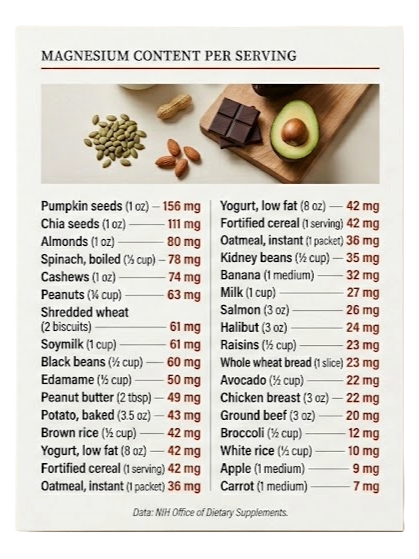
In theory yes, in practice not quite. Magnesium-rich foods (pumpkin seeds, almonds, spinach, black beans, dark chocolate, avocado) are worth eating regardless. But getting 300 mg of elemental magnesium from food daily, every day, is harder than it sounds, especially given that soil magnesium has declined over the past century and processed foods are stripped of most of it. A supplement is the bridge. Real food is still the foundation.
Will I get loose stool?
Citrate and oxide can cause that. Glycinate is the form least likely to. If you do experience it on glycinate at 400 mg, drop back to 200 mg or split the dose (100 mg twice a day). The threshold varies by person.
Is magnesium threonate worth the price?
Threonate (sold as Magtein) crosses the blood-brain barrier more readily than other forms and is marketed for cognitive support. There is real mechanism behind it. The trade-offs are that the dose per serving is much lower (typically 144 mg elemental versus 200 mg for glycinate), the cost is two to three times higher, and the comparative data for sleep specifically is thin. For sleep alone, glycinate is the better value. If you also want a cognitive support angle, threonate is a reasonable add-on. Most readers do not need both.
What about magnesium spray or transdermal magnesium?
The evidence for transdermal absorption of magnesium is weak. Some users find a magnesium-oil spray on the calves or feet helpful for restless legs, but the mechanism is more likely a topical relaxation effect than systemic magnesium repletion. If you want systemic magnesium, take it orally.
Can I take it with my other meds?
Magnesium can interact with thyroid medications, some antibiotics (tetracyclines, fluoroquinolones), and bisphosphonates. Space them at least 2 hours apart. If you are on lithium or potassium-sparing diuretics, ask your clinician first. For most readers on no prescriptions, magnesium glycinate is one of the cleanest supplements in the cabinet.
Why does the multivitamin industry keep using oxide if it does not work?
Because it is cheap, shelf-stable, and lets the label say ‘contains magnesium’ without driving up the cost of goods. The industry incentive is the label claim, not the bioavailability. The reader has to know the difference, because the marketing will not point it out.
Is there anything else I should add?
For most readers, no. Magnesium glycinate plus the behavioral baseline (caffeine cutoff at 2 PM, last meal 3 hours before bed, alcohol moderation, lights-out at 10:30 PM) covers 80 percent of what supplements can do. L-theanine at 100 to 200 mg is a defensible add-on for anxiety-driven onset issues. Everything else (ashwagandha, valerian, GABA, glycine, 5-HTP) is marginal at best for most people. Keep the stack short. Keep the dose right. Track what works.
Legal Disclaimer
The content published on Livium Health is for informational and educational purposes only. Nothing on this site constitutes medical advice, diagnosis, or treatment. Always consult a qualified healthcare provider before making decisions about your health, including changes to medications, supplements, diet, or exercise.
Livium Health is not a medical practice and does not have a patient-provider relationship with its readers. We do not sell supplements, medications, or treatments, and we have no financial relationship with the products or services we reference.
While we work to ensure the information we publish is accurate and up to date, health and medical guidance evolves. We make no guarantees about the completeness or currency of any content on this site. Reliance on any information provided by Livium Health is solely at your own risk.
If you are experiencing a medical emergency, call 911 or your local emergency services immediately.
We may receive compensation, free products, or affiliate commissions for products mentioned in this post. Opinions are our own.