
Share
Sleep
Women's Health
Restless legs at night: What’s driving it and what actually helps
6 min read

Key takeaways
- Restless legs syndrome (RLS) affects roughly 5 to 15% of adults and is almost twice as common in women. Many cases go undiagnosed for years because the symptoms sound vague to describe.
- Iron deficiency is the most consistent environmental cause. Brain iron, not just blood iron, and the standard ferritin cutoffs used in most labs miss many cases. Anyone with blood iron in the bottom half of the normal range may benefit from supplementation.
- The standard first-line treatment for 20-plus years (dopamine agonists like pramipexole) has now been de-recommended by the American Academy of Sleep Medicine. Long-term use makes RLS worse for many people.
- Iron supplementation, gabapentinoids, and behavioral changes are now the recommended starting points before any dopamine medication.
It is almost midnight. Your legs are wide awake
Not pain, exactly. More like a crawling, pulling, electric-buzzing discomfort that is impossible to ignore and immediately worse if you try to be still. Moving helps. The relief lasts as long as you are moving. Sit back down. It returns.
If you have tried to describe this to a doctor and felt like it did not quite translate, you are not alone. RLS is a genuinely difficult condition to characterize in words, which is part of why it is under-diagnosed. The patient says, “My legs are uncomfortable,” and the doctor writes “leg cramps” and moves on.
But RLS is real, measurable, and, for many people, has a root cause that a blood test can detect.
The iron-dopamine connection
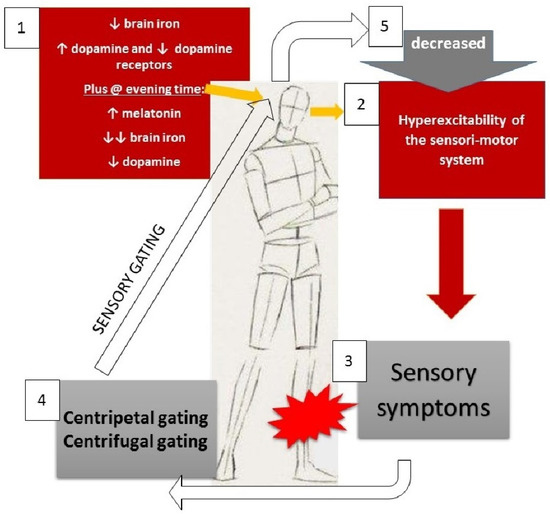
The pathophysiology of RLS centers on two variables: brain iron and dopamine function in the brain region called the substantia nigra.
Iron is required for dopamine synthesis. When brain iron is low, the dopaminergic system that modulates sensorimotor function does not function properly, resulting in the characteristic urge-to-move symptoms of RLS. Johns Hopkins’ research on RLS established iron deficiency as the single most consistent environmental risk factor for the condition, with Professor Nordlander at Hopkins first demonstrating in his clinical work that treating iron deficiency often markedly improved or eliminated RLS symptoms.
The critical nuance: serum ferritin levels that look normal on a standard blood panel may still be associated with low brain iron. Harvard’s Dr. John Winkelman, an RLS specialist at Harvard Medical School, was direct in a 2025 Harvard Health report: anyone with blood iron levels in the bottom half of the normal range has an increased risk of low brain iron and may benefit from iron supplementation.
Most standard labs flag ferritin as deficient below 12-15 nanograms per milliliter. RLS research suggests the threshold for clinical relevance is closer to 50-75. A result of 30 looks fine on a standard report. In the context of RLS, it warrants attention.
The treatment that was standard for 20 years is no longer recommended
This is new, important, and many prescribing doctors do not yet know it.
Dopamine agonists, including pramipexole (Mirapex), ropinirole, and rotigotine patch (Neupro), were the go-to RLS medications for over two decades. They work by mimicking dopamine in the brain. They do help initially. The problem is a phenomenon called augmentation: with long-term use, symptoms come back worse, often earlier in the day, affecting more of the body, and becoming harder to treat.
In 2025, the American Academy of Sleep Medicine (AASM) published updated guidelines formally de-recommending the long-term use of dopamine agonists for RLS. Harvard’s Dr. Winkelman: “We no longer recommend them as a first-line treatment, and maybe not even the second.”
If you are currently on a dopamine agonist for RLS and your symptoms have been getting worse over time, augmentation is the likely explanation. Stopping requires careful tapering under supervision. The rebound is real. But continuing on a medication that is making the underlying condition worse is not a long-term solution either.
The Livium take. Dopamine agonists were a warning light covered with tape. They hid the symptom while the underlying problem continued. The new guidelines push the field back toward actually fixing what can be fixed (iron) and managing what cannot with less problematic tools (gabapentinoids).
The Livium recipe
Tool. A full iron panel: serum ferritin, serum iron, total iron-binding capacity (TIBC), and transferrin saturation. A standard CBC alone is not enough. The ferritin number is the one to look at. If it is below 75, supplementation is reasonable to trial even if your lab report says you are in range. Function Health includes the complete iron panel alongside their standard blood work. Bring the ferritin number specifically to the RLS conversation with your doctor.
Behavior. Iron supplementation if ferritin is below 75. Ferrous bisglycinate or ferrous sulfate taken on an empty stomach with vitamin C for absorption. Separate it from caffeine, antacids, and calcium supplements by at least two hours, as these all impair iron absorption. Some RLS patients with low ferritin see symptoms improve significantly within four to eight weeks. Others need intravenous iron if oral forms do not raise levels. Behavioral additions: avoid antihistamines, antidepressants, and antinausea medications where possible as these worsen RLS. Reduce caffeine and alcohol, both of which can trigger symptoms. Light stretching or walking before bed can help manage symptoms acutely; it is not a cure, but it provides real relief in the moment.
Threshold. Eight to twelve weeks of iron supplementation with ferritin retest to confirm levels are rising. If ferritin normalizes and RLS symptoms persist, the next step is to consult a sleep medicine doctor about gabapentin or pregabalin, which are now considered preferred over dopamine agonists for pharmacological management. If you are considering Hims sleep for a telehealth consultation about RLS management, Hims sleep connects you with providers who can evaluate the current options.
What makes RLS worse vs. what helps
| Factor | Effect on RLS | Notes |
|---|---|---|
| Low ferritin (under 75) | Worsens; primary remediable cause | Get the full iron panel. Most labs will not flag this as deficient. |
| Antihistamines (Benadryl, sleep aids) | Significantly worsens; blocks dopamine receptors | A common and avoidable trigger. Check every OTC sleep aid label. |
| Antidepressants (SSRIs, SNRIs) | Often worsens; mechanism involves serotonin-dopamine interaction | Do not stop antidepressants without consulting your doctor. But flag RLS as a possible side effect. |
| Caffeine and alcohol | Often worsens; particularly evening alcohol | Reducing both is one of the few behavioral levers with consistent evidence. |
| Iron supplementation (ferritin under 75) | Improves in many patients; partial to full resolution possible | Eight to twelve weeks to see effect. Retest ferritin to confirm absorption. |
| Gabapentinoids (gabapentin, pregabalin) | Improves; now preferred pharmacological option over dopamine agonists | Prescription only. Sedating for some; can cause dizziness. Lower augmentation risk than dopamine agonists. |
| Movement/stretching before bed | Temporary relief; does not address root cause | Worth doing as an acute management strategy. Not a fix. |
Sources: Harvard Health Publishing (2024, 2025); NHLBI; Johns Hopkins Medicine; American Academy of Sleep Medicine 2025 guidelines.
Plan of action
- Get the full iron panel: ferritin, serum iron, TIBC, transferrin saturation. Ask for the ferritin number specifically and compare it to the 75 ng/mL threshold, not the lab’s “normal” range. Function Health includes this.
- Review your medications and supplements for known RLS triggers. Antihistamines, antidepressants, and antinausea drugs are the main culprits. Do not stop prescriptions without consulting your doctor, but flag the connection.
- Cut evening caffeine and alcohol. Both are manageable behavioral triggers with solid evidence.
- If ferritin is below 75, trial oral iron supplementation. Ferrous bisglycinate is better tolerated than ferrous sulfate for most people. Take on an empty stomach with vitamin C. Give it 8 to 12 weeks, then retest.
- If you are currently on a dopamine agonist and your symptoms have been worsening over time, discuss augmentation with your doctor. Switching to a gabapentinoid or addressing iron first is the current standard. Tapering off a dopamine agonist requires medical supervision.
Table of Content

Know your body better.
Trusted By Thousands Daily








FAQ
Is RLS the same as periodic limb movement disorder?
Related but different. RLS is characterized by a conscious urge to move the legs when awake and at rest. Periodic limb movement disorder (PLMD) involves involuntary leg movements during sleep that the person may not be aware of but which disrupt sleep quality. Many people with RLS also have PLMD, but you can have one without the other. PLMD is usually identified in a sleep study.
Why is RLS more common in women?
The data show RLS occurs roughly twice as often in women as in men. Iron deficiency is more common in women due to menstruation and the higher prevalence of dietary iron restriction. Pregnancy significantly increases RLS risk, and postmenopausal women have persistently higher rates than age-matched men. Hormonal factors are likely involved alongside the iron connection.
Can magnesium help RLS?
Some anecdotal and small-study evidence suggests that magnesium supplementation may help with mild RLS, possibly through a muscle-relaxing mechanism. It is not well studied specifically for RLS and is not listed in clinical guidelines. Given the safety profile of magnesium glycinate and its general sleep benefit, it is reasonable to add it, but do not rely on it as a primary RLS treatment if ferritin and dopamine mechanisms are the actual drivers.
Legal Disclaimer
The content published on Livium Health is for informational and educational purposes only. Nothing on this site constitutes medical advice, diagnosis, or treatment. Always consult a qualified healthcare provider before making decisions about your health, including changes to medications, supplements, diet, or exercise.
Livium Health is not a medical practice and does not have a patient-provider relationship with its readers. We do not sell supplements, medications, or treatments, and we have no financial relationship with the products or services we reference.
While we work to ensure the information we publish is accurate and up to date, health and medical guidance evolves. We make no guarantees about the completeness or currency of any content on this site. Reliance on any information provided by Livium Health is solely at your own risk.
If you are experiencing a medical emergency, call 911 or your local emergency services immediately.