
Share
Sleep
Sleep tracker data: What to watch, what to ignore
10 min read
Key takeaways
- Most of what your sleep tracker shows you is noise; three numbers carry almost all the useful signal: heart rate variability (HRV) trend, resting heart rate (RHR) during sleep, and sleep latency.
- Sleep stage percentages (deep, REM, light) are the least accurate measurements consumer wearables produce; obsessing over them is the most common mistake people make with sleep data.
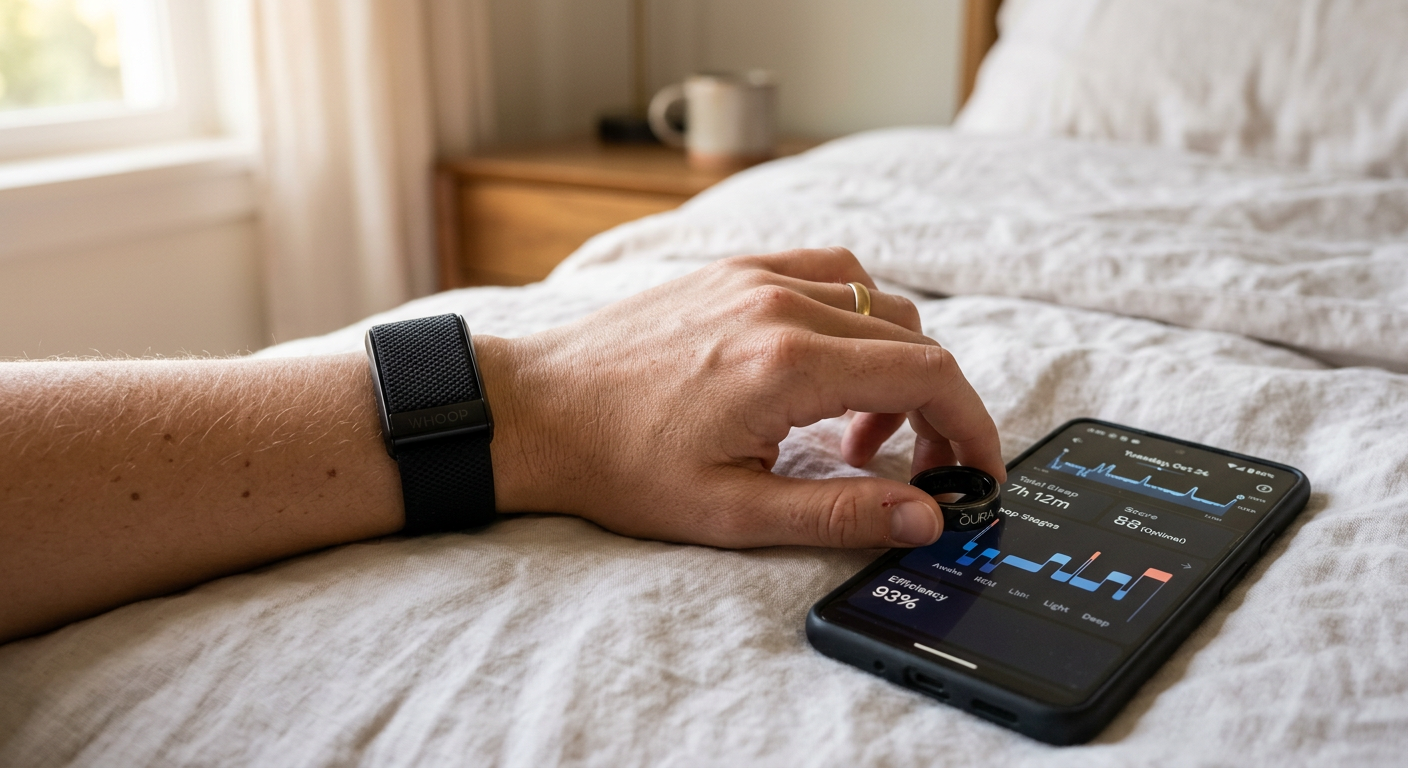
- Pick one tracker, wear it consistently, and look at weekly trends, not single-night scores; for sleep-first use, Oura Ring 4 is the cleanest choice, and WHOOP wins if you also care about training strain.
- Healthy 50-year-old baselines (RHR 55-80 bpm during sleep, HRV nighttime RMSSD 22-50 ms, sleep efficiency 85 percent+) matter only as a sanity check; your personal trend over 2 to 4 weeks is the signal you actually want.
Why your sleep score doesn’t mean what you think it means
Your tracker yells at you every morning. A red day. A yellow day. A dropping recovery score. A vague suggestion to go to bed earlier. After a few weeks, you start optimizing for the number instead of for your sleep. That’s the trap. The score is a compression of many measurements into one labeled output, and the algorithm behind the label is a black box. Most of what it’s flagging doesn’t matter. Three numbers do.
Consumer wearables have gotten dramatically better at measuring some things and stayed about the same at measuring others. A 2020 validation study published in Sleep compared seven common wearables to clinical polysomnography and found they were strong on sleep-versus-wake detection, decent on heart rate trends, and weak at staging (deep, REM, light). Eight years of firmware updates haven’t moved the staging accuracy as much as people assume. The takeaway: trust the trend data, ignore the specific stage percentages.
What your tracker is actually doing
Modern wearables use three core sensors: an optical heart rate sensor (LED light that bounces off your skin to pick up blood flow), an accelerometer (motion detection), and a temperature sensor on some devices. From those three streams, software infers everything else. Sleep, wake, deep stage, REM, HRV, sleep latency, even a personalized readiness score, are all derived calculations.
Some of those calculations are accurate. Heart rate during sleep, resting heart rate, and HRV trend are measured directly from your pulse and validated against medical-grade equipment in dozens of studies. Sleep efficiency (time actually asleep divided by time in bed) is reliable. Sleep latency (how long it takes you to fall asleep) is reasonably reliable.
Other calculations are softer. Deep sleep, REM, and light sleep are inferred from heart rate patterns and movement, not directly measured. The same minute of sleep on the same body, tracked by two different devices, can return wildly different stage percentages. If your tracker tells you that you got 8 percent deep sleep last night, that number has a margin of error wide enough to drive a truck through. The trend over weeks is fine; the single-night value is not where you should put your attention.
What your tracker keeps telling you that doesn’t matter
The most common mistake we see with sleep data is treating the composite score as the goal. A 92 isn’t sleep; an 84 isn’t a problem. The score is a weighted average, often pessimistic, designed to get you to engage with the app. Optimizing for it pushes you toward behaviors that look good in the dashboard but don’t necessarily improve how you feel or function.
Other things to stop chasing: a specific deep sleep percentage (your individual variation is far larger than any optimization protocol you’ll find online), the daily recovery or readiness label (it’s based on the night’s data, which is too noisy to act on), and comparisons against population averages or your friends’ scores (different bodies, different baselines, different devices). One bad night is a bad night. Two weeks of declining HRV is a signal.
Sleep masks, blue light blockers, and elaborate evening protocols won’t move these numbers if the underlying variable hasn’t been addressed. The trackers are mirrors. Useful mirrors. Just mirrors.
The Livium recipe
Tool. Pick one tracker and wear it consistently. Running two devices doesn’t give you twice the data; it gives you two slightly different stories and a reason to argue with both. Three options cover most use cases. Oura Ring 4 (around $349 plus a $5.99 monthly subscription) is the best choice if your priority is sleep specifically. Discreet ring form factor, robust nighttime HRV and temperature tracking, clean app. WHOOP (subscription-only at around $30 per month with the strap included) is the best choice if you also care about training strain and recovery. No screen, no notifications, just data. Apple Watch is the best choice if you want one device for general health, sleep, and notifications, and you’re already in the Apple ecosystem. Garmin is the right call if you’re an endurance athlete; their sleep tracking has caught up to the dedicated wearables in the last two model cycles. If you have an Eight Sleep Pod for temperature control, it’s also already tracking your sleep; you don’t necessarily need a second device.
Behavior. Wear the device consistently for at least three to four weeks before you start interpreting trends. A single week is too small a sample. Look at your dashboard once a week, not every morning. The morning ritual of checking your sleep score is the fast path to anxiety; the weekly review is the path to insight. Note what you did differently on the weeks your trend moved (better or worse) and treat those as the variables to test next.
Threshold. Three numbers matter. First, HRV trend across a rolling 7-day average. Second, resting heart rate during sleep compared to your own personal baseline. Third, sleep latency under 20 minutes most nights. If those three are trending in the right direction over 2 to 4 weeks, you are sleeping well, regardless of what the composite score says. If they are not, the variable to investigate is upstream of the tracker, not inside the app.
The three numbers worth watching
Heart rate variability (HRV) is the variation in time between consecutive heartbeats. Higher variability generally signals a well-recovered autonomic nervous system; lower variability signals stress, illness, alcohol, undertraining, overtraining, or poor sleep. Modern trackers measure HRV during sleep, when the nervous system is at rest, typically using the RMSSD method (root mean square of successive differences, the gold-standard short-term HRV metric). HRV is highly individual: comparing your number to anyone else’s is meaningless. Comparing your number to your own trend over weeks is the entire point. Healthy 50-year-old baselines from WHOOP age-banded data and the 2010 Nunan systematic review run roughly 25 to 50 ms for men and 22 to 45 ms for women. Trend up is good. Trend down for two consecutive weeks is the time to look at what changed.
Resting heart rate (RHR) during sleep is the lowest sustained heart rate you hit during the night. It is one of the most reliably measured numbers on any tracker, and it’s a clean cardiovascular trend over time. The Mayo Clinic and American Heart Association put healthy adult resting heart rate in the 60 to 100 bpm daytime range; during sleep, healthy 50-year-old men typically run 55 to 75 bpm, women 60 to 80 bpm. Athletic individuals can run in the high 40s. Anything consistently over 80 during sleep is a flag worth bringing to a doctor.
Sleep latency is how long it takes you to fall asleep after you get into bed. Under 20 minutes is normal. Over 30 minutes is a flag, especially if it’s a new pattern. Long sleep latency points to caffeine timing, late workouts, stress, or stimulating evening content; it can also point to insomnia or thermoregulation problems. The trend matters more than any single night.
| Metric | Watch or ignore | Why |
|---|---|---|
| HRV (weekly trend) | Watch | Best single signal of nervous-system recovery |
| Resting heart rate (sleep) | Watch | Cardiovascular trend; rises with stress, alcohol, illness |
| Sleep latency | Watch | Under 20 min is good; over 30 min flags stress or stimulants |
| Sleep efficiency | Watch | Time asleep ÷ time in bed; over 85 percent is the target |
| Composite sleep score | Ignore | Compresses many variables into one context-free number |
| Deep sleep % vs strangers | Ignore | Individual variation is huge; track your baseline only |
| Single-night spikes or dips | Ignore | Too noisy; trends only on 7- to 14-night windows |
| Daily readiness/recovery label | Ignore | Often pessimistic; the underlying HRV trend is what matters |
Source: Livium editorial synthesis of validation research, including Chinoy et al., 2020, in Sleep.
Choosing your tracker
Oura Ring 4 is the cleanest sleep-first choice. Ring form factor means no wrist commitment, the battery lasts 4 to 8 days, and the app emphasizes long-term trends rather than daily anxiety. Cost is around $349 with a $5.99 monthly subscription that you need to access the full data. HRV is measured every five minutes overnight, which produces a smoother trend than wrist-based snapshot measurements. Temperature tracking on the ring is also genuinely useful for women in perimenopause and for catching early signs of illness.
WHOOP is the right call if you also care about training. The strap measures continuously, the algorithms are tuned for athletic recovery, and the strain score gives you a usable daily training load number. No screen means no notifications, which some people love and some people hate. Subscription-only model at around $30 per month includes the strap; there’s no one-time hardware purchase to spread the cost.
Apple Watch has gotten dramatically better at sleep tracking in the last three model cycles. The Series 10 and Ultra 2 capture HRV, RHR, sleep stages, and have the added benefit of nighttime breathing disturbance detection (relevant if you’re concerned about sleep apnea). If you’re already in the Apple ecosystem and don’t want a second device, this is the practical choice. The downside is battery life; charging during the day or before bed is part of the workflow.
Garmin devices, particularly the Forerunner and Fenix lines, are the right pick for endurance athletes who want training load, recovery, and sleep in one device, with multi-week battery life. The sleep algorithms have improved substantially and now compete with Oura and WHOOP on trend accuracy. No subscription.
If you already own an Eight Sleep Pod 5, it’s logging your sleep automatically via the mattress cover sensors. The data is reasonably good and doesn’t require wearing anything. Most readers don’t need a second device on top of it, although adding an Oura or WHOOP layers in HRV detail that the bed-based sensor can’t produce.
| Device | Best for | Cost | Subscription | Form factor |
|---|---|---|---|---|
| Oura Ring 4 | Sleep-first focus | ~$349 | $5.99/month | Ring |
| WHOOP | Strain plus recovery for training | Included with subscription | ~$30/month (required) | Wrist strap |
| Apple Watch | General health plus sleep | $399-$799 | Optional Apple One | Smartwatch |
| Garmin | Endurance training plus sleep | $300-$1,000 | None | Sportswatch |
| Eight Sleep Pod 5 | Already-own-it sleep tracking | $2,499 | $25/month | Mattress cover |
Plan of action
- If you don’t have a tracker, pick one from the table above and order it this week. Oura Ring 4 for sleep focus, WHOOP for training, Apple Watch for ecosystem convenience.
- Wear it consistently for 3 to 4 weeks before you interpret any trend. Single nights are noise.
- Look at your dashboard weekly, not daily. Pick a day (Sunday is common) and review the week.
- Track only three numbers in a notes app or spreadsheet: weekly HRV average, weekly RHR average during sleep, and weekly sleep latency average.
- If two of the three trend down over 2 consecutive weeks, audit the previous month: alcohol, late workouts, travel, work stress, illness, hormonal changes.
- If your numbers sit below the 50-year-old baselines (HRV under 20 ms, RHR over 80 during sleep) for more than a month and you feel it, get bloodwork. The tracker has done its job by flagging the problem; the answer is upstream.
- Stop checking your sleep score in the morning. It’s the single most anxiety-producing thing you can do with the data.
Table of Content

Know your body better.
Trusted By Thousands Daily


Do I need a wearable at all to know if I'm sleeping well?
No. If you wake up feeling rested, have steady energy through the day, and aren’t getting sick more than usual, your sleep is probably fine. Wearables are most useful when something feels off and you want to identify what changed.
Which tracker is the most accurate?
For HRV and resting heart rate, Oura and WHOOP consistently top validation studies. For sleep staging, none of the consumer trackers are fully accurate; treat stage percentages as ballpark, not diagnostic. The differences between top devices are small enough that picking the one you’ll actually wear is more important than picking the most accurate one on a spec sheet.
What if my tracker says my sleep is bad but I feel fine?
Trust your body over the device. The score is an algorithm’s interpretation of incomplete data. If you feel rested and your week was clean, the score is wrong, not you.
How long until trends become meaningful?
Two to four weeks of consistent wear. Daily, weekly, and even biweekly variation can be misleading. A month gives you enough data to see real shifts.
Should I optimize for my readiness or recovery score?
No. Optimize for HRV trend, RHR baseline, and sleep latency. The readiness label is a downstream summary; the inputs are what actually matter. Reverse-engineer the inputs.
Legal Disclaimer
The content published on Livium Health is for informational and educational purposes only. Nothing on this site constitutes medical advice, diagnosis, or treatment. Always consult a qualified healthcare provider before making decisions about your health, including changes to medications, supplements, diet, or exercise.
Livium Health is not a medical practice and does not have a patient-provider relationship with its readers. We do not sell supplements, medications, or treatments, and we have no financial relationship with the products or services we reference.
While we work to ensure the information we publish is accurate and up to date, health and medical guidance evolves. We make no guarantees about the completeness or currency of any content on this site. Reliance on any information provided by Livium Health is solely at your own risk.
If you are experiencing a medical emergency, call 911 or your local emergency services immediately.
We may receive compensation, free products, or affiliate commissions for products mentioned in this post. Opinions are our own.