
Share
Longevity & Aging
Men's Health
Women's Health
Tinnitus finally has a real treatment (the first of its kind): Lenire
9 min read
Key takeaways
- For decades, ringing in the ears was a “learn to live with it” diagnosis. That stopped being true in March 2023, when the FDA granted a De Novo authorization for Lenire, the first device of its kind cleared to treat the condition. De Novo is the pathway for a device with no prior equivalent, so “first of its kind” is a plain statement of regulatory fact, not a slogan. Many ear, nose, and throat (ENT) doctors have not raised it with patients yet.
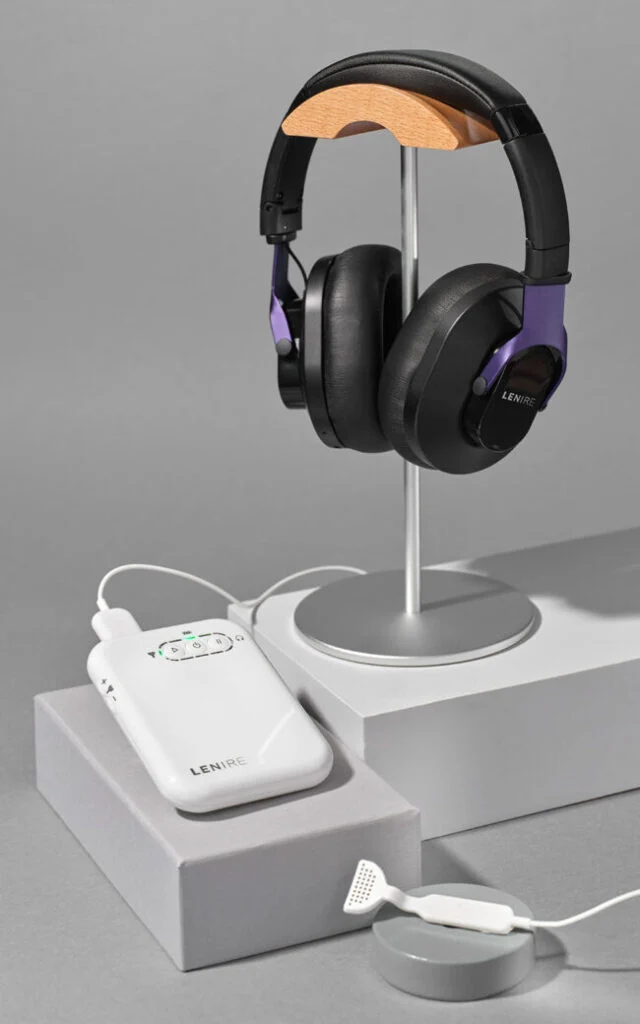
- Lenire is not a pill and not a hearing aid. It pairs sound through wireless headphones with mild electrical pulses delivered to the tip of the tongue through a small mouthpiece. Roughly one hour a day for twelve weeks, tuned by a trained provider. The idea is to retrain the brain to turn the ringing down.
- The headline number that gets quoted is real but easy to misread. In the trials, more than 80 percent of people who actually stuck with the protocol reported that their tinnitus got less severe, and the benefit held for a year. That is a volume reduction, not silence, and not a cure.
- It costs money, most of it out of your pocket. Expect roughly $3,200 to $4,750 in the US, and insurance does not cover it. Whether that math works is a personal call, but for the first time the option is real.
The end of “there’s nothing we can do”
Somewhere between 10 and 25 percent of adults live with tinnitus, the ringing or buzzing or hissing that nobody else can hear. For most of modern medicine, the standard answer at the end of the appointment was some version of the same shrug. There is no cure. There is no drug the FDA has approved for it. Learn to tune it out.
That answer was honest, for a long time. It just was not the whole story anymore.
Picture the daytime cost instead of the 2 AM version everyone pictures. Mid-morning, coffee gone cold, one finger pressed against an ear like that will help. The ringing does not care that you have a meeting. It has been there since you woke up and it will be there when you go to bed. Masking apps, white-noise machines, a fan running all night. You have probably tried most of it. It helps you cope. It does not touch the signal.
Here is what changed. In March 2023, the FDA granted a De Novo authorization for a device called Lenire, made by an Irish company named Neuromod Devices out of Dublin. That grant landed Lenire as a Class II device, cleared to market for treating tinnitus. Worth being precise here, because the marketing gets loose. Lenire is FDA-cleared, not FDA-approved. Those are different regulatory doors and the distinction matters when you are deciding who to trust.
What the thing actually does
Lenire runs on an idea called bimodal stimulation, which is a fancy way of saying two signals at once. You wear wireless headphones that play a sequence of tones. At the same time, a small mouthpiece Neuromod calls the Tonguetip sends mild electrical pulses to the surface of your tongue. Sound and touch, timed together, over and over.
The point of pairing them is neuroplasticity. Tinnitus, in a lot of cases, is the brain cranking up the gain on a signal that should be quiet, the way a microphone too close to a speaker starts to howl. Feed the brain a paired sound-and-touch pattern for long enough and you can nudge it to stop amplifying the phantom noise. Turn the gain back down. That is the theory, and it is the theory the trials were built to test. If you want the manufacturer’s own walkthrough, it is on the science of Lenire page.
The protocol is not a one-and-done. Roughly one hour a day, every day, for twelve weeks. A trained audiologist or provider assesses your hearing and your tinnitus first, then programs the device to you and checks in as you go. This is closer to physical therapy than to filling a prescription. You have to actually do the reps.
The numbers, read honestly
Three clinical trials sit behind Lenire, run under one research program and published across three journals. People quote them loosely and get the details wrong, so here they are, straight.
| Trial | Where it was published | Size | What it found |
|---|---|---|---|
| TENT-A1 (Conlon et al., 2020) | Science Translational Medicine | 326 patients | More than 80 percent of people who used the device as directed responded, and the improvement held out to 12 months. |
| TENT-A2 (2022) | Scientific Reports (Nature portfolio) | 191 patients | About 91 percent of compliant users improved, with an average drop of 20.3 points on the Tinnitus Handicap Inventory (THI), a standard questionnaire that scores how much tinnitus disrupts your life. |
| TENT-A3 (2024) | Nature Communications | 112 patients | The pivotal trial behind the FDA grant. Bimodal stimulation beat sound-only stimulation for people with moderate-or-worse tinnitus. |
Sources: TENT-A1, Science Translational Medicine, 2020; TENT-A2, Scientific Reports, 2022; TENT-A3, Nature Communications, 2024.
Read that top-line 80 percent number carefully, because it gets stretched into things it does not say. It is not the share who reached silence, and it is not a cure rate. What the data supports is a real, durable reduction in how loud and how bothersome the ringing is for most people who put in the twelve weeks. Volume down. Not off.
It helps to put the THI figures in scale. On that questionnaire, a drop of about 7 points is the smallest change a patient reliably notices, the commonly cited threshold for a real difference. Lenire’s reported reductions of roughly 13 to 20 points sit well past that line, so the improvement is a felt, noticeable change, not a rounding error. The 20.3-point drop is a genuinely meaningful size.
Two limits sit behind those numbers. The controls are the bigger one. TENT-A1 and TENT-A2 did not test the device against a placebo. They compared different active settings of the device against each other. Only TENT-A3 had a separate comparator group, and even that was sound-only stimulation, an active control rather than a sugar-pill sham. The headline 20.3-point drop comes from TENT-A2, which had no placebo arm at all. The other limit is who the percentages describe. They count people who finished the full twelve weeks, responders among the finishers, which reads better than counting everyone who started and quit along the way. No published whole-sample figure sits beside it, so read the percentages as best-case, among-finishers numbers.
One more thing you deserve to know. Dr. Hubert Lim, the principal investigator on the TENT trials, is also Neuromod’s Chief Scientific Officer, so the scientist who ran the studies has a stake in the company that sells the device. That does not make the results fake, and the work was peer-reviewed. But it is why independent replication matters, and as of 2026 that has not happened. The published evidence is the manufacturer-run TENT trials plus two real-world clinic reviews, out of Alaska and New York, that are also co-authored by Neuromod’s Chief Scientific Officer. No group with no Neuromod funding and no involvement from Dr. Lim has replicated it yet. So the fair read is that the effect looks genuinely meaningful and held for a year, but the trials are manufacturer-run without a true placebo arm and independent confirmation is still missing. Promising and real in size, not yet independently confirmed.
The Livium take
Most of what the tinnitus industry sells you is a way to cope with the noise, not a way to change it. White-noise machines, masking apps, sound generators, the advice to just get used to it. That is cranking the car radio to bury an engine knock. It works, sort of, for as long as the radio is on. The knock is still there. The second you turn the volume down, so is the problem.
Lenire is the first widely available tool that tries to change the signal instead of just covering it. It works on the engine, not the radio. Twelve weeks of paired stimulation aimed at the brain circuit doing the amplifying, not the ears doing the hearing. It is worth being honest about both sides of it. Working on the engine is slower, costs more up front, and asks you to actually show up every day. Masking is cheap and instant. The trade Livium would make, if it were our ears, is the slower fix that changes the signal over the quick fix that only hides it.
Honest caveat, because the brand does not do hype. Working on the engine here turns the knock down. It does not promise a silent ride. For a condition that was filed under “nothing we can do” for generations, turning it down is not a small thing.
If you want the broader picture on hearing and why it matters past the ears, our piece on the hearing-dementia link your doctor isn’t telling you about is the companion read, and if plain hearing loss is part of your picture, OTC hearing aids in 2026 covers what actually works.
What Lenire is, and what it isn’t
| Lenire is | Lenire is not |
|---|---|
| An FDA-cleared medical device (De Novo, March 2023, Class II) | FDA-approved (a different regulatory pathway; the marketing blurs it) |
| A twelve-week, provider-tuned retraining protocol | A pill, a supplement, or a hearing aid |
| A tool that reduces tinnitus severity for most compliant users | A cure, or a device that delivers silence |
The Livium recipe
Tool: Lenire, the bimodal neuromodulation device, fitted through a certified provider via the Lenire clinic locator.
Behavior: One hour a day of paired sound-and-tongue stimulation, every day, for the full twelve weeks, with your provider’s programming and check-ins.
Threshold: Twelve weeks of compliance is the line where the trial benefit shows up. Track your tinnitus severity on a standard measure like the THI or the Tinnitus Functional Index (TFI) at week zero and week twelve. If the number has not moved and you did the hour every day, you have your answer and a conversation to have with your provider.
Plan of action
- Get the ringing checked out properly first. Tinnitus can point at something fixable underneath it, from earwax to blood pressure to a medication side effect. Rule those out with an audiologist before you spend a nickel on a device. If you do not have one, a general locator like HearingLife will find you an audiologist, though note it does not fit Lenire specifically.
- Set your expectation on purpose. Walk in wanting silence and a tool that turns the volume down will disappoint you. Walk in wanting less intrusive ringing and the data is on your side.
- Find a certified provider through the official Lenire clinic locator. Lenire is fitted and programmed by trained clinicians, not sold direct-to-consumer, and the locator is the way in.
- Budget honestly. Roughly $3,500 to $4,000 is the common range, out of pocket, and it usually includes the device, the assessment, your personal programming, and follow-up. Ask exactly what is included before you commit.
- Commit to the twelve weeks or do not start. One hour a day is the whole ballgame. The trial results belong to the people who did the reps. Half a protocol buys you half of nothing.
Table of Content

Know your body better.
Trusted By Thousands Daily










Is Lenire FDA-approved?
No, and the wording matters. Lenire is FDA-cleared through the March 2023 De Novo authorization, not FDA-approved, and you will see the marketing use “approved” loosely. Hold them to the accurate word.
Will it make the ringing stop completely?
No. The honest claim is a reduction in severity, not silence. Most people who complete the protocol report less loud, less intrusive ringing that holds for a year. Think turning the volume down, not switching it off.
Does it actually work, or is this another gadget?
Three peer-reviewed trials say it works for most people who stick with it. The honest asterisk is that they are all manufacturer-run, without a true placebo arm, and no independent group has replicated them yet. The effect size looks real. Go in with clear eyes.
How much does it cost, and will insurance help?
You can expect roughly $3,200 to $4,750 in the US, and you’ll need to pay it yourself. Insurance does not cover it today.
How do I get one?
Through a trained provider, not off a shelf. Use the Lenire clinic locator to find a certified clinic near you, who then assess you, program the device, and follow up across the twelve weeks.
My ENT never mentioned this. Why not?
There are two reasons, and it is worth knowing which one you have. Some practices are simply behind, still working off the older “nothing we can do” script for a device the De Novo grant only cleared in 2023. But some doctors are being deliberately cautious, and that is fair. This is a $3,500 to $4,000 out-of-pocket device backed by one pivotal trial with no independent replication yet, and a careful clinician might reasonably not lead with it. If your doctor has not raised it, ask, and listen for whether you are hearing caution or catch-up.
Legal Disclaimer
The content published on Livium Health is for informational and educational purposes only. Nothing on this site constitutes medical advice, diagnosis, or treatment. Always consult a qualified healthcare provider before making decisions about your health, including changes to medications, supplements, diet, or exercise.
Livium Health is not a medical practice and does not have a patient-provider relationship with its readers. We do not sell supplements, medications, or treatments, and we have no financial relationship with the products or services we reference.
While we work to ensure the information we publish is accurate and up to date, health and medical guidance evolves. We make no guarantees about the completeness or currency of any content on this site. Reliance on any information provided by Livium Health is solely at your own risk.
If you are experiencing a medical emergency, call 911 or your local emergency services immediately.
We may receive compensation, free products, or affiliate commissions for products mentioned in this post. Opinions are our own.