
Share
Men's Health
Peptides
Women's Health
BPC-157 and the peptide injury recovery conversation
7 min read

Key takeaways
- BPC-157 (Body Protection Compound 157) is a synthetic 15-amino-acid peptide derived from a protein found in human gastric juice. It has significant published research demonstrating accelerated healing of tendons, ligaments, muscles, and gut mucosa in animal models. Human clinical trial data is limited but emerging.
- The mechanism is well-characterized in the animal literature: BPC-157 upregulates growth hormone receptor expression in tendons, promotes angiogenesis (new blood vessel formation) in injured tissue, modulates nitric oxide pathways, and reduces inflammatory cytokine production. These mechanisms explain the observed acceleration of healing in rodent models of tendon, ligament, and muscle injury.
- BPC-157 is not FDA-approved for any indication. It is not a licensed medication. It exists in a regulatory gray area: it was available as a research chemical, widely used in the sports medicine and biohacking communities, and compounding pharmacies were producing it until 2022, when the FDA moved to restrict its compounding. The current supply situation is complex and varies by jurisdiction.
- The honest assessment: the animal data is genuinely compelling and mechanistically coherent. The absence of human clinical trials is a significant gap. The risk profile appears low based on animal safety studies and the anecdotal human use record. Adults pursuing BPC-157 for injury recovery are making a decision in the gap between promising preclinical data and the lack of human trial confirmation. That is the accurate framing.
The injury that will not heal
Tendons and ligaments have notoriously poor blood supply, which is why they heal slowly and incompletely. A tendon injury at 45 does not follow the same timeline as the same injury at 28. The cellular machinery for tissue repair is less responsive, the inflammatory resolution is slower, and the structural quality of the repair is lower. Many midlife adults carry injuries that have been “almost better” for years: a shoulder that is functional but not right, an Achilles that flares with any volume increase, a knee that has been managed rather than resolved.
This is the population that has driven significant interest in BPC-157. The people most interested in it are not trying to recover from acute injuries faster; they are trying to resolve the chronic, nagging, partially healed injuries that standard medicine offers little for beyond rest, which has already failed, and surgery, which most people prefer to avoid.
What the animal data shows
The BPC-157 research base is substantial and consistently positive in rodent models. Key findings: Achilles tendon transection in rats treated with BPC-157 resulted in significantly faster restoration of tensile strength and histological organization compared with controls. Muscle crush injuries healed with reduced fibrosis and faster return of contractile function. Ligament injuries showed accelerated healing with better structural quality at the repair site. Gut mucosa injuries (stomach ulcers, intestinal anastomosis sites) healed significantly faster.
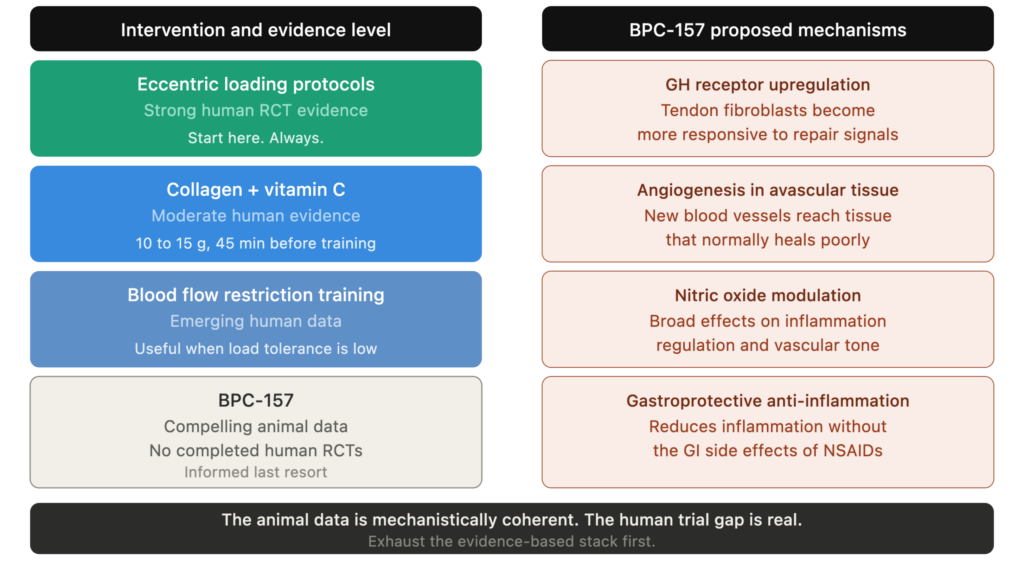
The mechanism driving these effects appears to be primarily through upregulation of growth hormone receptor expression in tendon fibroblasts and through promotion of angiogenesis in avascular tissues. Tendons are relatively avascular, which is why they heal poorly. BPC-157 appears to promote the formation of new blood vessels in injured tissue, thereby improving the nutrient and growth factor delivery required for the healing process. It also modulates the nitric oxide system, which has broad effects on the regulation of inflammation and vascular tone.
The systemic anti-inflammatory effect, documented in rodent models of NSAID-induced gut damage, is particularly interesting: BPC-157 appears to be gastroprotective, which is the opposite of most anti-inflammatory interventions. This suggests it could be used alongside standard pain management without the GI side effects of NSAIDs.
The human trial gap
There is one completed phase II human clinical trial of BPC-157 for inflammatory bowel disease, conducted in Croatia, with unpublished results. No completed human trials of BPC-157 for musculoskeletal injury have been conducted. This is the central limitation of the current evidence base. Animal models of injury healing have historically been poor predictors of human outcomes in pharmaceutical development. The compound may work exactly as it appears to in rodents. It may work differently in humans. Without controlled human trials, this is unknowable.
The anecdotal record of human use is extensive. BPC-157 has been used by a large number of athletes, biohackers, and sports medicine patients over the past decade. The reported safety profile is favorable: no serious adverse events have been commonly reported, and the animal toxicology studies have not identified significant safety concerns. Anecdotal reports of accelerated injury resolution are widespread. None of this constitutes clinical evidence, but it informs the risk-benefit framing for informed adults making their own decisions about emerging therapies.
The regulatory situation
BPC-157 is not a licensed drug. In the United States, it was previously available from compounding pharmacies, but the FDA moved to restrict its use in compounded medications in 2022, classifying it as a bulk drug substance that cannot be used in compounding without FDA approval. It is currently available from overseas peptide suppliers and gray-market research chemical vendors. The quality control in this supply chain is variable and not subject to pharmaceutical manufacturing standards.
In other jurisdictions (Australia, some European countries), the regulatory status differs. Some physicians working in functional and sports medicine contexts continue to prescribe it off-label or source it through research channels. The situation is changing as regulatory interest in peptides increases. Anyone considering BPC-157 should verify the current regulatory status in their jurisdiction before pursuing it.
The Livium recipe
Tool. For the nagging injury that has not resolved with standard approaches: the evidence-based foundation first. Eccentric loading protocols for tendinopathies are supported by strong evidence from human clinical trials and should take precedence over any consideration of peptides. Collagen supplementation (10 to 15 g of hydrolyzed collagen with vitamin C, taken 45 to 60 minutes before training) has moderate clinical evidence supporting tendon healing and is available without regulatory complexity. Hydrolyzed collagen peptides support the substrate for connective tissue repair. Vitamin C is required for collagen cross-linking and is frequently deficient in adults under high stress.
Behavior. The foundation of connective tissue recovery is load management, not rest. Tendons and ligaments require mechanical loading to signal repair. Complete rest is contraindicated for most tendinopathies. A progressive loading program, starting at sub-pain-threshold loads and increasing systematically, is what drives tissue remodeling. Physiotherapy provides this programming; self-directed eccentric protocols are the home equivalent. Blood flow restriction (BFR) training, which uses a tourniquet to increase metabolic stress at very low loads, has emerging evidence for tendon healing and allows loading of injured tissue that cannot tolerate conventional loads. BFR cuffs for home use are available.
Threshold. For adults who have exhausted standard interventions (physiotherapy, eccentric loading, collagen supplementation, adequate protein, appropriate rest) for a persistent connective tissue injury and are considering BPC-157: a physician working in sports medicine or functional medicine who is familiar with the peptide literature is the appropriate conversation partner. The decision requires understanding the current regulatory status, the limitations of the evidence, and the individual clinical picture. It is not a decision to be made based on online forums or supplement vendor websites.
| Intervention | Evidence quality | Regulatory status | Livium take |
|---|---|---|---|
| Eccentric loading protocols | Strong (multiple RCTs) | No restrictions | Start here, always |
| Hydrolyzed collagen plus vitamin C | Moderate (human RCTs) | No restrictions | Evidence-based adjunct |
| Blood flow restriction training | Moderate (emerging human data) | No restrictions | Useful when load tolerance is low |
| BPC-157 | Compelling animal data; no human RCTs | Gray area; varies by jurisdiction | Informed adult decision after standard approaches fail |
Source: Sikiric et al., Current Pharmaceutical Design 2018 — BPC-157 Tendon and Ligament Healing.
Plan of action
- If you have a persistent tendon or ligament injury: start with an eccentric loading protocol specific to that tendon. For Achilles: eccentric calf raises. For patellar: eccentric single-leg squats. For rotator cuff: eccentric external rotation. A physiotherapist provides the correct parameters; the basic protocol is widely documented in the literature.
- Add hydrolyzed collagen 10 to 15 g with vitamin C 250 to 500 mg taken 45 to 60 minutes before your training or rehabilitation session. The timing matters: vitamin C is required for collagen synthesis, and the window of enhanced collagen production around exercise is when substrate availability matters most.
- Optimize protein intake. Tendons are collagen, and collagen synthesis requires adequate amino acid substrate. Most people with persistent injuries are under-consuming protein. Target 1.6 to 2.2 g per kg of body weight daily.
- If the injury has not responded to six months of consistent loading, appropriate nutrition, and adequate protein: a sports medicine physician or orthopedic specialist familiar with emerging therapies is the next conversation. Bring the BPC-157 research. Ask whether they can recommend a physician who works with peptide protocols. The conversation is more productive than navigating the gray-market supply chain without clinical guidance.
Table of Content

Know your body better.
Trusted By Thousands Daily








FAQs
Can you take BPC-157 orally or does it need to be injected?
Both routes have animal data. Oral BPC-157 is active in gut-related applications (ulcers, gut permeability) and some systemic applications, which is consistent with the fact that the compound is derived from gastric juice and presumably has some resistance to gastric degradation. Subcutaneous injection is the route used for musculoskeletal injury applications in most animal studies and in the anecdotal human use literature. The oral route is more convenient; the subcutaneous route delivers the compound more directly to the systemic circulation. The optimal route for specific indications in humans has not been established by clinical trial.
Is BPC-157 a steroid or growth hormone?
No. It is a peptide (a short chain of amino acids), not a steroid or a growth hormone. It does not directly increase growth hormone levels. It upregulates the expression of growth hormone receptors in certain tissues, making those tissues more sensitive to whatever growth hormone is circulating. It is not a prohibited substance on the WADA list as of the current update, though this may change as the compound receives more regulatory attention.
What other peptides are used for injury recovery?
TB-500 (Thymosin Beta-4) is the other commonly discussed peptide for injury recovery, often stacked with BPC-157. TB-500 promotes actin upregulation, cell migration into injured tissue, and angiogenesis through a mechanism distinct from BPC-157. The animal literature supports both individually and in combination. Human trial data for TB-500 in musculoskeletal injury is similarly limited. The combination is popular in the sports medicine biohacking community, but the rationale for combining them rather than using either alone has not been tested under controlled conditions.
Legal Disclaimer
The content published on Livium Health is for informational and educational purposes only. Nothing on this site constitutes medical advice, diagnosis, or treatment. Always consult a qualified healthcare provider before making decisions about your health, including changes to medications, supplements, diet, or exercise.
Livium Health is not a medical practice and does not have a patient-provider relationship with its readers. We do not sell supplements, medications, or treatments, and we have no financial relationship with the products or services we reference.
While we work to ensure the information we publish is accurate and up to date, health and medical guidance evolves. We make no guarantees about the completeness or currency of any content on this site. Reliance on any information provided by Livium Health is solely at your own risk.
If you are experiencing a medical emergency, call 911 or your local emergency services immediately.
We may receive compensation, free products, or affiliate commissions for products mentioned in this post. Opinions are our own.