
Share
Energy & Focus
Men's Health
Women's Health
Cortisol, adenosine, and the crash that arrives on schedule
6 min read
Key takeaways
- The post-lunch energy dip is real, but lunch is not the primary cause. The dip corresponds to a predictable circadian trough in alertness that occurs approximately 7 to 8 hours after waking, independent of meal timing or composition. It happens whether you eat lunch or skip it.
- Cortisol follows a daily rhythm that peaks 30 to 45 minutes after waking and declines steadily through the afternoon. For adults in their 40s and 50s with elevated chronic stress, this afternoon cortisol decline is steeper, and the trough is deeper, producing an energy drop that feels disproportionate to the day’s demands.
- A 10 to 20-minute nap taken during the circadian trough (roughly 1 to 3 PM) clears adenosine, reduces cortisol, and restores alertness for 2 to 3 hours more effectively than caffeine, without the sleep disruption that comes with late caffeine use.
- For adults with dysregulated cortisol rhythms, the afternoon crash is a signal about the morning, not the afternoon. Elevated morning cortisol from poor sleep, high stress load, or early over-stimulation sets up the steep afternoon decline hours later.
1:52 PM
You had a reasonable lunch. Not heavy, not carb-loaded. You have had a productive morning. There is nothing acutely stressful happening. And yet at 1:52 PM you are reading the same paragraph for the fourth time and retaining none of it.
The reflex is to blame the meal. Or the desk. Or the meeting that ran long. Most people reach for coffee. A few eat something sugary. The crash returns an hour later either way, because neither intervention addresses the actual mechanism.
The afternoon crash is a feature of human circadian biology, not a malfunction of your diet or your discipline. Understanding the mechanism changes what you do about it.
The circadian dip
Human alertness follows a two-process model governed by circadian rhythm (the 24-hour biological clock) and sleep pressure (adenosine accumulation). Circadian alertness runs high in the morning, dips in the early afternoon, recovers in the early evening, and drops sharply before sleep. This dip is not caused by lunch. Research on fasting adults who eat nothing until dinner still shows the same afternoon alertness trough at the same time.
What lunch does is amplify the dip. Postprandial blood flow shifts toward digestion. Insulin rises. If the meal is high in refined carbohydrates, blood glucose spikes and drops. All of these stack on top of an already-declining alertness curve, deepening the trough.
After 40, the dip tends to arrive earlier and hit harder for two reasons. Slow-wave sleep declines with age, meaning more adenosine accumulates before the circadian dip arrives. And cortisol’s morning peak, which partially offsets sleep pressure, declines more steeply through the afternoon in adults with elevated chronic stress loads.
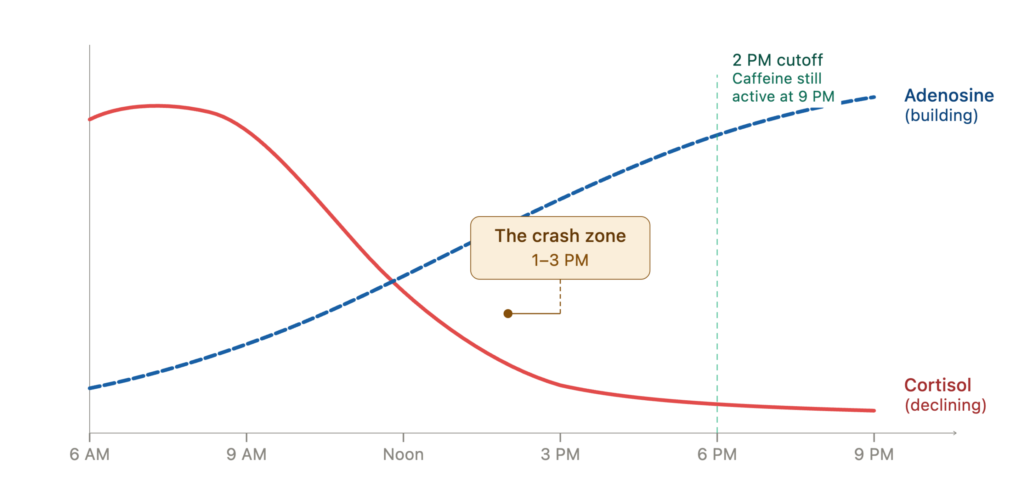
Cortisol peaks in the first hour after waking and declines through the day. Adenosine builds continuously from the moment you open your eyes. They cross in the early afternoon — cortisol too low to offset sleep pressure, adenosine too high to ignore. That intersection is the crash. Caffeine blocks the adenosine signal without clearing it; a 2 PM cup is still active at 9 PM. Source: Segerstrom et al., International Journal of Environmental Research and Public Health 2022 — Stressed at Work: Investigating the Relationship between Occupational Stress and Salivary Cortisol Fluctuations. CC BY 4.0.
The cortisol angle
Cortisol is not a stress hormone in the dramatic sense. It is a daily energy-mobilization hormone that rises sharply in the first hour after waking (the cortisol awakening response), provides a natural alertness boost throughout the morning, and declines throughout the afternoon. This decline is by design.
The problem for many midlife adults is that the morning peak is too high and the afternoon decline is too steep. Chronic stress, poor sleep, and excess morning caffeine (consumed before the natural cortisol peak clears) all amplify the morning rise. A higher morning peak means a further fall by afternoon. The crash at 2:47 PM was scheduled for 7:30 AM.
For adults who can track their stress physiology, heart rate variability (HRV) is the most accessible proxy for the autonomic balance underlying cortisol rhythm. Low morning HRV consistently predicts high morning cortisol and worse afternoon energy. This is a measurable pattern, not a feeling.
The Livium recipe
Tool. A 10 to 20-minute nap taken between 1 and 3 PM is the most evidence-supported intervention for the afternoon dip. NASA research on napping found that a 26-minute nap improved performance by 34 percent and alertness by 100 percent in pilots. The key is to keep it under 20 minutes to avoid entering slow-wave sleep (which produces grogginess on waking) and to time it to the circadian trough rather than when fatigue peaks. A sleep mask and a quiet environment are the only equipment required. For adults who track recovery, an HRV monitor worn throughout the morning provides a direct read of the autonomic state underlying cortisol rhythm.
Behavior. Protect the lunch break for what it actually is: a circadian recovery window, not a productivity gap. A short walk after eating reduces the postprandial glucose spike that amplifies the dip. Keeping lunch protein and fat-dominant rather than carbohydrate-dominant blunts the insulin response without requiring caloric restriction. Delaying caffeine until the dip arrives (rather than preemptively dosing at noon) means the caffeine lands exactly when it is needed and clears before sleep. Magnesium glycinate, taken in the evening, supports the cortisol rhythm reset overnight by improving sleep quality and reducing elevated morning cortisol levels, which can trigger the afternoon crash.
Threshold. If the afternoon crash is severe (falling asleep at the desk, inability to function without caffeine after 1 PM, crash arriving by noon), the cortisol rhythm is significantly dysregulated and warrants investigation. A four-point salivary cortisol test (morning, noon, afternoon, evening) maps the full daily curve and identifies whether the morning is too high, the afternoon is too low, or both. Ask your physician or a functional medicine provider. A standard blood cortisol test is a single snapshot and misses the pattern.
| Intervention | Mechanism | Evidence quality | Timing |
|---|---|---|---|
| 10–20 minute nap | Clears adenosine; reduces cortisol | Strong (NASA; multiple RCTs) | 1–3 PM |
| Post-lunch walk (10 min) | Blunts postprandial glucose; raises alertness | Moderate (glucose and alertness studies) | Immediately after lunch |
| Delayed caffeine (not before 9:30 AM) | Avoids cortisol stacking; smoother curve | Moderate (cortisol rhythm research) | 60–90 min after waking |
| Protein-dominant lunch | Reduces insulin spike; blunts dip amplification | Moderate (postprandial research) | At lunch |
| Afternoon coffee (not after 2 PM) | Blocks adenosine during dip; disrupts sleep if late | Strong (adenosine/sleep research) | 1–2 PM maximum |
Source: NIH NINDS: Brain Basics: Understanding Sleep.
Plan of action
- Try a 15-minute nap between 1 and 2 PM for five consecutive workdays. Set an alarm. Do not worry about actually sleeping. Lying down with eyes closed in a quiet environment produces cognitive recovery even without sleep onset. Track your afternoon performance on each day.
- Shift your first coffee to 90 minutes after waking and your last coffee to 1 PM for two weeks. This is the single highest-leverage behavioral change for the afternoon crash in most adults over 40.
- Take a 10-minute walk after lunch before returning to your desk. The evidence on postprandial walking and glucose management is strong, and the alertness benefit is immediate.
- If the crash arrives before noon or is severe enough to impair function, book a four-point salivary cortisol test. The pattern, not the level, is what matters. A functional medicine provider can order this; most standard GP panels do not include it. At-home cortisol test kits are also available for a first-pass look at the pattern before a clinical appointment.
Table of Content

Know your body better.
Trusted By Thousands Daily








FAQs
Does skipping lunch eliminate the afternoon crash?
No. The circadian alertness dip occurs independently of meal timing. Fasting studies consistently show the same afternoon trough at the same time regardless of whether subjects ate lunch. Skipping lunch removes the postprandial amplification of the dip but does not eliminate the dip itself. For most people, skipping lunch also increases hunger-driven cortisol in the early afternoon, which in turn disrupts energy levels.
Is the afternoon crash worse on low-sleep nights?
Substantially. Sleep debt accelerates adenosine accumulation, which means the homeostatic sleep pressure component of the two-process model is elevated before the circadian dip even arrives. Poor sleep the night before produces an earlier and deeper afternoon crash, which drives more caffeine use, which further disrupts sleep. The cycle is self-reinforcing. Addressing sleep quality is the upstream fix for the afternoon crash, not managing the crash itself.
Can exercise replace the nap for afternoon energy recovery?
Light to moderate exercise (a walk, 10 minutes of movement) during the early part of the afternoon dip raises alertness by increasing heart rate, norepinephrine, and body temperature. It does not clear adenosine the way sleep does, so the recovery is shorter and less complete than a nap. Intense exercise in the afternoon (heavy lifting, high-intensity training) should be timed before 5 PM to avoid cortisol and body temperature elevation that disrupts sleep onset.
Legal Disclaimer
The content published on Livium Health is for informational and educational purposes only. Nothing on this site constitutes medical advice, diagnosis, or treatment. Always consult a qualified healthcare provider before making decisions about your health, including changes to medications, supplements, diet, or exercise.
Livium Health is not a medical practice and does not have a patient-provider relationship with its readers. We do not sell supplements, medications, or treatments, and we have no financial relationship with the products or services we reference.
While we work to ensure the information we publish is accurate and up to date, health and medical guidance evolves. We make no guarantees about the completeness or currency of any content on this site. Reliance on any information provided by Livium Health is solely at your own risk.
If you are experiencing a medical emergency, call 911 or your local emergency services immediately.
We may receive compensation, free products, or affiliate commissions for products mentioned in this post. Opinions are our own.