
Share
Fitness
Men's Health
Women's Health
Eccentric training after 40: The most efficient way to build muscle most people have never tried
6 min read

Key takeaways
- Eccentric muscle contractions occur during the lowering phase of any movement: the descent of a squat, the lowering of a dumbbell in a bicep curl, the controlled drop in a push-up. The muscle is lengthening while producing force. This phase generates significantly more mechanical tension than the concentric (lifting) phase, and mechanical tension is the primary stimulus for muscle protein synthesis.
- Most people unconsciously rush the eccentric phase and spend their effort on the concentric. Slowing the eccentric to three to five seconds per repetition dramatically increases the muscle-building stimulus per set, allows heavier, more effective loads with lower joint stress, and produces greater recruitment of type I and type II muscle fibers than equivalent concentric-focused training.
- After 40, the argument for eccentric emphasis is stronger. Anabolic resistance (the blunted muscle protein synthesis response to a given training stimulus) increases with age. Eccentric training overcomes anabolic resistance more effectively than standard concentric-dominant training, producing similar or superior hypertrophy at lower absolute training volumes.
- Tendons and connective tissue respond better to eccentric loading than to concentric loading. Tendon stiffness and collagen synthesis are both upregulated by slow eccentric load, which is why eccentric training is also the primary rehabilitation protocol for tendinopathies (Achilles, patellar, rotator cuff). After 40, when connective tissue recovery slows, this dual benefit matters.
The half of the rep you are ignoring
Watch most people in a gym, and the pattern is consistent: the concentric phase (curling up, pressing up, squatting up) is deliberate and controlled. The eccentric phase (coming back down) is fast, often gravity-assisted, and functionally uncontrolled. The weight drops more than it lowers. This is how most people waste half of every rep they do.
The eccentric phase is not the rest between reps. It is where the majority of the mechanical tension is generated. Muscle fibers under eccentric load experience greater cross-bridge tension than under concentric load of the same absolute weight. This is why you can lower more weight than you can lift: the eccentric strength of any muscle is approximately 20 to 40 percent greater than its concentric strength. Most training programs exploit exactly none of this advantage.
Why it matters more after 40
Anabolic resistance is the age-related decline in the muscle protein synthesis response to a given anabolic stimulus (e.g., food or exercise). A 25-year-old and a 55-year-old performing the same workout with the same protein intake will exhibit different rates of muscle protein synthesis, with the older adult showing a lower rate. This is one of the primary drivers of sarcopenia (muscle loss with age) and is why older adults need more training stimulus to produce the same adaptive response.
Eccentric training overcomes anabolic resistance more effectively than concentric-dominant training. Multiple studies comparing eccentric and concentric protocols in older adults (defined in the literature as 60 and above, though the mechanisms are relevant from 40 onward) report equivalent or greater hypertrophy with eccentric-emphasizing protocols at lower total training volumes. This means you get more muscle-building stimulus per unit of time in the gym, and at lower systemic fatigue cost.
The connective tissue argument is equally important. Tendons become less elastic with age and more susceptible to the micro-damage that produces tendinopathy. Eccentric loading, specifically slow eccentric loading under controlled conditions, is the most evidence-supported protocol for improving tendon stiffness, collagen cross-linking, and tissue tolerance to load. This is why every physiotherapist prescribing rehabilitation for Achilles tendinopathy recommends eccentric calf raises rather than concentric ones.
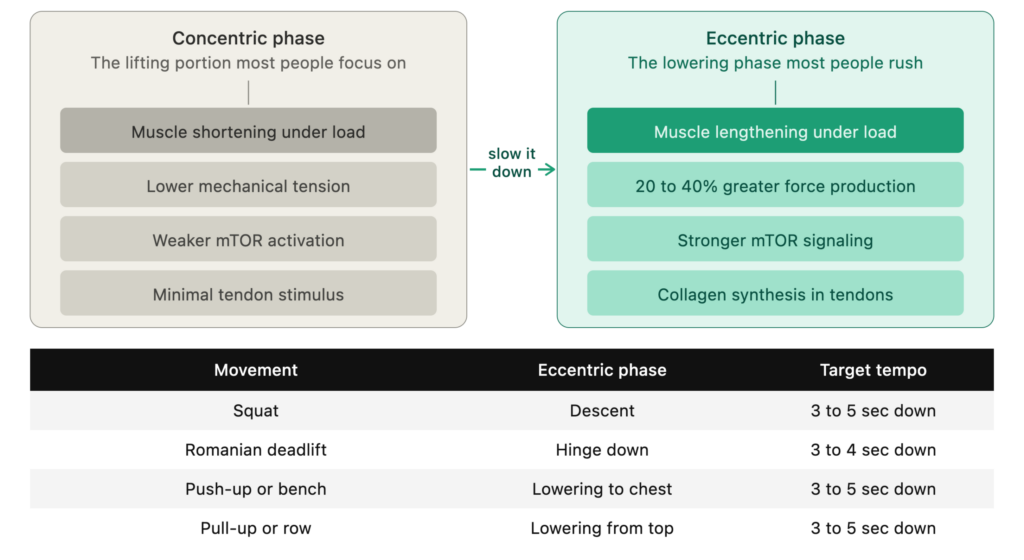
Eccentric loading generates 20 to 40 percent greater mechanical tension than equivalent concentric loading at the same weight. Slowing the lowering phase to three to five seconds per rep is the simplest intervention with the largest return on stimulus per set. Most people have been skipping the most productive half of every rep they have ever done. Source: Cvečka et al., International Journal of Environmental Research and Public Health 2023 — Benefits of Eccentric Training with Emphasis on Demands of Daily Living Activities and Feasibility in Older Adults. CC BY 4.0.
How to apply it
Slow the lowering phase. The simplest and most practical application: count three to five seconds on every eccentric phase of every compound movement you already do. Squat down in three seconds. Lower the bar in three seconds. Descend into a push-up in three seconds. This single change, applied to your existing program, dramatically increases the effective stimulus of every set.
Eccentric overload. Because eccentric strength exceeds concentric strength by 20 to 40 percent, you can train with supramaximal eccentric loads by using assistance on the concentric and control on the eccentric. The classic example: use two legs to stand up from a single-leg position, then lower on one leg only. This exposes the eccentric phase to a load greater than you could lift concentrically.
Eccentric-only sets. A more advanced approach: perform only the eccentric phase of a movement, assisted back to the start position. Eccentric-only pull-up negatives (jump to the top, lower in five seconds, repeat) build the lat strength to perform full pull-ups in people who currently cannot do one. Eccentric-only protocols are used in clinical settings for rehabilitation and in strength training for breaking through strength plateaus.
The Livium recipe
Tool. A tempo training app or metronome keeps the eccentric count honest. Most people who intend to slow the eccentric still rush it without external pacing. Even a phone metronome set to one beat per second provides the external cue that makes three-second eccentrics actually three seconds. For home training without a barbell: adjustable dumbbells allow eccentric overload on unilateral movements (two-arm curl-up, one-arm lower) without a spotter. A set of resistance bands adds eccentric load to bodyweight movements like squats and push-ups at home.
Behavior. Apply the three-second rule to the four compound movements with the highest eccentric yield: squat, hinge (deadlift or Romanian deadlift), push (bench or push-up), and pull (row or lat pulldown). These four movements cover the major muscle groups and tendons most relevant to functional longevity. Expect significant delayed onset muscle soreness (DOMS) in the first one to two weeks of eccentric emphasis. This is the muscle adaptation process working correctly, not injury. It resolves. Reduce volume in week one and build progressively. The eccentric stimulus is strong enough that less total volume is needed; most people need to do less, not more, when they start training this way seriously.
Threshold. If you have an existing tendinopathy (Achilles, patellar, rotator cuff, lateral elbow), eccentric loading is the evidence-based rehabilitation protocol. Work with a physiotherapist to implement the specific eccentric protocol for your tendon. The loading parameters matter: frequency, range of motion, and load progression are all prescribed. A generic eccentric approach is better than nothing; a specific one is significantly better than a generic one.
| Movement | Eccentric phase | Tempo target | Eccentric overload option |
|---|---|---|---|
| Squat | Descent | 3 to 5 sec down | Two legs up, one leg down |
| Romanian deadlift | Hinge down | 3 to 4 sec down | Increase load, focus descent control |
| Push-up or bench | Lowering to chest | 3 to 5 sec down | Eccentric-only from top position |
| Pull-up or row | Lowering from top | 3 to 5 sec down | Jump to top, lower only (negatives) |
Source: NSCA: The Importance of Eccentric Training.
Plan of action
- This week: apply a three-second eccentric to every set of squats, hinges, pushes, and pulls you already do. Nothing else changes. Reduce your normal working weight by 20 percent initially because the increased time under tension will make your usual weight feel significantly heavier.
- Expect soreness in days two to three of the first week. This is expected and temporary. Do not mistake it for injury. The soreness indicates the eccentric stimulus is working and the adaptation is occurring.
- If you cannot do a pull-up: start eccentric-only negatives three times per week. Jump or step to the top of the bar (or use a box), hold a five-second descent, step off, repeat for three to five reps. This builds the eccentric strength pattern required for full pull-ups and will help you achieve your first full pull-up faster than any other approach.
- Pair eccentric training with adequate protein intake. Eccentric stimulus requires protein to convert the breakdown signal into muscle protein synthesis. A high-quality whey or casein protein supplement within 2 hours of training supports recovery. Target 1.6 to 2.2 g of protein per kg of bodyweight daily when actively building.
Table of Content

Know your body better.
Trusted By Thousands Daily










FAQs
Is eccentric training safe for older joints?
Yes, with appropriate load management. Because eccentric strength exceeds concentric strength, you can achieve high mechanical tension with lighter absolute loads, reducing joint compression stress. The key is controlled movement through a comfortable range of motion. Ballistic or uncontrolled eccentrics (dropping weights) are contraindicated; slow, controlled eccentrics are the safest way to progressively load aging connective tissue.
Does eccentric training require a gym?
No. The most effective eccentric protocols can be performed with bodyweight alone using bilateral-to-unilateral overload: two legs up, one leg down on squats; two arms up, one arm down on push-up progressions; jump to top, one-leg lower on step-up variations. A set of resistance bands considerably expands the options. A gym provides access to heavier loads that accelerate progression, but it is not a prerequisite for effective eccentric training.
How does eccentric training compare to isometric for tendon health?
Both improve tendon stiffness and reduce tendinopathy pain. Isometric holds (holding a position under load without movement) have the advantage of producing no joint movement, making them useful in acute or highly irritable tendinopathies where any movement is painful. Eccentric loading produces greater tendon collagen synthesis and is superior for long-term tendon remodeling once the acute phase has passed. Most rehabilitation protocols progress from isometric in the acute phase to eccentric in the loading phase.
Legal Disclaimer
The content published on Livium Health is for informational and educational purposes only. Nothing on this site constitutes medical advice, diagnosis, or treatment. Always consult a qualified healthcare provider before making decisions about your health, including changes to medications, supplements, diet, or exercise.
Livium Health is not a medical practice and does not have a patient-provider relationship with its readers. We do not sell supplements, medications, or treatments, and we have no financial relationship with the products or services we reference.
While we work to ensure the information we publish is accurate and up to date, health and medical guidance evolves. We make no guarantees about the completeness or currency of any content on this site. Reliance on any information provided by Livium Health is solely at your own risk.
If you are experiencing a medical emergency, call 911 or your local emergency services immediately.
We may receive compensation, free products, or affiliate commissions for products mentioned in this post. Opinions are our own.