
Share
Energy & Focus
Men's Health
Low testosterone and low energy: The connection most men ignore
6 min read
Key takeaways
- Testosterone declines at roughly 1 to 2 percent per year after age 30. By their mid-40s, many men have testosterone levels low enough to produce symptoms including persistent fatigue, reduced motivation, cognitive fog, and reduced physical capacity, without being in the clinical hypogonadism range that triggers a standard diagnosis.
- Standard lab reference ranges for testosterone are based on population averages that include men who are significantly symptomatic. A level of 350 ng/dL is technically “normal” in most lab panels; it is also the level at which most men feel meaningfully worse than they did at 600 ng/dL. The number matters less than the trend and the symptoms.
- The fatigue pattern of low testosterone is specific: worst in the afternoon, accompanied by reduced motivation and drive rather than simple tiredness, not restored by a full night of sleep, and often combined with reduced libido, slower recovery from exercise, and difficulty building or maintaining muscle.
- Testosterone replacement therapy (TRT) is the most direct intervention for clinically low testosterone. Lifestyle factors (sleep, exercise, body composition, alcohol) significantly affect testosterone levels and are the first-line intervention before pharmacology is considered.
The fatigue that does not respond to sleep
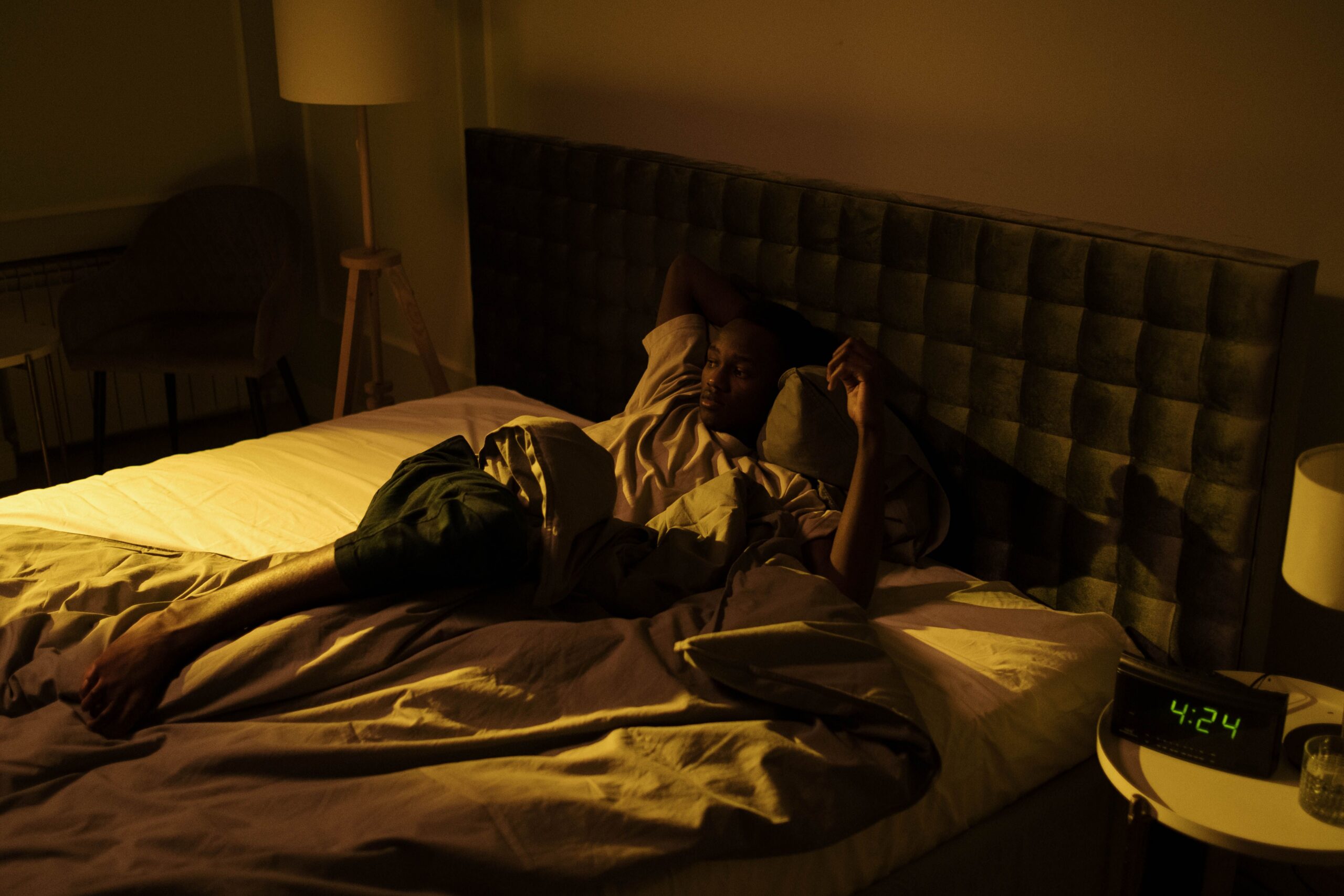
Most fatigue has an obvious cause: not enough sleep, too much stress, poor nutrition, a demanding week. You know what made you tired and you know that rest will fix it. The fatigue pattern of low testosterone is different. It is present on both rested and unrested days. It does not track with what happened yesterday. It is persistent in a way that feels like a new baseline rather than a temporary state.
Men describe it as a reduction in drive rather than tiredness. Tasks that would have engaged them at 35 feel effortful at 47, not because the tasks changed but because the motivational engine behind them is running at reduced output. This is not depression (though the two coexist frequently). It is a physiological change in the hormonal substrate of motivation and energy that responds differently to interventions than lifestyle optimization does.
What testosterone actually does for energy
Testosterone affects energy through several mechanisms. It stimulates red blood cell production, which determines oxygen-carrying capacity and directly affects physical and cognitive stamina. It influences dopamine signaling in the brain, which drives motivation, reward-seeking, and the subjective experience of task engagement. It affects mitochondrial function in muscle cells, which determines how efficiently the body produces energy from fuel. And it influences sleep quality by affecting slow-wave sleep, the most restorative phase of the sleep cycle.
When testosterone is low, each of these systems runs below capacity. The result is a man who sleeps adequately, eats well, exercises reasonably, and still feels like he is operating at 70 percent of his previous capacity. The ceiling has dropped without an obvious explanation.
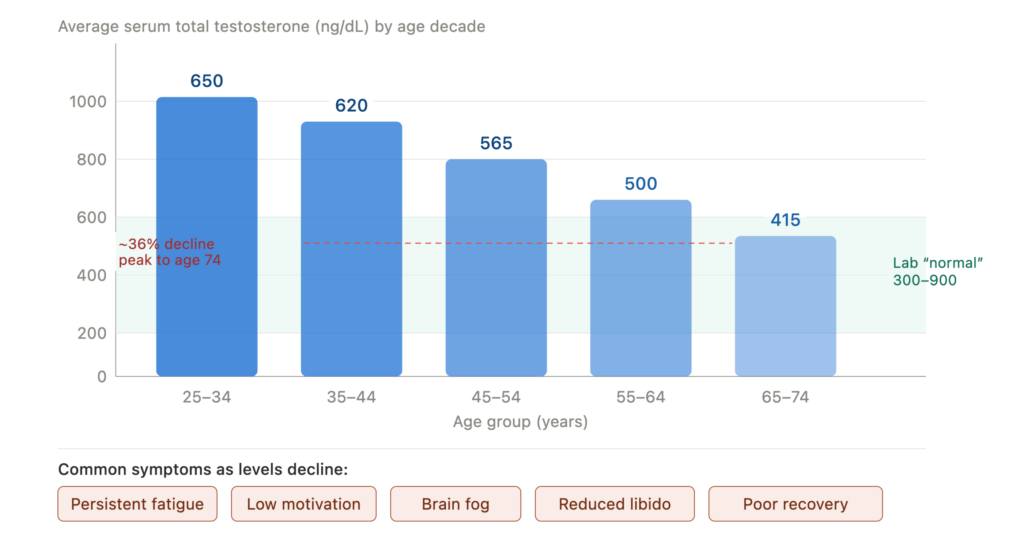
Testosterone declines roughly 1 to 2 percent per year after 30. A man at 420 ng/dL is technically within the lab normal range and clinically symptomatic. The number on the report matters less than where it sits relative to his personal baseline and his symptom picture. Sources: Travison et al., Journal of Clinical Endocrinology and Metabolism (2007) — population-level testosterone trends in aging men.
The testing problem
A standard GP testosterone test usually measures total testosterone in the morning. The issues with this single measurement are significant. Total testosterone does not account for sex hormone-binding globulin (SHBG), a protein that binds testosterone and renders it inactive. Free testosterone (the biologically active fraction) is the more relevant measurement. A man with total testosterone of 450 ng/dL and high SHBG may have less free testosterone than a man with total testosterone of 350 ng/dL and low SHBG.
The useful panel includes total testosterone, free testosterone, SHBG, estradiol (estrogen), luteinizing hormone (LH), follicle-stimulating hormone (FSH), prolactin, and a complete metabolic panel, including thyroid function. The LH and FSH values indicate whether the problem is primary (testicular failure) or secondary (pituitary signaling failure), which affects treatment options. Most standard GP panels measure only total testosterone and miss most of the picture.
Function Health covers the full hormonal panel including free testosterone, SHBG, and estradiol. Hone Health specializes in male hormone optimization and offers both a full panel and clinical guidance for interpreting the results.
Lifestyle first
Before pharmacology, the lifestyle factors that most significantly affect testosterone in midlife men are sleep, body composition, alcohol, and resistance training. Each is worth addressing independently of whether TRT is ultimately pursued.
Sleep. Most testosterone production occurs during sleep, specifically during slow-wave and REM phases. One week of sleep restriction to 5 hours per night reduces testosterone by 10 to 15 percent in healthy young men. Chronic sleep debt is one of the most underappreciated drivers of low testosterone in otherwise healthy midlife men.
Body composition. Visceral fat contains aromatase, an enzyme that converts testosterone to estradiol. High visceral fat accelerates this conversion, reducing effective testosterone levels and elevating estrogen levels. Improvements in body composition through resistance training and dietary changes directly improve the testosterone-to-estrogen ratio in men with excess visceral fat.
Alcohol. Alcohol suppresses testosterone production directly and increases aromatase activity. Even moderate alcohol consumption (2 to 3 drinks per day) measurably reduces testosterone over time. Heavy use produces more significant suppression.
Resistance training. Heavy compound movements (squat, deadlift, bench, row) produce an acute elevation in testosterone and, over time, support the hormonal environment that maintains testosterone production. Endurance-heavy training without resistance training can suppress testosterone in some men.
The Livium recipe
Tool. The full male hormonal panel first, before anything else. Hone Health provides a comprehensive hormone assessment and connects you to a clinician who can interpret the full picture and discuss options including TRT if warranted. If TRT is ultimately the right intervention, the forms with the most evidence and clinical flexibility are topical gel and weekly subcutaneous injection of testosterone cypionate. Both are available through telehealth. A grip strength dynamometer is a simple proxy metric for testosterone-driven physical capacity that you can track at home between blood tests.
Behavior. The four lifestyle factors in order of leverage for most men: sleep quality first (most testosterone production is sleep-dependent), alcohol reduction second (direct suppression effect), visceral fat reduction third (aromatase reduction), resistance training fourth (anabolic stimulus and hormonal environment support). Address all four for 90 days before or alongside getting tested. The test after 90 days of lifestyle optimization gives a cleaner picture than a test taken during a period of poor sleep and high alcohol use. Zinc 30 mg and vitamin D3 are the two micronutrients most consistently associated with testosterone in deficient men. Test both; supplement if deficient.
Threshold. Total testosterone below 400 ng/dL combined with symptoms (fatigue, low drive, cognitive fog, reduced libido, reduced muscle recovery) warrants a clinical conversation about TRT. Free testosterone below 50 pg/mL in a symptomatic man is the same. Do not wait for your primary care physician to bring it up; most do not. Ask specifically for the full panel including free testosterone, SHBG, and estradiol.
| Symptom pattern | More likely low T | Less likely low T |
|---|---|---|
| Fatigue timing | Persistent; not restored by rest | Correlates with specific sleep-deprived nights |
| Motivation | Reduced drive across domains; flat affect | Situational; task-specific |
| Libido | Noticeably reduced from prior baseline | Unchanged or stress-correlated |
| Muscle and recovery | Harder to build; slower to recover | Normal given training age and volume |
| Cognitive function | Brain fog; reduced sharpness; word retrieval | Situational; improves after rest |
Source: The Endocrine Society: Testosterone Therapy in Adult Men with Androgen Deficiency Syndrome.
Plan of action
- Get the full male hormonal panel: total testosterone, free testosterone, SHBG, estradiol, LH, FSH, prolactin, and thyroid function. Hone Health covers this and provides clinical guidance on results.
- Test in the morning between 7 and 10 AM. Testosterone peaks in the morning and declines through the day. An afternoon test can show values 20 to 30 percent lower than morning values and is not representative of your true level.
- Address sleep, alcohol, and body composition for 90 days before or alongside testing. These factors can move testosterone by 15 to 25 percent in some men without pharmacology.
- If TRT is the right path, work with a clinician who monitors estradiol alongside testosterone. TRT elevates estradiol (through aromatase conversion of the added testosterone), and managing the testosterone-to-estrogen ratio is essential for avoiding the fatigue, mood, and libido issues that poorly managed TRT produces.
Table of Content

Know your body better.
Trusted By Thousands Daily






FAQs
Will TRT affect fertility?
Yes. Exogenous testosterone suppresses LH and FSH, which suppresses the body’s own testosterone production and sperm production. Men who wish to preserve fertility should discuss this explicitly with their prescribing clinician. Alternatives that stimulate the body’s own production (clomiphene citrate, enclomiphene, hCG) are options that do not suppress fertility and may be appropriate depending on the cause of the low testosterone.
Does TRT increase cardiovascular risk?
The TRAVERSE trial (2023), the largest randomized controlled trial of TRT in men with hypogonadism and elevated cardiovascular risk, found no increase in major cardiovascular events compared to placebo over a 33-month follow-up. This largely settled the long-standing uncertainty about TRT and cardiovascular risk in men with established low testosterone. TRT does increase hematocrit (red blood cell density), which warrants monitoring; elevated hematocrit increases the risk of clotting and is managed with dose adjustment or periodic blood donation.
What about testosterone boosters sold at supplement stores?
The ingredients in most commercial testosterone boosters (fenugreek, D-aspartic acid, tribulus terrestris) have either failed to produce meaningful testosterone increases in clinical trials or have shown small effects only in deficient populations. If your zinc and vitamin D are low, addressing those deficiencies can modestly support testosterone levels. Everything else in the testosterone booster aisle is largely marketing. The only intervention that reliably and substantially raises testosterone in a hypogonadal man is TRT.
Legal Disclaimer
The content published on Livium Health is for informational and educational purposes only. Nothing on this site constitutes medical advice, diagnosis, or treatment. Always consult a qualified healthcare provider before making decisions about your health, including changes to medications, supplements, diet, or exercise.
Livium Health is not a medical practice and does not have a patient-provider relationship with its readers. We do not sell supplements, medications, or treatments, and we have no financial relationship with the products or services we reference.
While we work to ensure the information we publish is accurate and up to date, health and medical guidance evolves. We make no guarantees about the completeness or currency of any content on this site. Reliance on any information provided by Livium Health is solely at your own risk.
If you are experiencing a medical emergency, call 911 or your local emergency services immediately.
We may receive compensation, free products, or affiliate commissions for products mentioned in this post. Opinions are our own.