
Share
Men's Health
Mental Health
Women's Health
Sleep and mental health after 40: The bidirectional problem most people treat in the wrong order
6 min read

Key takeaways
- The relationship between sleep and mental health is bidirectional and self-amplifying. Poor sleep worsens anxiety, depression, and emotional regulation. Anxiety and depression produce insomnia and sleep fragmentation. Breaking the loop requires treating both sides simultaneously.
- The standard treatment order is wrong for most people. Most adults with concurrent sleep and mood problems are treated for the mood disorder first, with the assumption that sleep will improve as mood improves. The evidence increasingly supports the opposite approach: treating insomnia first produces faster and more durable mental health improvements than treating the mood disorder alone.
- CBT for insomnia (CBT-I) is the most effective treatment for chronic insomnia and produces clinically meaningful improvements in depression and anxiety symptoms independently of any direct mood treatment. It is the first-line recommendation from every major sleep and psychiatric organization and is significantly underused.
- Sleep changes in midlife are not just symptoms of mental health problems. Hormonal shifts, circadian rhythm changes, and the increased prevalence of sleep apnea all independently disrupt sleep in adults over 40. These physiological drivers require their own assessment and are not addressed by treating depression alone.
Which came first
Most people with poor sleep and poor mental health cannot tell you which started first. They know both are bad and that they feel related. They are right. The neurobiological connection runs in both directions with equal potency, and in midlife the relationship is complicated by hormonal and physiological changes that operate independently of both.
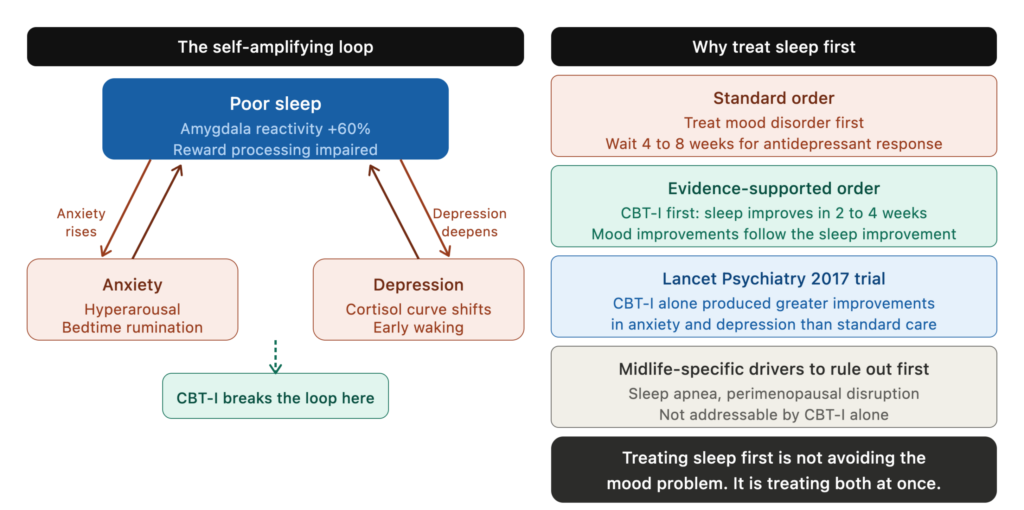
Sleep deprivation amplifies amygdala reactivity by up to 60 percent in neuroimaging studies, while simultaneously reducing prefrontal regulatory input to the amygdala. The brain becomes more reactive to threat and less able to modulate that reactivity. This is anxiety. The same sleep-deprived brain shows impaired reward processing and reduced dopamine response to pleasurable stimuli. This is anhedonia. A single night of poor sleep produces measurable changes in emotional processing that resemble clinical anxiety and depression. Multiply that across months of chronic sleep disruption and the clinical picture follows.
Running the other direction: anxiety produces hyperarousal that is physiologically incompatible with sleep onset. Rumination, the repetitive processing of worry and regret that characterizes both anxiety and depression, peaks at bedtime when external demands compete less with internal mental activity. Depression disrupts slow-wave sleep and increases early morning awakening through HPA axis changes that shift the cortisol curve earlier. The mental health problem actively and mechanistically prevents the sleep that would help it.
Why treating sleep first is often the better move
A landmark 2017 trial published in The Lancet Psychiatry randomized adults with insomnia and comorbid anxiety and depression to receive either CBT-I alone or standard care. The CBT-I group showed significantly greater improvements in anxiety, depression, and psychological wellbeing at six months compared to controls, with the sleep improvement mediating the psychiatric outcomes. Treating the insomnia improved mental health.
This finding has since been replicated in multiple studies. The evidence for CBT-I as a mental health intervention is now substantial enough that several psychiatric guidelines recommend it as a first-line treatment specifically for depression and anxiety in patients with concurrent insomnia. Reaching for the mood disorder treatment first, while leaving the sleep problem unaddressed, is increasingly recognized as the wrong order of operations.
The practical reason this matters: antidepressants typically take four to eight weeks to produce mood effects. CBT-I produces measurable sleep improvements within two to four weeks, and mood improvements follow. For the patient who has been suffering for months, treating insomnia first may produce faster visible improvement in how they feel than waiting for antidepressant response.
The midlife-specific drivers that need their own investigation
Sleep apnea becomes significantly more prevalent after 40 and in women after menopause. Undiagnosed sleep apnea produces sleep fragmentation, oxygen desaturation, and daytime fatigue that mimics and worsens depression. Adults with treatment-resistant depression who have never been screened for sleep apnea are missing a workup step. A home sleep test from Lofta costs under $200 and diagnoses OSA without a sleep lab visit.
Perimenopausal sleep disruption, driven by night sweats, hot flashes, and hormonal fluctuation, is not primarily a psychological disorder. It is a physiological process that happens to produce insomnia and the mood consequences of insomnia. Treating it as anxiety or depression without addressing the hormonal driver produces incomplete and often temporary improvement.
The Livium recipe
Tool. CBT-I is available digitally at a fraction of the cost and wait time of in-person therapy. Sleepio and the VA’s Insomnia Coach app are the two most validated digital CBT-I programs with published clinical data. For sleep tracking, an Oura Ring or an equivalent consumer tracker provides sleep-stage data and HRV trends that make the sleep-mood correlation visible over time. For nighttime rumination, the most common acute barrier to sleep onset, a structured worry journal used 30 minutes before bed externalizes the cognitive load that prevents sleep and is among the specific CBT-I behavioral techniques with the most consistent evidence. For sleep apnea screening: a home sleep test from Lofta if snoring, witnessed apneas, or significant daytime fatigue are present.
Behavior. Fix the wake time first. A consistent wake time, seven days a week, is the single most effective behavioral lever for consolidating sleep and is the first intervention in CBT-I. It works by building sleep pressure (adenosine accumulation) that overrides the hyperarousal preventing sleep onset. It is uncomfortable for the first two weeks. It works. Combine with stimulus control: bed is for sleep only. No screens, no reading, no lying awake for more than 20 minutes. If you are awake, get up, do something quiet in dim light, and return when sleepy. This feels counterproductive and is clinically effective. For anxiety-driven insomnia, Thorne Magnesium Bisglycinate 400 mg in the evening reduces physiological hyperarousal through GABA-A receptor support and has consistent evidence for improving sleep onset latency.
Threshold. If sleep problems and mood problems have coexisted for more than four weeks: see a physician and name both. “I am not sleeping well, and my mood has been low.” Request a referral to CBT-I in addition to any mood treatment discussion. If sleep apnea is suspected, screen for it before prescribing any sleep medication. Sedating sleep medications in undiagnosed sleep apnea worsen the apnea and the hypoxia that is driving the mood problem.
| Sleep problem type | Likely driver | First intervention |
|---|---|---|
| Difficulty falling asleep, racing thoughts | Anxiety-driven hyperarousal | CBT-I stimulus control, worry journaling, magnesium |
| Early morning waking, flat mood | Depression-related HPA axis shift | CBT-I plus clinical mood treatment |
| Night sweats, fragmented sleep in perimenopause | Hormonal disruption | Hormone evaluation, menopause-informed provider |
| Snoring, witnessed apneas, unrefreshing sleep | Sleep apnea | Home sleep test, CPAP if confirmed |
Source: NIMH: Sleep Disorders.
Plan of action
- Set a fixed wake time and hold it for two weeks. Pick a time you can keep seven days a week. Do not change it based on how you slept. The consistency is the mechanism. This is uncomfortable and effective.
- Download a digital CBT-I program. Sleepio and Insomnia Coach are the two with published clinical evidence. Commit to the full program, not just the first two sessions. The techniques that produce the most improvement are the ones that feel most counterintuitive in the early weeks.
- If you snore or suspect sleep apnea: order a home sleep test from Lofta before starting any sleep medication. Sedating medications in undiagnosed apnea worsen both the apnea and the mood outcomes.
- Add a blue light blocking glasses protocol after 8 PM and a blackout sleep mask if your bedroom is not fully dark. Light is the most powerful circadian disruptor and the one environmental variable most adults have not fully controlled. Both interventions have consistent evidence and zero side effects.
Table of Content

Know your body better.
Trusted By Thousands Daily








FAQs
Should I treat the sleep or the depression first?
The evidence increasingly supports treating both simultaneously, with CBT-I as a first-line addition rather than a follow-on. If only one is possible to start: treating insomnia first with CBT-I produces mood improvements that are clinically meaningful and faster than waiting for antidepressant response. Discuss this with your physician.
Are sleep medications safe for anxiety or depression?
Short-term use of certain sleep medications is appropriate in specific presentations. The risk is dependency, rebound insomnia on discontinuation, and in older adults, fall risk and cognitive effects. CBT-I produces more durable improvements than medication without these risks. Medication is appropriate as a bridge, not a long-term solution for chronic insomnia.
Why does anxiety peak at bedtime?
During waking hours, external task demands compete with and suppress rumination. At bedtime, those demands disappear, and the mental activity that anxiety generates (worry, planning, catastrophizing) runs without competition. The result is hyperarousal at exactly the time the nervous system needs to downregulate. CBT-I addresses this directly through scheduled worry time, stimulus control, and cognitive restructuring techniques.
Legal Disclaimer
The content published on Livium Health is for informational and educational purposes only. Nothing on this site constitutes medical advice, diagnosis, or treatment. Always consult a qualified healthcare provider before making decisions about your health, including changes to medications, supplements, diet, or exercise.
Livium Health is not a medical practice and does not have a patient-provider relationship with its readers. We do not sell supplements, medications, or treatments, and we have no financial relationship with the products or services we reference.
While we work to ensure the information we publish is accurate and up to date, health and medical guidance evolves. We make no guarantees about the completeness or currency of any content on this site. Reliance on any information provided by Livium Health is solely at your own risk.
If you are experiencing a medical emergency, call 911 or your local emergency services immediately.
We may receive compensation, free products, or affiliate commissions for products mentioned in this post. Opinions are our own.